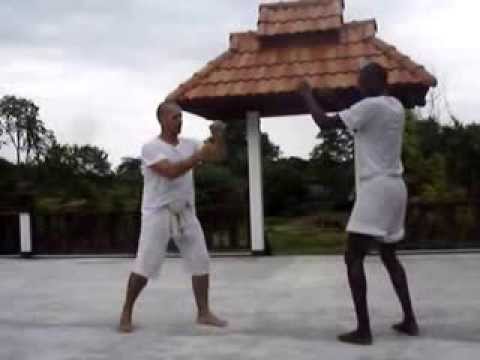
Muay Thai Sangha Lower Hand Outside and Inside techniques
0
Standard Outside Low·Sangha Muay Thai Thailand
Pedro Solana Villalobos shows 8 hand counter techniques for the jab and the cross with the rear and lower hand. Muay Cha…
Translation: standard outside low
The Standard Outside Low Kick is the fundamental outside leg kick, executed by pivoting on the lead foot, rotating the hips, and driving the lower shin into the outside of the opponent's lead thigh. [1] The kick targets the quadriceps and IT band area with the hard bone of the shin, and the kicker follows through the target with full hip rotation. [1],[2] This is the most frequently thrown kick in Muay Thai and kickboxing, serving as a constant attritive weapon throughout a fight. [2],[3]
The standard outside low kick is the foundational leg kick technique taught in every Muay Thai and kickboxing gym, representing the most basic and commonly used leg attack in combat sports. [1] Its effectiveness has been demonstrated in thousands of professional bouts across multiple combat sports. [2],[3]
The standard outside low kick targets the outer thigh. [1]
A fundamental Muay Thai low kick. [1]
Used in Muay Thai and MMA. [1]
No images yet for this technique.
Sign in to suggest an image.
Pedro Solana Villalobos shows 8 hand counter techniques for the jab and the cross with the rear and lower hand. Muay Cha…
No instructional courses yet for this technique.
Sign in to suggest a course.
Risk of injury to the person this technique is applied to
Most common KO kick; generates ~1,000N force to head (Falco et al. 2009)
Skill level needed to execute this technique reliably
Whether this technique is allowed under major competition rule sets
Muay Thai: The Art of Fighting (Yod Ruerngsa, Khun Kao Charuad & James Cartmell, 2002)
Alias sources — [1] Muay Thai Unleashed (Delp, 2006) [2] Muay Thai: The Art of Fighting (Kraitus & Kraitus, 1988) [3] WBC Muay Thai Rules (2014)
Effectiveness sources — [1] Muay Thai Unleashed (Delp, 2006)
Mixed Japanese-Western terminology — combines traditional Japanese terms with katakana loanwords
Alias sources — [1] Muay Thai Unleashed (Delp, 2006) [2] Muay Thai: The Art of Fighting (Kraitus & Kraitus, 1988) [3] WBC Muay Thai Rules (2014)
Effectiveness sources — [1] Muay Thai Unleashed (Delp, 2006)
hip flexibility, rotational hip power, balance on support leg
long legs for reach, flexible hips for high kicks
hip flexors, glutes, quadriceps, obliques, calves
Every move, in any martial art, shares a few universal traits. Mix and match below to pinpoint the right tool — or compare equivalents across styles.
The Calf Kick is a low roundhouse kick that specifically targets the opponent's calf muscle (gastrocnemius and soleus) and the peroneal nerve on the lower leg, rather than the traditional thigh target. [1] The calf kick impacts below the knee on the fleshy posterior portion of the lower leg, where the musculature is thinner and the peroneal nerve is more exposed, causing sharp pain and rapid loss of leg function. [1,2] The calf kick gained enormous popularity in MMA beginning around 2020, with fighters discovering that targeting the calf produced faster accumulation of damage than traditional thigh kicks. [2,3]
The Chopping Low Kick is an outside low kick variation delivered with a steep downward angle, where the shin chops into the opponent's thigh from above rather than sweeping across horizontally. [1] The chopping trajectory concentrates force into a smaller impact area and drives the shin into the muscle at an angle that compresses it against the femur bone, producing more intense localised damage. [1,2] The chopping low kick is effective against opponents who attempt to absorb leg kicks by flexing their quadriceps, as the downward angle bypasses the muscular resistance. [2,3]
The Dutch Low Kick is the distinctive outside low kick as developed and refined by the Dutch kickboxing school, characterised by a deeper pivot, more committed hip rotation, and integration within boxing combinations (typically following a cross or hook). [1] The Dutch low kick is often set up with punches that draw the opponent's attention high before the kick sweeps their lead leg, and it is thrown with the intention of full power on every repetition rather than as a range-finding tool. [1,2] Dutch kickboxers traditionally emphasise devastating leg kicks as a primary strategy, aiming to compromise the opponent's mobility within the first two rounds. [2,3]
The Standard Outside Low Kick is the fundamental outside leg kick, executed by pivoting on the lead foot, rotating the hips, and driving the lower shin into the outside of the opponent's lead thigh. The kick targets the quadriceps and IT band area with the hard bone of the shin, and the kicker follows through the target with full hip rotation.
The standard outside low kick is the foundational leg kick technique taught in every Muay Thai and kickboxing gym, representing the most basic and commonly used leg attack in combat sports. Its effectiveness has been demonstrated in thousands of professional bouts across multiple combat sports.
Unified MMA: legal — Legal striking technique; WBC/Boxing: banned — All kicks prohibited in boxing; WKF: legal — Legal, chudan (body) kick scores 2 points, jodan (head) kick scores 3 points; Kyokushin: legal — Legal at full power to body and head; WT: legal — Legal, body kick 2 points, head kick 3 points, spinning body 4 points, spinni…; WAKO: legal — Legal in Full Contact and Low Kick formats; K: legal — 1/GLORY — Legal; IFMA: legal — Legal — kicks are a core Muay Thai technique
Danger rating 6/10. High — most common KO kick; generates ~1,000N force to head (Falco et al. 2009)
The standard setup chain: Assume Fighting Stance → Generate Power → Execute Strike → Recover to Guard.
Standard counters include: Check (Shin Block) — raise the shin to intercept the kick before it lands / Catch and Sweep — catch the kicking leg and sweep the standing leg / Step Inside — close distance inside the kick's effective range to smother it.
Common variants: Standard variation (primary execution of the strike from the most common stance); Power variation (modified mechanics for maximum force generation); Speed variation (minimised telegraph for a faster, harder-to-read attack); Counter variation (timed to exploit the opponent's offensive commitment).
Used in Muay Thai and MMA.
Top errors to watch for: Kicking straight across instead of at a downward angle — the chopping angle is what makes the kick punishing / Not stepping forward before kicking and falling short, connecting only with the instep / Keeping the support leg completely straight, which makes you unstable and easy to sweep / Over-rotating the hip as if throwing a body kick — the low kick needs less rotation and more downward angle.
The Standard Outside Low is also known as Sutandādo Soto Rō, Standard Leg Kick, Standard Low Round Kick, Tee Tad Nok.