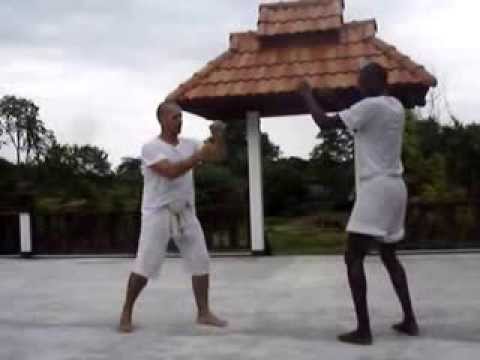
Muay Thai Sangha Lower Hand Outside and Inside techniques
0
Dutch Low Kick·Sangha Muay Thai Thailand
Pedro Solana Villalobos shows 8 hand counter techniques for the jab and the cross with the rear and lower hand. Muay Cha…
Translation: Dutch low kick
The Dutch Low Kick is the distinctive outside low kick as developed and refined by the Dutch kickboxing school, characterised by a deeper pivot, more committed hip rotation, and integration within boxing combinations (typically following a cross or hook). [1] The Dutch low kick is often set up with punches that draw the opponent's attention high before the kick sweeps their lead leg, and it is thrown with the intention of full power on every repetition rather than as a range-finding tool. [1],[2] Dutch kickboxers traditionally emphasise devastating leg kicks as a primary strategy, aiming to compromise the opponent's mobility within the first two rounds. [2],[3]
The Dutch low kick was developed in the Netherlands during the 1970s and 1980s as Dutch fighters cross-trained with Thai boxers and adapted Muay Thai techniques within a Western boxing framework. [1] Pioneers like Jan Plas (who founded Mejiro Gym after training in Japan and Thailand), Rob Kaman, and later Ernesto Hoost and Ramon Dekkers, refined the integration of low kicks with punching combinations into what became the signature Dutch kickboxing style. [2],[3]
The Dutch low kick emphasises a shorter, more compact arc with the shin making contact at closer range, allowing it to be integrated seamlessly into boxing combinations without significant loss of hand position or balance. [1] The Dutch approach prioritises volume and combination integration over single-strike power. [1]
The Dutch low kick was developed by the Dutch kickboxing school in Amsterdam, principally at Mejiro Gym (founded by Jan Plas after training in Japan) and Chakuriki Gym during the 1970s-1980s. [1] Dutch trainers synthesised Muay Thai kicking with Western boxing to create a distinctive combination-heavy style. [1]
Rob Kaman, known as 'Mr. Low Kick,' was a Dutch kickboxer who won multiple world titles in the 1980s-1990s using the Dutch low kick as his primary weapon, scoring numerous leg-kick TKO victories. [1] Ramon Dekkers (1969-2013) brought the Dutch low kick style to Thailand, winning Muay Thai championships using a combination-heavy approach featuring the Dutch low kick. [1]
No images yet for this technique.
Sign in to suggest an image.
Pedro Solana Villalobos shows 8 hand counter techniques for the jab and the cross with the rear and lower hand. Muay Cha…
No instructional courses yet for this technique.
Sign in to suggest a course.
Risk of injury to the person this technique is applied to
Most common KO kick; generates ~1,000N force to head (Falco et al. 2009)
Skill level needed to execute this technique reliably
Whether this technique is allowed under major competition rule sets
Karate-Do Kyohan: The Master Text (Gichin Funakoshi, 1935)
Alias sources — [1] Dutch Kickboxing System (Mejiro Gym tradition) [2] K-1 Broadcast Terminology (2000s) [3] Muay Thai Unleashed (Delp, 2006)
Effectiveness sources — [1] Muay Thai Unleashed (Delp, 2006)
Standard katakana transliteration of Western martial arts terminology (外来語) — used in Japanese MMA, boxing, and BJJ communities
Alias sources — [1] Dutch Kickboxing System (Mejiro Gym tradition) [2] K-1 Broadcast Terminology (2000s) [3] Muay Thai Unleashed (Delp, 2006)
Effectiveness sources — [1] Muay Thai Unleashed (Delp, 2006)
hip rotation power, rear foot pivot, full kinetic chain coordination
reach advantage, strong hips for power transfer
glutes, obliques, pectorals, triceps, deltoids
The Dutch Low Kick is the distinctive outside low kick as developed and refined by the Dutch kickboxing school, characterised by a deeper pivot, more committed hip rotation, and integration within boxing combinations (typically following a cross or hook). The Dutch low kick is often set up with punches that draw the opponent's attention high before the kick sweeps their lead leg, and it is thrown with the intention of full power on every repetition rather than as a range-finding tool.
The Dutch low kick was developed in the Netherlands during the 1970s and 1980s as Dutch fighters cross-trained with Thai boxers and adapted Muay Thai techniques within a Western boxing framework. Pioneers like Jan Plas (who founded Mejiro Gym after training in Japan and Thailand), Rob Kaman, and later Ernesto Hoost and Ramon Dekkers, refined the integration of low kicks with punching combinations into what became the signature Dutch kickboxing style.
Unified MMA: legal — Legal striking technique; WBC/Boxing: banned — All kicks prohibited in boxing; WKF: banned — Kicks below the waist prohibited in sport karate; Kyokushin: legal — Legal at full power; WT: banned — Kicks below the waist prohibited; WAKO: legal — Legal in Low Kick and K-1 formats; K: legal — 1/GLORY — Legal — low kicks are a core technique; IFMA: legal — Legal — leg kicks are highly scored in Muay Thai
Danger rating 6/10. High — most common KO kick; generates ~1,000N force to head (Falco et al. 2009)
The standard setup chain: Stance and Range → Chamber the Leg → Execute the Kick → Recover.
Standard counters include: Check (Shin Block) — raise the shin to intercept the kick before it lands / Catch and Sweep — catch the kicking leg and sweep the standing leg / Step Inside — close distance inside the kick's effective range to smother it.
Common variants: Standard cross (rear-hand straight punch with full hip rotation); Counter cross (pull counter) (leaning back to avoid the jab, firing the cross as a counter); Step-in cross (stepping forward with the punch for added reach and power); Body cross (targeting the solar plexus or liver with the straight rea…).
Rob Kaman, known as 'Mr. Low Kick,' was a Dutch kickboxer who won multiple world titles in the 1980s-1990s using the Dutch low kick as his primary weapon, scoring numerous leg-kick TKO victories.
Top errors to watch for: Throwing the low kick without punches first — the Dutch method specifically relies on combinations to set up the kick / Pausing between the hook and the low kick, which breaks the rhythm and lets the opponent reset / Not stepping offline during the combination — the angle created by the punches is what opens the low kick target / Over-committing to the punches and forgetting to throw the kick — the kick is the point of the combination.
The Dutch Low Kick is also known as Dacchi Rō Kikku, Dutch Kick, Holland Low Kick, Kickboxing Low Kick.