How To | Outside Low Leg Kick with TJ Dillashaw
0
Outside Low Kick·TjDillashaw
Low leg kicks are the most common kicks in MMA. With proper technique and blocking they are a safe option that can do a …
Translation: outside low kick
The Outside Low Kick is the most commonly thrown low kick in combat sports, targeting the outside of the opponent's lead thigh (vastus lateralis and IT band) with a circular shin strike. [1] The outside low kick attacks the large quadriceps muscle group, causing bruising and progressive loss of leg function that affects the opponent's ability to move, kick, and maintain balance. [1],[2] When delivered repeatedly to the same area, outside low kicks produce a cumulative effect that can render the targeted leg nearly immobile, as demonstrated in numerous high-profile fights where leg kick accumulation led to stoppages. [2],[3]
The outside low kick is the quintessential leg attack in Muay Thai and has been a core technique since the art's earliest competitive era. [1] Dutch kickboxers such as Rob Kaman, Ernesto Hoost, and Ramon Dekkers elevated the outside low kick to a primary weapon in international kickboxing competition during the 1980s and 1990s. [2],[3]
The outside low kick targets the lateral quadriceps and common peroneal nerve on the outside of the opponent's lead leg, causing cumulative muscle damage that degrades mobility, stance stability, and kicking ability over the course of a fight. [1] Muay Thai competition has demonstrated that sustained low kicks can render an opponent unable to stand by the later rounds. [1]
Low kicks have been central to Muay Thai for centuries, where attacks to the legs are considered as fundamental as punches. [1] The Dutch kickboxing school, developed by trainers like Johan Vos and Lucien Carbin at Mejiro Gym and Chakuriki Gym in Amsterdam during the 1970s-1980s, particularly emphasised heavy low kicks combined with boxing combinations. [2]
Ernesto Hoost was renowned for his devastating low kicks during his four K-1 World Grand Prix championships (1997, 1999, 2000, 2002), frequently damaging opponents' legs to the point of TKO stoppage. [1] Pedro Rizzo's low kicks caused visible damage to opponents in multiple UFC fights in the early 2000s. [2]
No images yet for this technique.
Sign in to suggest an image.
Low leg kicks are the most common kicks in MMA. With proper technique and blocking they are a safe option that can do a …
No instructional courses yet for this technique.
Sign in to suggest a course.
Risk of injury to the person this technique is applied to
Most common KO kick; generates ~1,000N force to head (Falco et al. 2009)
Skill level needed to execute this technique reliably
Whether this technique is allowed under major competition rule sets
Karate-Do Kyohan: The Master Text (Gichin Funakoshi, 1935)
Alias sources — [1] Muay Thai: The Art of Fighting (Kraitus & Kraitus, 1988) [2] Dynamic Karate (Nakayama, 1966) [3] Muay Thai Unleashed (Delp, 2006)
Effectiveness sources — [1] Muay Thai: The Art of Fighting (Kraitus & Kraitus, 1988)
Mixed Japanese-Western terminology — combines traditional Japanese terms with katakana loanwords
Alias sources — [1] Muay Thai: The Art of Fighting (Kraitus & Kraitus, 1988) [2] Dynamic Karate (Nakayama, 1966) [3] Muay Thai Unleashed (Delp, 2006)
Effectiveness sources — [1] Muay Thai: The Art of Fighting (Kraitus & Kraitus, 1988)
hip flexibility, rotational hip power, balance on support leg
long legs for reach, flexible hips for high kicks
hip flexors, glutes, quadriceps, obliques, calves
Every move, in any martial art, shares a few universal traits. Mix and match below to pinpoint the right tool — or compare equivalents across styles.
The Standard Outside Low Kick is the fundamental outside leg kick, executed by pivoting on the lead foot, rotating the hips, and driving the lower shin into the outside of the opponent's lead thigh. [1] The kick targets the quadriceps and IT band area with the hard bone of the shin, and the kicker follows through the target with full hip rotation. [1,2] This is the most frequently thrown kick in Muay Thai and kickboxing, serving as a constant attritive weapon throughout a fight. [2,3]
The Switch Outside Low Kick is an outside leg kick preceded by a rapid switch step, converting the lead leg into the kicking leg with enhanced power derived from the momentary rear-position loading. [1] The switch step creates a timing disruption that makes the kick harder to anticipate, and the stance change engages the full hip rotation and weight transfer normally associated with rear-leg kicks. [1,2] The switch low kick is effective as a lead technique or counter, exploiting the opponent's forward movement with an unexpected leg attack. [2,3]
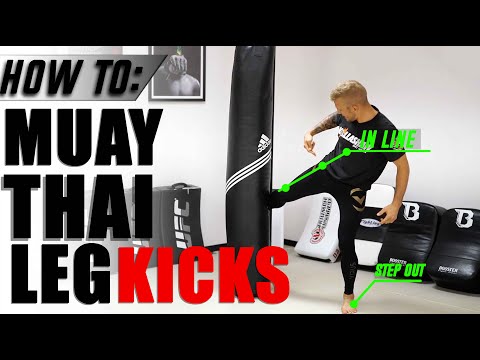
TJ Dillashaw recommends practicing on a heavy bag in your gym or garage rather than constantly kicking a partner, as this allows you to build endurance, strength, power, and technique repeatedly without wearing out your training partner.
According to TJ Dillashaw, you need to rotate your hips, get your head outside, and step outside to move your body offline. Your knee, hip, and belly button should all be in line with your kick, and you should keep your hand in your opponent's face to block counter strikes.
TJ Dillashaw emphasizes landing with the middle of your shin, as this is where you can generate the most speed and distance.
TJ Dillashaw advises aiming just above the knee in a real fight for maximum damage, but when practicing in the gym with a partner, target the middle of the leg to avoid injuring them.
The Outside Low Kick is the most commonly thrown low kick in combat sports, targeting the outside of the opponent's lead thigh (vastus lateralis and IT band) with a circular shin strike. The outside low kick attacks the large quadriceps muscle group, causing bruising and progressive loss of leg function that affects the opponent's ability to move, kick, and maintain balance.
The outside low kick is the quintessential leg attack in Muay Thai and has been a core technique since the art's earliest competitive era. Dutch kickboxers such as Rob Kaman, Ernesto Hoost, and Ramon Dekkers elevated the outside low kick to a primary weapon in international kickboxing competition during the 1980s and 1990s.
Unified MMA: legal — Legal striking technique; WBC/Boxing: banned — All kicks prohibited in boxing; WKF: banned — Kicks below the waist prohibited in sport karate; Kyokushin: legal — Legal at full power; WT: banned — Kicks below the waist prohibited; WAKO: legal — Legal in Low Kick and K-1 formats; K: legal — 1/GLORY — Legal — low kicks are a core technique; IFMA: legal — Legal — leg kicks are highly scored in Muay Thai
Danger rating 6/10. High — most common KO kick; generates ~1,000N force to head (Falco et al. 2009)
The standard setup chain: Stance and Range → Chamber the Leg → Execute the Kick → Recover.
Standard counters include: Check (Shin Block) — raise the shin to intercept the kick before it lands / Catch and Sweep — catch the kicking leg and sweep the standing leg / Step Inside — close distance inside the kick's effective range to smother it.
Common variants: Standard variation (primary execution of the strike from the most common stance); Power variation (modified mechanics for maximum force generation); Speed variation (minimised telegraph for a faster, harder-to-read attack); Counter variation (timed to exploit the opponent's offensive commitment).
Ernesto Hoost was renowned for his devastating low kicks during his four K-1 World Grand Prix championships (1997, 1999, 2000, 2002), frequently damaging opponents' legs to the point of TKO stoppage. Pedro Rizzo's low kicks caused visible damage to opponents in multiple UFC fights in the early 2000s.
Top errors to watch for: Kicking the knee joint, which is illegal in most rulesets and dangerous — aim for the meat of the thigh above the knee / Not chopping downward and instead throwing a flat roundhouse, which is easier to check / Dropping both hands when kicking low — this is the primary reason fighters get knocked out while low-kicking / Standing in range after kicking without moving the head, inviting the immediate counter punch.
The Outside Low Kick is also known as Soto Rō Kikku, Tee Tad, Gedan Mawashi Geri, Leg Kick.