Kali Coolness: Generic FMA Stick Passing for Coordination and Boredom Killing
0
Standard Rear Headbutt Technique·Coach Kurt
Various styles of Filipino Martial Arts utilize stick-passing for different reasons relative to their overall strategies…
Translation: standard rear headbutt technique
The Standard Rear Headbutt Technique is executed by dropping the chin toward the chest, then explosively snapping the head backward to strike the opponent's face with the hard occipital bone. [1] The striker aims for the bridge of the attacker's nose or the mouth area, targeting structures that are easily broken or cut on impact. [1],[2] This technique is used in Krav Maga, military combatives, and self-defence scenarios as an immediate response to rear clinch attacks. [2],[3]
The rear headbutt technique is a universal self-defence response to rear attacks, documented in combat training manuals across numerous military and law enforcement programmes worldwide. [1] Its inclusion in Krav Maga's standard curriculum reflects the technique's reliability in real-world confrontation scenarios. [2],[3]
A rear headbutt technique. [1]
Traditional. [1]
Illegal. [1]
No images yet for this technique.
Sign in to suggest an image.
Various styles of Filipino Martial Arts utilize stick-passing for different reasons relative to their overall strategies…
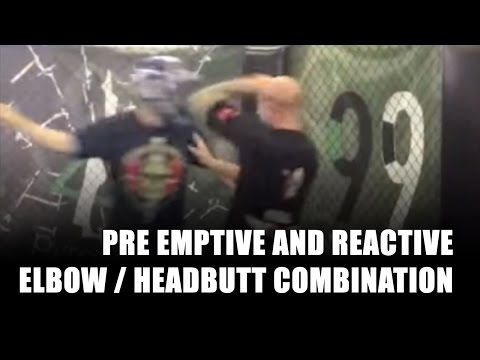
Martial Arts Guardian Scott Caldwell shows us his 'Technique For The Street' - Pre emptive and reactive elbow / headbutt…
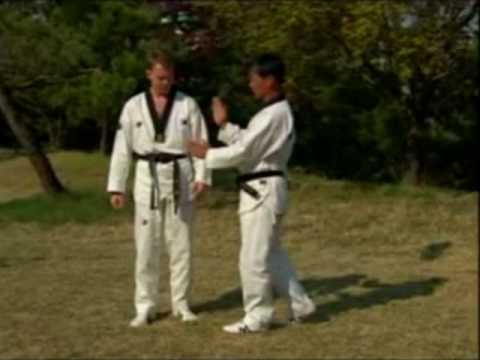
Two basic Taekwondo knees, and two basic shin checking techniques. PROOF that Kukkiwon standard South Korean Taekwond…
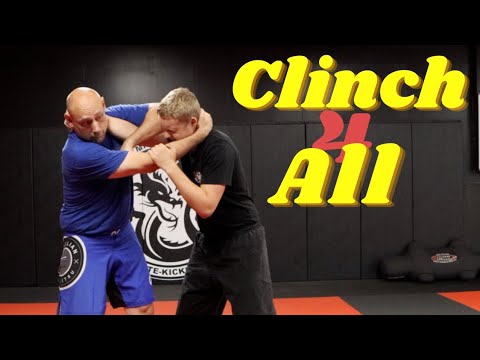
In this video, we go over some clinch techniques as well as how to pass them. We start with a standard head and arm cli…
The standard rear headbutt technique involves driving forward with full bodyweight while maintaining an upright head position, according to Martial Arts Guardian's instruction on street-applicable striking combinations. The fundamental principle centers on forward momentum rather than backward loading: the striker keeps their chin tucked and pushes weight off the rear foot, propelling the head directly into the target without pulling back beforehand. This differs from common misconceptions where practitioners travel backward before striking. Range management is critical—the striker must be within proper distance to ensure full contact rather than merely grazing the opponent. Weight transfer from the posterior chain drives power through the strike; hip engagement and forward pressure generation create cumulative force. After connection, the striker should maintain contact and continue driving forward to maximize impact, keeping the opponent immobilized rather than allowing them to escape rearward. The technique pairs effectively as a follow-up to preceding strikes (such as elbows) in combination sequences. Hand positioning remains active throughout, with one hand potentially controlling the opponent to prevent countering or disengagement while the headbutt executes. This method prioritizes functional street application over sportive contexts, emphasizing immediate follow-up actions and ensuring the opponent remains engaged in close quarters.
Synthesized from 1 instructor
No instructional courses yet for this technique.
Sign in to suggest a course.
Risk of injury to the person this technique is applied to
Backward occipital strike; used to escape clinch/back control
Skill level needed to execute this technique reliably
Whether this technique is allowed under major competition rule sets
Dirty Boxing for Mixed Martial Arts (Anderson Silva, 2012)
Effectiveness sources — [1] Comprehensive Asian Fighting Arts (Draeger & Smith, 1969)
Alias sources — [1] Dirty Boxing (Hatmaker, 2006) [2] Complete Krav Maga (Levine & Whitman, 2007) [3] British boxing slang (Hazlitt, 1822)
Official karate technique names (和語/漢語)
Established Japanese martial arts naming convention — native Japanese term (和語/漢語)
Alias sources — [1] Dirty Boxing (Hatmaker, 2006) [2] Complete Krav Maga (Levine & Whitman, 2007) [3] British boxing slang (Hazlitt, 1822)
Effectiveness sources — [1] Comprehensive Asian Fighting Arts (Draeger & Smith, 1969)
strong neck stabilisation, explosive forward drive, short range comfort
thick frontal bone, strong neck muscles
neck flexors, trapezius, core, legs (for drive)
According to Martial Arts Guardian, hip movement is critical—you need to switch your hips and move straight into the headbutt rather than just popping your head back. Drive through with your whole body weight and power, not just your head alone.
Martial Arts Guardian emphasizes that range is the most important thing—you need to be within the correct distance to avoid missing the gap. Connect at the back/base of the skull rather than just making surface contact with the top of the head.
Keep your head up at all times, and when you deliver the headbutt, hold your opponent in place rather than allowing your weight to drive them backward. Pin your ear to their shoulder to protect yourself from counter-strikes like elbows.
The Standard Rear Headbutt Technique is executed by dropping the chin toward the chest, then explosively snapping the head backward to strike the opponent's face with the hard occipital bone. The striker aims for the bridge of the attacker's nose or the mouth area, targeting structures that are easily broken or cut on impact.
The rear headbutt technique is a universal self-defence response to rear attacks, documented in combat training manuals across numerous military and law enforcement programmes worldwide. Its inclusion in Krav Maga's standard curriculum reflects the technique's reliability in real-world confrontation scenarios.
Unified MMA: banned — Headbutts prohibited; WBC/Boxing: banned — Prohibited; WKF: banned — Prohibited; Kyokushin: banned — Prohibited; WT: banned — Prohibited; ITF: banned — Prohibited; WAKO: banned — Prohibited; K: banned — 1/GLORY — Prohibited; IFMA: banned — Prohibited; FIAS Combat Sambo: legal — Legal — headbutts permitted in combat sambo
Danger rating 7/10. Very High — backward occipital strike; used to escape clinch/back control
The standard setup chain: Assume Fighting Stance → Generate Power → Execute Strike → Recover to Guard.
Standard counters include: Block — absorb the strike with a protective guard position / Evasion — move the target out of the strike's path / Counter-Attack — time an offensive response during the recovery phase of the strike.
Common variants: Standard variation (primary execution of the strike from the most common stance); Power variation (modified mechanics for maximum force generation); Speed variation (minimised telegraph for a faster, harder-to-read attack); Counter variation (timed to exploit the opponent's offensive commitment).
Illegal.
Top errors to watch for: Driving backward without first lowering the base — you push yourself off-balance instead of driving with power / Using only the neck and missing the full-body drive / Hitting the chest or shoulder because you did not locate the face first / Pausing after the headbutt instead of immediately continuing the escape sequence.
The Standard Rear Headbutt Technique is also known as Ushiro Zutsuki (Kihon-gata), Back-of-Head Butt, Occipital Headbutt, Reverse Nut.