Introduction to Stick Passing
Stick passing develops coordination, dexterity, and spatial awareness through dynamic hand-to-hand transitions. While these techniques offer functional applications such as counters to disarms and deflection-based movements, they are equally valuable for developing the body awareness and weapon control that form the foundation of Filipino martial arts practice.
Overhead Shoulder Pass
The overhead shoulder pass mirrors nunchaku (Tabak Toyak) mechanics, bringing the stick over and behind the near shoulder in a saluting motion. The stick is angled downward and passed beneath the armpit by reaching across the body, maintaining firm grip pressure throughout to prevent disarming. This drill can be performed solo with alternating slashes to develop hand positioning and repetition.
Front Plane Pass
The front plane pass functions similarly to the overhead pass but operates in the anterior plane, passing over the elbow and forearm rather than the shoulder. The receiving hand maintains a lateral palm orientation to catch the stick smoothly, with transfers performed side-to-side or combined with horizontal and upward slashing motions.
Body Rotation Integration
Hip rotation and foot pivoting transition the stick between planes of motion without manual adjustment. By rotating the torso, a front-plane pass naturally transitions into a rear-shoulder position, allowing continuous flow between techniques through efficient body mechanics rather than isolated hand movements.
Behind-the-Back Pass
The behind-the-back pass requires prior familiarization with palm-down grip positioning to map hand distance and catching angles accurately. The technique mirrors front-plane mechanics but executes posteriorly, allowing practitioners to develop ambidextrous control while maintaining situational awareness.
Armpit Tuck and Roll
The armpit tuck technique positions the stick tip in the armpit from neutral ready position, then rolls the stick underneath while switching grip. Minimal shoulder and elbow movement prevents exposure to counterattack, and body rotation can feed the stick to the opposite side without reaching, simultaneously generating strike opportunities with the stick or elbow.
Technique Combination and Flow
All passing variations—front, rear, overhead, and underneath—can be sequenced along one side of the body before transitioning to the opposite side. This approach maintains continuous stick control while building endurance and establishing efficient movement patterns applicable to functional combat scenarios.
Kali Coolness: Generic FMA Stick Passing for Coordination and Boredom Killing
Key Takeaways
- •Introduction to Stick Passing
- •Overhead Shoulder Pass
- •Front Plane Pass
- •Body Rotation Integration
Various styles of Filipino Martial Arts utilize stick-passing for different reasons relative to their overall strategies. In this video, we’re pulling a few of these passes out of their intended context in an effort to use them for developing attributes like coordination, sensitivity (awareness), creativity, and fluidity. Mostly, it just scratches that itch that calls for doing cool things with weapons despite how effective we can make them, if only because that’s why we fell in love with the Art to begin with. Go ahead and have some fun with it.
Frequently Asked Questions
What does this video teach about standard rear headbutt technique?
This video covers introduction to stick passing, overhead shoulder pass, front plane pass. It provides detailed instruction from Coach Kurt.
How long does it take to learn standard rear headbutt technique?
The basic mechanics can be understood in a single session, but developing reliable execution requires consistent drilling over weeks of practice. This 7-part breakdown helps structure your training by isolating each phase of the technique.
What are the key details for finishing standard rear headbutt technique?
The armpit tuck technique positions the stick tip in the armpit from neutral ready position, then rolls the stick underneath while switching grip. Minimal shoulder and elbow movement prevents exposure to counterattack, and body rotation can feed the stick to the opposite side without reaching, simultaneously generating strike opportunities with the stick or elbow.
Related videos
Clinch Control with Coach JD - Wrestling, Muay Thai, & More
Martial Arts Unlimited
Formal Taekwondo: Knees and Shin Checks
TaekwondoCentral
Technique For The Street, Pre emptive and reactive elbow / headbutt combination
Martial Arts Guardian
HOW TO HEADBUTT IN THE CLINCH!
URBAN COMBATIVES: SCHOOL OF SELF-PROTECTION
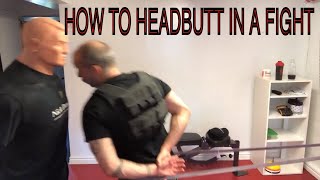
Krav Maga - How to Train a Headbutt
Nick Drossos Defensive Tactics