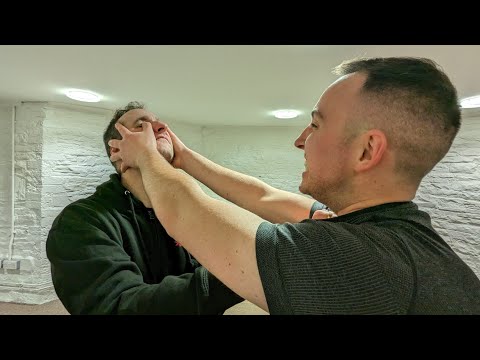
2 Simple Ways To Defend Against A HEADBUTT!
0
Rear Headbutt·Simple Self Defence
FREE For Our Viewers: 📑 Want to feel safer in just 5 minutes? Grab your Free Street Safety Quick Guide: 👉 https://www.…
Translation: rear headbutt
The Rear Headbutt family covers headbutt strikes directed backward, where the striker drives the back of the skull (the occipital bone) into the face of an opponent positioned behind them. [1] The rear headbutt is a defensive or escape technique, used when an opponent secures a rear clinch, bear hug, or choking position, and the striker uses a sharp backward snap of the head to impact the attacker's nose, teeth, or orbital area. [1],[2] The occipital bone at the back of the skull is extremely dense and provides a hard striking surface against the more fragile facial bones of the attacker. [2],[3]
The rear headbutt strikes backward with the back of the head. [1]
A traditional close-range technique. [1]
Illegal in modern combat sports. [1]
No images yet for this technique.
Sign in to suggest an image.
FREE For Our Viewers: 📑 Want to feel safer in just 5 minutes? Grab your Free Street Safety Quick Guide: 👉 https://www.…
No instructional courses yet for this technique.
Sign in to suggest a course.
Risk of injury to the person this technique is applied to
Backward occipital strike; used to escape clinch/back control
Skill level needed to execute this technique reliably
Whether this technique is allowed under major competition rule sets
Dirty Boxing for Mixed Martial Arts (Anderson Silva, 2012)
Alias sources — [1] Boxing Mastery (Hatmaker, 2004) [2] Boxing Mastery (Hatmaker, 2004) [3] Boxing Mastery (Hatmaker, 2004)
Effectiveness sources — [1] Comprehensive Asian Fighting Arts (Draeger & Smith, 1969)
Official karate technique names (和語/漢語)
Established Japanese martial arts naming convention — native Japanese term (和語/漢語)
Alias sources — [1] Boxing Mastery (Hatmaker, 2004) [2] Boxing Mastery (Hatmaker, 2004) [3] Boxing Mastery (Hatmaker, 2004)
Effectiveness sources — [1] Comprehensive Asian Fighting Arts (Draeger & Smith, 1969)
strong neck stabilisation, explosive forward drive, short range comfort
thick frontal bone, strong neck muscles
neck flexors, trapezius, core, legs (for drive)
Every move, in any martial art, shares a few universal traits. Mix and match below to pinpoint the right tool — or compare equivalents across styles.
Principles and situational awareness are more important than flashy techniques—good awareness in crowded areas like pubs or clubs will probably be enough to keep you safe in a headbutt situation.
You can use an elbow strike to either actively strike or let the attacker drive their head into your elbow. Alternatively, eye gauge combined with a knee to the groin and awareness of the attacker's friends are effective responses.
The Rear Headbutt family covers headbutt strikes directed backward, where the striker drives the back of the skull (the occipital bone) into the face of an opponent positioned behind them. The rear headbutt is a defensive or escape technique, used when an opponent secures a rear clinch, bear hug, or choking position, and the striker uses a sharp backward snap of the head to impact the attacker's nose, teeth, or orbital area.
Rear headbutts have been taught in self-defence systems for decades as a primary response to attacks from behind. The technique appears in Krav Maga, British Army combatives, and Filipino martial arts, where close-quarters scenarios frequently involve rear clinch situations.
Unified MMA: banned — Headbutts prohibited; WBC/Boxing: banned — Prohibited; WKF: banned — Prohibited; Kyokushin: banned — Prohibited; WT: banned — Prohibited; ITF: banned — Prohibited; WAKO: banned — Prohibited; K: banned — 1/GLORY — Prohibited; IFMA: banned — Prohibited; FIAS Combat Sambo: legal — Legal — headbutts permitted in combat sambo
Danger rating 7/10. Very High — backward occipital strike; used to escape clinch/back control
The standard setup chain: Assume Fighting Stance → Generate Power → Execute Strike → Recover to Guard.
Standard counters include: Block — absorb the strike with a protective guard position / Evasion — move the target out of the strike's path / Counter-Attack — time an offensive response during the recovery phase of the strike.
Common variants: Standard variation (primary execution of the strike from the most common stance); Power variation (modified mechanics for maximum force generation); Speed variation (minimised telegraph for a faster, harder-to-read attack); Counter variation (timed to exploit the opponent's offensive commitment).
Illegal in modern combat sports.
Top errors to watch for: Using the neck alone to snap the head back — the legs and hips must drive the motion for power / Not knowing where the opponent's face is — look sideways briefly to locate the target before striking / Tilting the head too far back, which exposes the throat and is structurally weak / Hitting the opponent's forehead with the back of your skull — aim for the softer nose and mouth.
The Rear Headbutt is also known as Ushiro Zutsuki, Back Headbutt, Reverse Headbutt, Rear Head Strike.