Foundation: Hip-Driven Power
The instructor emphasizes that effective elbow strikes originate from hip rotation rather than arm strength alone. Practitioners must actively drive their hips forward to generate maximum power, ensuring the strike travels through the target rather than stopping at contact.
Range Assessment and Positioning
Proper distance management is critical before executing the technique. The practitioner must close to effective range and maintain the correct distance to deliver a full-power strike without leaving gaps that would result in a miss.
Elbow Execution with Hip Torque
The elbow strike requires coordinated hip rotation and forward movement. The practitioner should rotate their hip, drive straight forward, and follow through past the target to ensure the point of contact uses the hardest bony surface and generates full penetration.
Follow-up with Rear Headbutt
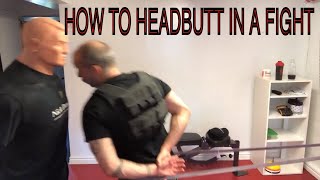
After the elbow strike lands, the practitioner immediately follows with a rear headbutt while maintaining contact with the opponent. The chin is tucked, weight is driven forward off the back foot, and the strike continues through the target to maximize impact.
Weight Distribution and Positioning
The practitioner must avoid drawing the head back before striking, as this telegraphs intent and allows counterattack. Instead, weight transfers continuously from the back foot forward, with hands up for protection while driving the headbutt into the opponent.
Force Control and Target Engagement
Rather than allowing the opponent to absorb and redirect force, the practitioner uses their bodyweight to drive and hold the target in place. This creates a collision effect where both combatants absorb the impact, with the practitioner's superior positioning determining dominance.
Range Verification Before Impact
The practitioner confirms proper distance one final time before execution. At optimal range, both strikes can land sequentially without adjustment, ensuring the combination flows as a single committed action.
Combination Flow and Finishing
The elbow and headbutt combination should leave the opponent unable to continue. If necessary, the practitioner can use their non-striking hand to control the opponent's movement while committing all remaining power to ensure the threat is neutralized.
Technique For The Street, Pre emptive and reactive elbow / headbutt combination
Key Takeaways
- •Foundation: Hip-Driven Power
- •Range Assessment and Positioning
- •Elbow Execution with Hip Torque
- •Follow-up with Rear Headbutt
Martial Arts Guardian Scott Caldwell shows us his 'Technique For The Street' - Pre emptive and reactive elbow / headbutt combination
Frequently Asked Questions
What does this video teach about standard rear headbutt technique?
This video covers foundation: hip-driven power, range assessment and positioning, elbow execution with hip torque. It provides detailed instruction from Martial Arts Guardian.
How long does it take to learn standard rear headbutt technique?
The basic mechanics can be understood in a single session, but developing reliable execution requires consistent drilling over weeks of practice. This 8-part breakdown helps structure your training by isolating each phase of the technique.
What are the key details for finishing standard rear headbutt technique?
The practitioner confirms proper distance one final time before execution. At optimal range, both strikes can land sequentially without adjustment, ensuring the combination flows as a single committed action.
Related videos
Clinch Control with Coach JD - Wrestling, Muay Thai, & More
Martial Arts Unlimited
Formal Taekwondo: Knees and Shin Checks
TaekwondoCentral
Kali Coolness: Generic FMA Stick Passing for Coordination and Boredom Killing
Coach Kurt
HOW TO HEADBUTT IN THE CLINCH!
URBAN COMBATIVES: SCHOOL OF SELF-PROTECTION
Krav Maga - How to Train a Headbutt
Nick Drossos Defensive Tactics