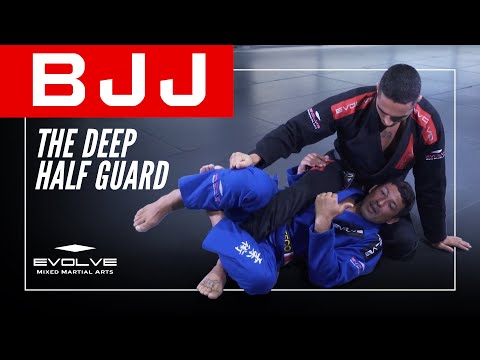
BJJ | An Introduction To The Deep Half Guard
0
Deep Half Guard·Evolve Mixed Martial Arts
BJJ World Champion Teco Shinzato from the EVOLVE Fight Team gives An Introduction To The Deep Half Guard in Brazilian Ji…
Translation: deep half guard
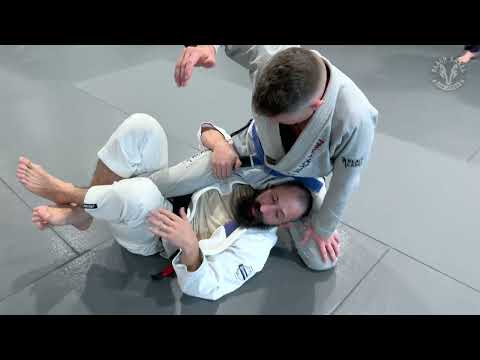
The Deep Half Guard subfamily covers the advanced half guard variation where the guard player dives deep underneath the opponent, positioning the body entirely beneath the opponent's hips with the head and shoulders under the opponent's centre of gravity. [1] Deep half guard provides extraordinary sweeping leverage because the guard player's body is directly under the opponent's weight, making off-balancing and sweeping possible with relatively little effort. [1],[2] The position requires comfort with being underneath an opponent and strong hip movement to navigate the under-body space. [2],[3]
The deep half guard was developed by Jeff Glover and further systematised by Ryan Hall and Bernardo Faria, who used it as the centrepiece of his five-time world championship competition game. [1] Faria's dominant use of deep half guard proved its effectiveness at the highest levels of competition. [2],[3]
The deep half guard provides an exceptionally strong sweeping position by placing the guard player directly underneath the opponent's centre of gravity, making sweeps mechanically efficient. [1] Bernardo Faria describes the deep half as the most reliable sweeping position in BJJ because the opponent's weight is loaded directly over the guard player's hips. [2]
Bernardo Faria used the deep half guard as his primary position to win five IBJJF World Championship titles at the black belt level, including victories over elite competitors. [1]
No images yet for this technique.
Sign in to suggest an image.
BJJ World Champion Teco Shinzato from the EVOLVE Fight Team gives An Introduction To The Deep Half Guard in Brazilian Ji…
The Coyote Guard is an amazing addition to the BJJ half guard allowing the guard player to take away the mobility of the…
No instructional courses yet for this technique.
Sign in to suggest a course.
Risk of injury to the person this technique is applied to
Guard positions are defensive; injury risk comes from transitions, not the position itself
Skill level needed to execute this technique reliably
Whether this technique is allowed under major competition rule sets
Jiu-Jitsu University (Saulo Ribeiro, 2008)
Alias sources — [1] IBJJF Rules (2024) [2] Jiu-Jitsu University (Ribeiro, 2008) [3] The Guard (Moreira & Beneville, 2003)
Effectiveness sources — [1] Jiu-Jitsu University (Ribeiro, 2008) [2] IBJJF official records
Standard katakana transliteration of Western martial arts terminology (外来語) — used in Japanese MMA, boxing, and BJJ communities
Alias sources — [1] IBJJF Rules (2024) [2] Jiu-Jitsu University (Ribeiro, 2008) [3] The Guard (Moreira & Beneville, 2003)
Effectiveness sources — [1] Jiu-Jitsu University (Ribeiro, 2008) [2] IBJJF official records
hip flexibility, active legs, grip management
long legs for distance control and guard retention
hip flexors, adductors, quadriceps, core, grip
Every move, in any martial art, shares a few universal traits. Mix and match below to pinpoint the right tool — or compare equivalents across styles.
The Standard Deep Half establishes the deep half guard with the guard player fully underneath the opponent, one arm hugging the controlled leg, head positioned under the opponent's hip, with the body serving as a platform beneath the opponent's base. [1] From this position, the guard player can execute waiter sweeps, Homer Simpson sweeps, and direct elevations by simply shifting the hips and using the under-body leverage. [1,2] The standard deep half requires the guard player to be comfortable in a compressed, underneath position. [2,3]
The Waiter Deep Half positions the guard player in deep half guard with the free leg extended upward to hook the opponent's far leg — holding it like a waiter holding a tray — creating a sweeping platform. [1] The waiter position adds the far-leg hook to the standard deep half, providing an additional lever for sweeping and control. [1,2] The extended leg hook both prevents the opponent from basing with the far leg and creates a powerful elevation mechanism for the sweep. [2,3]
Deep half guard appears in 18 passages across 4 books. The bottom player dives deep under the opponent's center of gravity with the underhook side. Jeff Glover and Bernardo Faria are the most famous deep half guard specialists. Jiu Jitsu Style (2015) documents de la Riva to deep half guard transitions and sleeve control sweeps from deep half. (Jiu Jitsu Style 28, 2015; 4 books in corpus)
The core concept is to put your arm in between, get your hips in close, and control your opponent's hips near your face. You don't need to be fast—you have to be tight and control the situation, then analyze your opponent's posture and weight distribution to choose the right response.
Deep half guard allows you to control your opponent close to you and gives you multiple ways to pass the guard or keep them far from you, providing more control options in specific situations.
You have transitions available—if your sweep attempt causes your opponent to stand up, you can change to X guard or transition to 50/50 guard to maintain control of the situation.
You can transition into deep half guard from positions like Bella Riva or lasso guard by lifting slightly, kicking, and hooking your opponent's leg while controlling the hips and knee.
The Deep Half Guard subfamily covers the advanced half guard variation where the guard player dives deep underneath the opponent, positioning the body entirely beneath the opponent's hips with the head and shoulders under the opponent's centre of gravity. Deep half guard provides extraordinary sweeping leverage because the guard player's body is directly under the opponent's weight, making off-balancing and sweeping possible with relatively little effort.
The deep half guard was developed by Jeff Glover and further systematised by Ryan Hall and Bernardo Faria, who used it as the centrepiece of his five-time world championship competition game. Faria's dominant use of deep half guard proved its effectiveness at the highest levels of competition.
IBJJF: legal — Legal — guard is fundamental to BJJ, sweeps from guard score 2 points; IJF: restricted — Guard pulling penalized as non-combativity — groundwork from guard permitted …; ADCC: legal — Legal, guard pull penalized -1 point in points portion; Unified MMA: legal — Legal — no penalty for playing guard; FIAS Sport Sambo: legal — Legal
Danger rating 2/10. Low — guard positions are defensive; injury risk comes from transitions, not the position itself
The standard setup chain: Achieve Guard Contact → Control Grips → Manage Distance → Threaten Submissions/Sweeps.
Standard counters include: Guard Pass — systematically work to clear the legs and establish a dominant position / Leg Pin — control one or both legs to neutralize guard retention / Pressure Passing — use heavy chest pressure to flatten and immobilize the guard player.
Common variants: Standard half guard (one leg trapped between both legs with an underhook); Deep half guard (fully under the opponent with the leg fully entangled); Lockdown half guard (figure-four leg lock on the trapped leg (10th Planet)); Z-guard (knee shield) (knee across the opponent's chest creating a frame).
Bernardo Faria used the deep half guard as his primary position to win five IBJJF World Championship titles at the black belt level, including victories over elite competitors.
Top errors to watch for: Entering deep half without controlling the far leg — the leg control is what makes the position work / Getting underneath without a plan to sweep — deep half is not a resting position; sweep immediately / Allowing the opponent to establish a crossface before entering deep half — the crossface prevents the entry / Not protecting the neck in deep half — guillotine threats exist; keep the chin tucked.
The Deep Half Guard is also known as Dīpu Hāfu Gādo, Deep Half, Meia Guarda Profunda, Deep Underhook Half.