Jiu-Jitsu Mini-Seminar on Deep Half Guard Techniques
0
Standard Deep Half·Knight Jiu-Jitsu·Added by Admin
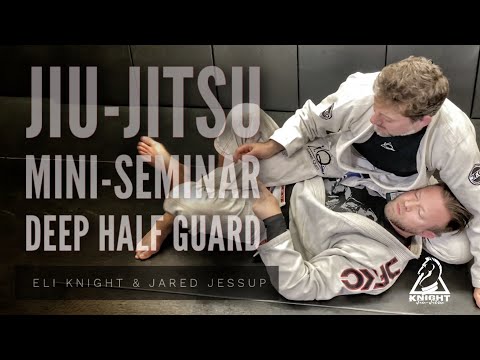
Deep Half Guard is a powerful position, especially for use against heavier aggressive opponents. This video is an explor…
Translation: standard deep half
The Standard Deep Half establishes the deep half guard with the guard player fully underneath the opponent, one arm hugging the controlled leg, head positioned under the opponent's hip, with the body serving as a platform beneath the opponent's base. [1] From this position, the guard player can execute waiter sweeps, Homer Simpson sweeps, and direct elevations by simply shifting the hips and using the under-body leverage. [1],[2] The standard deep half requires the guard player to be comfortable in a compressed, underneath position. [2],[3]
Deep half guard places the bottom player's body under the opponent's base, providing powerful off-balancing and sweep opportunities. [1]
Deep half guard was developed and popularised by Jeff Glover and other competitors in the 2000s as an advanced sweeping position. [1]
Deep half guard is used in BJJ competition, particularly by lighter-weight competitors. [1]
No images yet for this technique.
Sign in to suggest an image.
Deep Half Guard is a powerful position, especially for use against heavier aggressive opponents. This video is an explor…
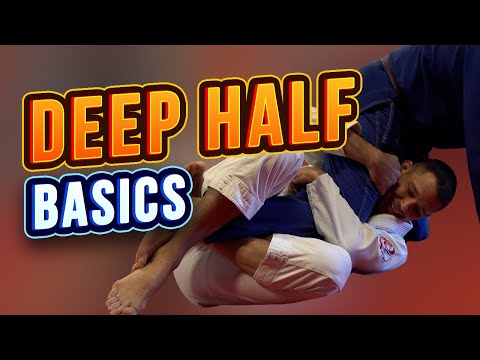
Here Coach James teaches the basics of Deep Half Guard, including a simple entry from Shin-On-Shin, and a couple sweeps …
The Standard Deep Half Guard is a versatile bottom position accessible from multiple entries, particularly from knee shield. Both Knight Jiu-Jitsu and James Clingerman emphasize foundational structure and connectivity as essential to the position's effectiveness. Knight Jiu-Jitsu details entry via knee shield, where the bottom player stacks feet and uses frames on the opponent's shoulder and arm to prevent cross-face attacks before shooting deep inside. The leg positioning creates a wall-like structure that resists rolling. Clingerman approaches entry via shin-on-shin contact with foot inside and knee outside, driving inward pressure while wrapping the opponent's leg, then falling to the inside with the head near the opposite leg. Both instructors stress that weight distribution and leverage—rather than muscular effort—determine sweep success. Knight Jiu-Jitsu presents multiple conditional responses based on opponent resistance: direct body rolls, scissor leg sweeps when the opponent posts, ankle control with perpendicular tailbone positioning, and leg-hook variations leading to back takes. Clingerman focuses on rocking sweeps and momentum-based finishing, emphasizing maintaining dual connectivity (hands or feet) throughout transitions. Where Knight Jiu-Jitsu systematizes decision trees around opponent energy and hand positioning, Clingerman prioritizes drilling foundational mechanics and progressive pressure application to generate sweeps quickly rather than statically.
Synthesized from 2 instructors
No instructional courses yet for this technique.
Sign in to suggest a course.
Risk of injury to the person this technique is applied to
Guard positions are defensive; injury risk comes from transitions, not the position itself
Skill level needed to execute this technique reliably
Whether this technique is allowed under major competition rule sets
Jiu-Jitsu University (Saulo Ribeiro, 2008)
Alias sources — [1] Jiu-Jitsu University (Ribeiro, 2008) [2] The Guard (Moreira & Beneville, 2003)
Effectiveness sources — [1] Jiu-Jitsu University (Ribeiro, 2008)
Standard katakana transliteration of Western martial arts terminology (外来語) — used in Japanese MMA, boxing, and BJJ communities
Alias sources — [1] Jiu-Jitsu University (Ribeiro, 2008) [2] The Guard (Moreira & Beneville, 2003)
Effectiveness sources — [1] Jiu-Jitsu University (Ribeiro, 2008)
hip flexibility, active legs, grip management
long legs for distance control and guard retention
hip flexors, adductors, quadriceps, core, grip
You need good pressure both inward toward your opponent and toward yourself to keep them stuck to you. James Clingerman emphasizes that without adequate pressure, your opponent can simply step their foot around and escape.
Knight Jiu-Jitsu instructs to kick the side of their body up toward their armpit to make them post on the opposite side, which prevents them from using a crossface to flatten you back out.
Position yourself hamstring to hamstring perpendicular to your opponent, pull their ankle, drive your foot for leverage on their leg, and roll them up and over. Make sure your leg structure is solid so you're sitting on a wall and difficult to roll through.
Yes—hook behind your opponent's ankle with your foot while clamping down to prevent them from posting their knee, then pull their hip to one side and extend the leg out to take their back.
The Standard Deep Half establishes the deep half guard with the guard player fully underneath the opponent, one arm hugging the controlled leg, head positioned under the opponent's hip, with the body serving as a platform beneath the opponent's base. From this position, the guard player can execute waiter sweeps, Homer Simpson sweeps, and direct elevations by simply shifting the hips and using the under-body leverage.
The standard deep half guard is the foundational position of the deep half guard system, made famous by Bernardo Faria's dominant competition performances. It is the base position from which all deep half attacks originate.
IBJJF: legal — Legal — guard is fundamental to BJJ, sweeps from guard score 2 points; IJF: restricted — Guard pulling penalized as non-combativity — groundwork from guard permitted …; ADCC: legal — Legal, guard pull penalized -1 point in points portion; Unified MMA: legal — Legal — no penalty for playing guard; FIAS Sport Sambo: legal — Legal
Danger rating 2/10. Low — guard positions are defensive; injury risk comes from transitions, not the position itself
The standard setup chain: Achieve Guard Contact → Control Grips → Manage Distance → Threaten Submissions/Sweeps.
Standard counters include: Guard Pass — systematically work to clear the legs and establish a dominant position / Leg Pin — control one or both legs to neutralize guard retention / Pressure Passing — use heavy chest pressure to flatten and immobilize the guard player.
Common variants: Standard half guard (one leg trapped between both legs with an underhook); Deep half guard (fully under the opponent with the leg fully entangled); Lockdown half guard (figure-four leg lock on the trapped leg (10th Planet)); Z-guard (knee shield) (knee across the opponent's chest creating a frame).
Deep half guard is used in BJJ competition, particularly by lighter-weight competitors.
Top errors to watch for: Sliding underneath without securing the leg first — the underhook on the far leg must be established before the slide / Entering too slowly — the entry must be quick and committed to prevent the opponent from adjusting / Not controlling the leg with the shoulder — the leg draping over the shoulder is the critical control point / Sweeping with arms only — the body extension (hips and legs) provides the sweep power.
The Standard Deep Half is also known as Sutandādo Dīpu Hāfu, Classic Deep Half Guard, Full Deep Half.