Definition and Core Concept
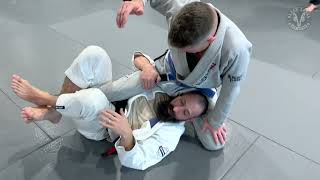
Deep half guard is a half guard variation played with one arm positioned between the opponent's legs while keeping the hips close to the player's face. This positioning prevents the opponent from controlling the player's neck and distributing weight across the face, allowing greater freedom of movement and the ability to anticipate opponent actions.
Advantages Over Traditional Half Guard
Deep half guard is effective against opponents who are stronger or faster, as it provides superior hip control compared to traditional half guard. While traditional half guard typically emphasizes underhook techniques on the same side, deep half guard uses the opposite arm inserted between the legs to control the opponent's hips and prevent neck pressure.
Defensive Responses to Attacks
When opponents attempt Kimura attacks on the inserted arm, the player rotates the hand to the floor and uses knee positioning in front of the biceps to break the hold and conceal the arm. Against choke attempts, moving deeper into the position allows the player to shift to the opposite side and maintain control.
Transitions and Position Flexibility
Deep half guard provides multiple transition options when sweeps fail or the position becomes compromised. Players can transition to X-guard when opponents stand up from a sweep attempt, transition to 50/50 guard when the primary hook is passed, or shift to leg attack positions when necessary.
Entry from Lasso Guard
From lasso guard, the player releases the hook and places their leg between the opponent's legs with the knee pressing behind the thigh, then kicks and hooks into deep half guard position while maintaining hip control.
Entry from Reverse Bellahiva Position
When the opponent attempts a passing sequence with their arm extended forward, the player establishes a reverse bellahiva hook while simultaneously hooking under the opponent's foot, pulling them inward and extending the leg to secure deep half guard.
Opponent Defense Positions
Common defensive postures against deep half guard include sitting on heels with extended legs, changing base to block space, placing the knee on the floor with legs open, and passing to the opposite side while stabilizing. Each defense requires specific technical responses.
Lapel Control Setup
The player controls the opponent's lapel and passes it to the opposite hand, threading it between the belly and opponent's leg while going deep. Once back is flat, the player repositions the lapel control to the pants to maintain position and prepare sweeping entries.
BJJ | An Introduction To The Deep Half Guard
Key Takeaways
- •Definition and Core Concept
- •Advantages Over Traditional Half Guard
- •Defensive Responses to Attacks
- •Transitions and Position Flexibility
BJJ World Champion Teco Shinzato from the EVOLVE Fight Team gives An Introduction To The Deep Half Guard in Brazilian Jiu-Jitsu! 0:16 Deep Half Guard Concepts 0:51 Reasons For Using The Deep Half Guard 1:51 Half Guard vs Deep Half Guard 3:37 Defending Against Submissions 4:42 Transitioning Out Of Deep Half Guard 5:40 Transitioning Into Deep Half Guard 7:58 Ways To Defend Against Deep Half Guard 10:00 Sweeps From Deep Half Guard Teco is a 2x Black Belt Mundials World Champion in Brazilian Jiu-Jitsu (BJJ) with over 25 years of experience. He holds a 4th degree Black Belt in Brazilian Jiu-Jitsu under the legendary Elcio Figueiredo. Teco is an Instructor at Evolve Mixed Martial Arts in Singapore. For more Brazilian Jiu-Jitsu video tutorials by BJJ World Champions, please go to https://evolve-university.com Subscribe to Evolve MMA on YouTube: https://bit.ly/31Xvpry Website: https://evolve-mma.com Facebook: https://www.facebook.com/EvolveMMA Twitter: https://twitter.com/EvolveMMA Instagram: https://www.instagram.com/evolvemma #BJJ #DeepHalfGuard #EvolveMMA
Related Techniques
Frequently Asked Questions
What does this video teach about deep half guard?
This video covers definition and core concept, advantages over traditional half guard, defensive responses to attacks. It provides detailed instruction from Evolve Mixed Martial Arts.
How long does it take to learn deep half guard?
The basic mechanics can be understood in a single session, but developing reliable execution requires consistent drilling over weeks of practice. This 8-part breakdown helps structure your training by isolating each phase of the technique.
What are the key details for finishing deep half guard?
Common defensive postures against deep half guard include sitting on heels with extended legs, changing base to block space, placing the knee on the floor with legs open, and passing to the opposite side while stabilizing. Each defense requires specific technical responses.