ESCAPING BACK CONTROL BY BEATING THE TOP HOOK!
0
Hook Back Control·Nexus Jiu Jitsu
When you are in a bad position, you need answers to a whole host of problems that may arise. Sometimes your first or sec…
Translation: hook back control
The Hook Back Control subfamily covers back control positions using hooks — feet inserted inside the opponent's thighs from behind — as the primary lower body control method. [1] Hooks are the traditional method of maintaining back control in BJJ, with the feet placed inside the opponent's inner thighs to prevent them from turning or sliding down to escape. [1],[2] Hook-based back control can use either a single hook (one foot inside one thigh) or double hooks (both feet inside both thighs), with double hooks providing more secure control. [2],[3]
Hook back control is the standard back control position in IBJJF, ADCC, and MMA competition. [1]
No images yet for this technique.
Sign in to suggest an image.
When you are in a bad position, you need answers to a whole host of problems that may arise. Sometimes your first or sec…
No instructional courses yet for this technique.
Sign in to suggest a course.
Risk of injury to the person this technique is applied to
Back control is dominant position; enables rear chokes (Danaher 2021)
Skill level needed to execute this technique reliably
Whether this technique is allowed under major competition rule sets
Brazilian Jiu-Jitsu: Theory and Technique (Renzo Gracie & Royler Gracie, 2001)
Alias sources — [1] IBJJF Rules (2024) [2] Jiu-Jitsu University (Ribeiro, 2008) [3] Mastering Jujitsu (Gracie & Danaher, 2003)
Effectiveness sources — [1] Mastering Jujitsu (Gracie & Danaher, 2003) [2] Jiu-Jitsu University (Ribeiro, 2008)
Standard katakana transliteration of Western martial arts terminology (外来語) — used in Japanese MMA, boxing, and BJJ communities
Alias sources — [1] IBJJF Rules (2024) [2] Jiu-Jitsu University (Ribeiro, 2008) [3] Mastering Jujitsu (Gracie & Danaher, 2003)
Effectiveness sources — [1] Mastering Jujitsu (Gracie & Danaher, 2003) [2] Jiu-Jitsu University (Ribeiro, 2008)
hook control, seatbelt grip endurance, hip connection
long legs for deep hooks, strong grip for seatbelt
hip adductors, biceps, forearms, core
Every move, in any martial art, shares a few universal traits. Mix and match below to pinpoint the right tool — or compare equivalents across styles.
The Double Hook back control inserts both feet inside the opponent's inner thighs from behind, creating two points of lower body control that prevent the opponent from turning, sliding down, or bridging to escape. [1] Double hooks represent the standard, fully established back control in BJJ — when both hooks are in, the position is considered secure and scores four points in IBJJF competition. [1,2] The double hook configuration allows the controlling fighter to use independent hook pressure to manage the opponent's escape attempts. [2,3]
The Single Hook back control uses one foot inserted inside the opponent's thigh while the other leg is positioned differently — typically wrapped around the waist, posted on the mat, or in transition. [1] Single hook back control is a transitional or partial back control position that provides less security than double hooks but can be sufficient for attack and may be the available option during transitions. [1,2] In competition, a single hook combined with upper body control may or may not score back control points depending on the ruleset. [2,3]
Your primary defensive hand is always the opposite hand of your opponent's primary choking arm. Understanding this distinction matters because using the wrong hand can compromise your defense, though the secondary hand also plays a role in the overall escape sequence.
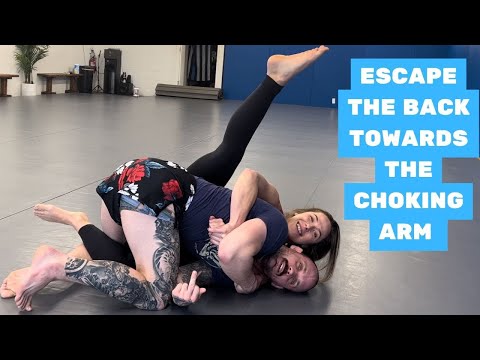
Extend your top leg to pull out your opponent's top hook, step over the bottom hook, and get knee-to-elbow to prevent the top hook from being re-inserted. Then reach for your opponent's primary elbow, pull it tight, scoot back, and transition to your knees to continue your escape.
When escaping to the underhook side, you beat the bottom hook first and win at the level of the hips before clearing your elbow. The overhook side escape involves a different sequence where you extend the top leg to clear hooks rather than focusing on the underhook positioning.
The Hook Back Control subfamily covers back control positions using hooks — feet inserted inside the opponent's thighs from behind — as the primary lower body control method. Hooks are the traditional method of maintaining back control in BJJ, with the feet placed inside the opponent's inner thighs to prevent them from turning or sliding down to escape.
Hook-based back control is the original back control method in BJJ, predating the body triangle as the standard way to maintain the back position. The hook system was formalised in BJJ's positional hierarchy and remains the first back control method taught to beginners.
IBJJF: legal — Legal, back control with hooks or body triangle scores 4 points; IJF: legal — Legal — back control leads to pin or submission opportunities; ADCC: legal — Legal, back mount scores 3 points (4 from sweep); Unified MMA: legal — Legal — dominant position for ground-and-pound and rear naked choke; UWW: legal — Legal — back exposure is the primary scoring mechanism in wrestling; FIAS Sport Sambo: legal — Legal
Danger rating 4/10. Moderate — back control is dominant position; enables rear chokes (Danaher 2021)
The standard setup chain: Achieve Position → Stabilize → Maintain → Attack.
Standard counters include: Hand Fight — grip-fight the choking hand to prevent the rear naked choke / Shoulder Walk — walk shoulders to the mat to escape back control / Turn into Guard — rotate to face the attacker and recover guard position.
Common variants: Back control with hooks (both feet hooked inside the opponent's thighs); Body triangle back control (legs locked in a figure-four around the torso); Rear mount (mounted on the back with both hooks, opponent face-down); Chair sit back control (sitting behind the opponent with hooks, upright position).
Hook back control is the standard back control position in IBJJF, ADCC, and MMA competition.
Top errors to watch for: Crossing the ankles — this creates a straight ankle lock vulnerability; keep feet uncrossed / Hooking too deep (feet past the opponent's thighs) — hooks should be just inside the inner thigh / Not actively pulling with the hooks — passive hooks are easily cleared; maintain active tension / Hooking with straight legs — keep knees bent for better hooking angles and mobility.
The Hook Back Control is also known as Fukku Bakku Kontorōru, Hooks-In Back Control, Traditional Back Control, Back Mount with Hooks.