Escaping Back Control
0
Back Control·Absolute MMA St Kilda - Melbourne
Full Course Playlist → https://youtube.com/playlist?list=PLDrQXekZsfYZfV1QZ4T5UkxLwFwQ12EbP Find the Introduction course…
Translation: back control
The Back Control family covers the various methods of controlling an opponent from behind, using combinations of hooks, body triangles, and upper body grips. [1] Back control is defined by having the chest against the opponent's back with some form of lower body control (hooks or body triangle) and upper body control (seatbelt, harness, or collar grip). [1],[2] The family encompasses hook-based controls (single and double hooks inside the thighs), body triangle controls (legs locked in a figure-four around the torso), seatbelt configurations (over-under arm control from behind), and the crucifix (extreme back control with both arms trapped). [2],[3]
Back control techniques evolved from judo's ushiro-kuzure-kesa-gatame and wrestling's back exposure positions into the comprehensive back control system developed in BJJ. [1] Modern back control methodology, including the seatbelt grip and systematic hook management, was refined through decades of BJJ competition. [2],[3]
Back control is considered the highest-value position in the BJJ positional hierarchy, scored at four points — the maximum — under IBJJF rules. [1] Saulo Ribeiro describes back control as the position where the attacker has the greatest submission threat with the least defensive options available to the opponent. [2]
Modern back control systems trace from Rolls Gracie's innovations in the 1970s-80s, [1] through Marcelo Garcia's back-taking methodology that emphasised arm drags and hook insertion, [2] to the Danaher Death Squad's systematised back attack system featuring the straitjacket and body triangle controls. [3]
Marcelo Garcia's competition career (2003-2011) demonstrated back control as the most reliable path to submission at the highest levels — the majority of his ADCC and IBJJF finishes came from the back position via rear naked choke. [1] Gordon Ryan's dominant run at ADCC 2022, where he submitted all opponents in the absolute division, relied heavily on back control. [2]
No images yet for this technique.
Sign in to suggest an image.
Full Course Playlist → https://youtube.com/playlist?list=PLDrQXekZsfYZfV1QZ4T5UkxLwFwQ12EbP Find the Introduction course…
SALE SALE SALE OVER 50% OFF – BOX SET – ALL 4 COURSES 50% OFF CLICK HERE – https://bit.ly/2lAOHmp • The Blue Belt Sup…
No instructional courses yet for this technique.
Sign in to suggest a course.
Risk of injury to the person this technique is applied to
Back control is dominant position; enables rear chokes (Danaher 2021)
Skill level needed to execute this technique reliably
Whether this technique is allowed under major competition rule sets
Brazilian Jiu-Jitsu: Theory and Technique (Renzo Gracie & Royler Gracie, 2001)
Alias sources — [1] Jiu-Jitsu University (Ribeiro, 2008) [2] Mastering Jujitsu (Gracie & Danaher, 2003) [3] Mastering Jujitsu (Gracie & Danaher, 2003)
Effectiveness sources — [1] IBJJF Rules and Regulations [2] Jiu-Jitsu University (Ribeiro, 2008)
Standard katakana transliteration of Western martial arts terminology (外来語) — used in Japanese MMA, boxing, and BJJ communities
Alias sources — [1] Jiu-Jitsu University (Ribeiro, 2008) [2] Mastering Jujitsu (Gracie & Danaher, 2003) [3] Mastering Jujitsu (Gracie & Danaher, 2003)
Effectiveness sources — [1] IBJJF Rules and Regulations [2] Jiu-Jitsu University (Ribeiro, 2008)
hook control, seatbelt grip endurance, hip connection
long legs for deep hooks, strong grip for seatbelt
hip adductors, biceps, forearms, core
Every move, in any martial art, shares a few universal traits. Mix and match below to pinpoint the right tool — or compare equivalents across styles.
The Body Triangle Back Control subfamily covers back control positions where the controlling fighter locks the legs in a figure-four configuration around the opponent's torso instead of using standard hooks. [1] The body triangle provides superior control compared to hooks because the interlocked legs create a powerful compression grip that is much harder to clear than individual hooks. [1,2] The body triangle can be applied from both seated and supine back positions and is increasingly preferred at the highest levels of competition and MMA. [2,3]
The Crucifix Back Control subfamily covers the extreme back control position where the controlling fighter traps both of the opponent's arms — one arm with the legs and the other with the arms — leaving the opponent completely immobilised. [1] The crucifix is one of the most dominant control positions in all of grappling because the defender has no arms available for defence, making them completely vulnerable to strikes (in MMA) and chokes. [1,2] The position requires significant skill to establish but provides near-total control once secured. [2,3]
The Hook Back Control subfamily covers back control positions using hooks — feet inserted inside the opponent's thighs from behind — as the primary lower body control method. [1] Hooks are the traditional method of maintaining back control in BJJ, with the feet placed inside the opponent's inner thighs to prevent them from turning or sliding down to escape. [1,2] Hook-based back control can use either a single hook (one foot inside one thigh) or double hooks (both feet inside both thighs), with double hooks providing more secure control. [2,3]
The Seatbelt Back Control subfamily covers back control positions defined by the seatbelt grip — an over-under arm configuration from behind where one arm goes over the shoulder and the other goes under the armpit, clasped together on the chest. [1] The seatbelt is the standard upper body control method for back control, providing a powerful grip that keeps the controlling fighter's chest tight against the opponent's back. [1,2] The seatbelt has a 'strong side' (choking arm over the shoulder) and 'weak side' (choking arm under the armpit), each with different tactical implications. [2,3]
Back control with hooks (or body triangle) scores 4 points in IBJJF — equal to mount. John Danaher considers the back the single most dominant position because the opponent cannot see or effectively defend against attacks. (IBJJF Rules v6.0; Danaher, Back Attacks: Enter the System)
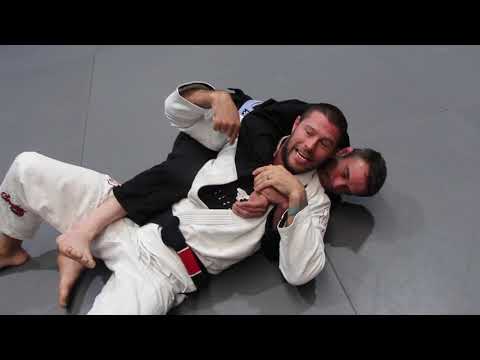
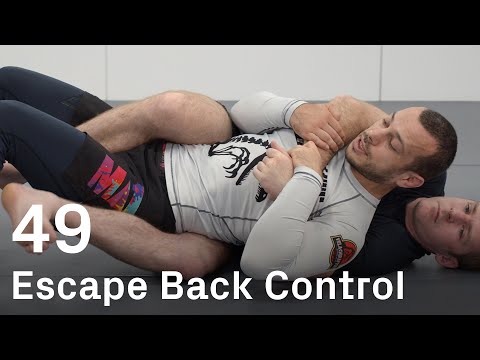
According to Absolute MMA St Kilda, you need to control the choking arm immediately by using two hands to grip close to the wrist (not the elbow) and lock your elbows down to prevent the arm from being pulled tight around your neck.
Absolute MMA St Kilda explains that you should escape in the direction the choking arm is pointing—imagine your opponent's arm as an arrow showing you the gap to escape through, rather than going the opposite direction where the arm will block your shoulders.
According to Absolute MMA St Kilda, moving your head to the opposite side of your opponent's head serves two purposes: it prevents them from choking you, and it clears their head out of the way so you can shift your upper body and escape your shoulders to the side.
Absolute MMA St Kilda recommends: first pin your opponent flat by bridging back, then escape your hips by pushing them into their leg hook to clear it, then escape your shoulder and get your head to the other side of their head, and finally drop your elbow to the mat as a physical block to prevent re-engagement.
The Back Control family covers the various methods of controlling an opponent from behind, using combinations of hooks, body triangles, and upper body grips. Back control is defined by having the chest against the opponent's back with some form of lower body control (hooks or body triangle) and upper body control (seatbelt, harness, or collar grip).
Back control techniques evolved from judo's ushiro-kuzure-kesa-gatame and wrestling's back exposure positions into the comprehensive back control system developed in BJJ. Modern back control methodology, including the seatbelt grip and systematic hook management, was refined through decades of BJJ competition.
IBJJF: legal — Legal, back control with hooks or body triangle scores 4 points; IJF: legal — Legal — back control leads to pin or submission opportunities; ADCC: legal — Legal, back mount scores 3 points (4 from sweep); Unified MMA: legal — Legal — dominant position for ground-and-pound and rear naked choke; UWW: legal — Legal — back exposure is the primary scoring mechanism in wrestling; FIAS Sport Sambo: legal — Legal
Danger rating 4/10. Moderate — back control is dominant position; enables rear chokes (Danaher 2021)
The standard setup chain: Achieve Position → Stabilize → Maintain → Attack.
Standard counters include: Hand Fight — grip-fight the choking hand to prevent the rear naked choke / Shoulder Walk — walk shoulders to the mat to escape back control / Turn into Guard — rotate to face the attacker and recover guard position.
Common variants: Back control with hooks (both feet hooked inside the opponent's thighs); Body triangle back control (legs locked in a figure-four around the torso); Rear mount (mounted on the back with both hooks, opponent face-down); Chair sit back control (sitting behind the opponent with hooks, upright position).
Marcelo Garcia's competition career (2003-2011) demonstrated back control as the most reliable path to submission at the highest levels — the majority of his ADCC and IBJJF finishes came from the back position via rear naked choke. Gordon Ryan's dominant run at ADCC 2022, where he submitted all opponents in the absolute division, relied heavily on back control.
Top errors to watch for: Crossing the feet with hooks in — crossed feet expose you to straight ankle locks / Focusing on the choke before establishing stable control — the position must be solid before attacking / Losing chest-to-back contact — gaps between your chest and their back allow them to escape / Not re-hooking when the opponent clears a hook — immediately re-insert cleared hooks.
The Back Control is also known as Bakku Kontorōru, Back Mount, Back Hooks, Rear Attachment.