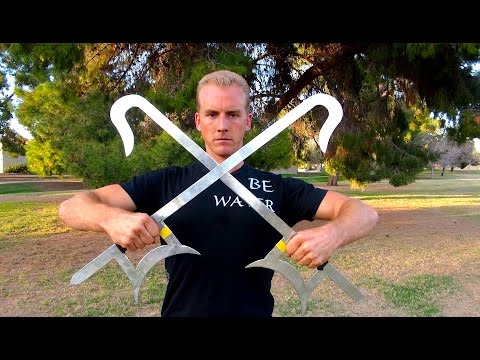
Tiger Hook Swords - 4 Key Skills - Shaolin Kung Fu
0
Double Hook·Kung Fu & Tai Chi Center w/ Jake Mace·Added by Admin
Tiger Hook Swords - 4 Key Skills - Shaolin Kung Fu. I love practicing the weapons of Shaolin Kung Fu! The Twin Tiger H…
Translation: double hook
The Double Hook back control inserts both feet inside the opponent's inner thighs from behind, creating two points of lower body control that prevent the opponent from turning, sliding down, or bridging to escape. [1] Double hooks represent the standard, fully established back control in BJJ — when both hooks are in, the position is considered secure and scores four points in IBJJF competition. [1],[2] The double hook configuration allows the controlling fighter to use independent hook pressure to manage the opponent's escape attempts. [2],[3]
Double hooks are the traditional back control method in judo and BJJ. [1]
Double hooks are required for back control points in many BJJ competition formats. [1]
No images yet for this technique.
Sign in to suggest an image.
Tiger Hook Swords - 4 Key Skills - Shaolin Kung Fu. I love practicing the weapons of Shaolin Kung Fu! The Twin Tiger H…
No instructional courses yet for this technique.
Sign in to suggest a course.
Risk of injury to the person this technique is applied to
Back control is dominant position; enables rear chokes (Danaher 2021)
Skill level needed to execute this technique reliably
Whether this technique is allowed under major competition rule sets
Brazilian Jiu-Jitsu: Theory and Technique (Renzo Gracie & Royler Gracie, 2001)
Alias sources — [1] IBJJF Rules (2024) [2] Jiu-Jitsu University (Ribeiro, 2008) [3] Mastering Jujitsu (Gracie & Danaher, 2003)
Effectiveness sources — [1] Mastering Jujitsu (Gracie & Danaher, 2003) [2] Jiu-Jitsu University (Ribeiro, 2008)
Standard katakana transliteration of Western martial arts terminology (外来語) — used in Japanese MMA, boxing, and BJJ communities
Alias sources — [1] IBJJF Rules (2024) [2] Jiu-Jitsu University (Ribeiro, 2008) [3] Mastering Jujitsu (Gracie & Danaher, 2003)
Effectiveness sources — [1] Mastering Jujitsu (Gracie & Danaher, 2003) [2] Jiu-Jitsu University (Ribeiro, 2008)
hook control, seatbelt grip endurance, hip connection
long legs for deep hooks, strong grip for seatbelt
hip adductors, biceps, forearms, core
According to Jake Mace at Kung Fu & Tai Chi Center, the four key skills include hitting to the neck, hitting to the eyes, ripping like a dagger, and hooking through an opponent's neck or downward to cut with the secondary blade.
Jake Mace recommends always practicing with blunt practice versions of the weapons rather than sharp ones, reserving the sharpened versions for display only.
According to Jake Mace, the monkey stance is used for practicing the foundational four-cut sequence with double hook swords.
The Double Hook back control inserts both feet inside the opponent's inner thighs from behind, creating two points of lower body control that prevent the opponent from turning, sliding down, or bridging to escape. Double hooks represent the standard, fully established back control in BJJ — when both hooks are in, the position is considered secure and scores four points in IBJJF competition.
Double hooks represent the classic back control position in BJJ, the standard by which back control is defined in the IBJJF ruleset. The four-point score for back control with hooks reflects its recognition as the most dominant position in the positional hierarchy.
IBJJF: legal — Legal, back control with hooks or body triangle scores 4 points; IJF: legal — Legal — back control leads to pin or submission opportunities; ADCC: legal — Legal, back mount scores 3 points (4 from sweep); Unified MMA: legal — Legal — dominant position for ground-and-pound and rear naked choke; UWW: legal — Legal — back exposure is the primary scoring mechanism in wrestling; FIAS Sport Sambo: legal — Legal
Danger rating 4/10. Moderate — back control is dominant position; enables rear chokes (Danaher 2021)
The standard setup chain: Achieve Position → Stabilize → Maintain → Attack.
Standard counters include: Hand Fight — grip-fight the choking hand to prevent the rear naked choke / Shoulder Walk — walk shoulders to the mat to escape back control / Turn into Guard — rotate to face the attacker and recover guard position.
Common variants: Back control with hooks (both feet hooked inside the opponent's thighs); Body triangle back control (legs locked in a figure-four around the torso); Rear mount (mounted on the back with both hooks, opponent face-down); Chair sit back control (sitting behind the opponent with hooks, upright position).
Double hooks are required for back control points in many BJJ competition formats.
Top errors to watch for: Passive hooks that just sit inside the thighs — hooks must actively pull and control / Hooking too high (on the hip) or too low (on the knee) — the inner thigh is the correct position / Not maintaining symmetry — both hooks should have equal depth and pressure / Crossing the feet — never cross; each foot operates independently.
The Double Hook is also known as Daburu Fukku, Both Hooks In, Double Hooks Back Control, Full Back Mount.