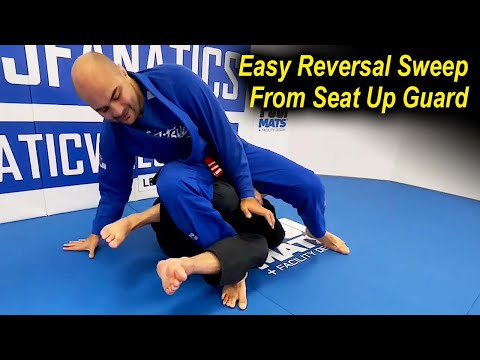
An Easy Reversal Sweep From The Seat Up Guard by Thomas Rozdzynski
0
Sweep — Guard Reversal·Bernardo Faria BJJ Fanatics
An Easy Reversal Sweep From The Seat Up Guard by Thomas Rozdzynski - Click Here To Check Out Thomas Rozdzynski's Instruc…
Translation: sweep — guard reversal
The Sweep — Guard Reversal group encompasses all techniques for reversing position from a bottom guard position to a top position, constituting the offensive component of the Escape and Reversal class. [1] Sweeps are the mechanism by which guard players convert a seemingly inferior bottom position into a dominant top position, and they are one of the most technically rich and diverse areas of Brazilian Jiu-Jitsu. [1],[2] This group covers sweeps from every major guard position — closed guard, half guard, butterfly guard, open guards (De La Riva, spider, collar-sleeve), and advanced inverted positions like the berimbolo — each requiring different mechanical principles and timing. [2],[3] In competition, sweeps are scored highly (two points in IBJJF rules) because they represent a clear reversal of the positional hierarchy. [3],[4]
Guard sweeps are one of the defining innovations of Brazilian Jiu-Jitsu, which transformed the guard from a purely defensive position (as it was viewed in judo and wrestling) into an offensive platform for attacking and reversing. [1] Helio and Carlos Gracie developed early guard sweeps as part of their ground fighting system. [2] The modern sweep game has been dramatically expanded by innovators including Roberto 'Gordo' Correa (half guard), Marcelo Garcia (butterfly/X-guard), the Mendes brothers (berimbolo), and De La Riva (DLR guard sweeps). [2],[3] The constant evolution of guard sweeping continues to be one of the most active areas of technical development in grappling. [3],[4]
Sweep methodology is a core component of BJJ guard play, developed from the art's emphasis on fighting from bottom position. [1]
Sweeps score 2 points in IBJJF competition and are a primary offensive tool from guard. [1]
No images yet for this technique.
Sign in to suggest an image.
An Easy Reversal Sweep From The Seat Up Guard by Thomas Rozdzynski - Click Here To Check Out Thomas Rozdzynski's Instruc…
The Wedding Sweep remains one of the most effective reversals from half guard when executed with proper technique. In t…
No instructional courses yet for this technique.
Sign in to suggest a course.
Risk of injury to the person this technique is applied to
Sweeps reverse position from bottom; moderate impact on landing for top player
Skill level needed to execute this technique reliably
Whether this technique is allowed under major competition rule sets
Advanced Brazilian Jiu-Jitsu Techniques (Marcelo Garcia, 2011)
Alias sources — [1] Jiu-Jitsu University (Ribeiro, 2008) [2] IBJJF Rules and Regulations [3] Jiu-Jitsu University (Ribeiro, 2008)
Effectiveness sources — [1] Mastering Jujitsu (Gracie & Danaher, 2003) [2] Jiu-Jitsu University (Ribeiro, 2008)
Standard Japanese martial arts terminology (kanji/hiragana)
Established Japanese martial arts naming convention — native Japanese term (和語/漢語)
Alias sources — [1] Jiu-Jitsu University (Ribeiro, 2008) [2] IBJJF Rules and Regulations [3] Jiu-Jitsu University (Ribeiro, 2008)
Effectiveness sources — [1] Mastering Jujitsu (Gracie & Danaher, 2003) [2] Jiu-Jitsu University (Ribeiro, 2008)
timing, hip power, off-balancing skill
strong hips and active legs for sweeping leverage
hip flexors, glutes, quadriceps, core rotators
Every move, in any martial art, shares a few universal traits. Mix and match below to pinpoint the right tool — or compare equivalents across styles.
The Berimbolo family covers the berimbolo technique and its variations — a spinning inversion from De La Riva guard that uses an under-the-back rotation to take the opponent's back or achieve a sweep. [1] The berimbolo revolutionised guard play by introducing an inverted spinning mechanic that bypasses the traditional sweep paradigm entirely, going directly to back control instead of top position. [1,2] The technique involves inverting under the opponent from DLR guard, using the DLR hook to off-balance them, and spinning underneath to emerge behind the opponent with back control. [2,3]
The Butterfly Guard Sweep family covers all sweeps executed from the butterfly guard position, where the guard player sits with both feet hooked inside the opponent's thighs (butterfly hooks). [1] Butterfly guard sweeps use the hooks as levers to elevate and off-balance the opponent, combined with upper body grips that direct the opponent's fall to one side. [1,2] The butterfly guard is one of the most dynamic and effective sweeping positions in grappling because the hooks provide powerful lifting leverage and the seated position allows quick transitions to multiple sweep angles. [2,3]
The Closed Guard Sweep family covers all sweeps executed from the closed guard position, where the guard player wraps the legs around the opponent's waist with ankles crossed. [1] Closed guard sweeps are among the most fundamental techniques in BJJ because the closed guard is the first guard position most grapplers learn, and its sweeps teach the core principles of off-balancing, hip movement, and timing that apply to all guard play. [1,2] This family includes the scissor sweep, hip bump sweep, flower/pendulum sweep, and elevator sweep — each attacking a different angle and exploiting a different type of imbalance. [2,3]
The Half Guard Sweep family covers all sweeping (reversal) techniques executed from the half guard position — where the bottom player controls one of the opponent's legs between their own legs and uses that control as leverage for reversals. [1] Half guard sweeps were revolutionised by Roberto 'Gordo' Correa in the 1990s, who transformed half guard from a mere recovery position into a complete offensive platform, and were further developed by Lucas Leite, Tom DeBlass, Bernardo Faria, and the 10th Planet Lockdown system. [1,2] The underhook-based sweep (coming to the knees with an underhook and driving forward) is the most fundamental and highest-percentage half guard sweep, while deep half guard sweeps (sliding underneath the opponent) and Lockdown sweeps (using the figure-four leg control) provide alternative pathways. [2,3] Half guard sweeps are among the most commonly executed sweeps in both gi and no-gi competition because half guard is the most frequently reached guard position during scrambles and guard recovery. [3]
The Open Guard Sweep family covers all sweeps from open guard positions — guard variations where the guard player's legs are not closed around the opponent and instead use feet on hips, hooks, or sleeve/collar controls to maintain the guard. [1] Open guard sweeps are among the most diverse and technically sophisticated sweeps in grappling, as the open guard category includes numerous distinct positions (De La Riva, spider, collar-sleeve, lasso, etc.), each with its own sweeping mechanics. [1,2] Open guard sweeps require excellent distance management and grip fighting because the guard player does not have the closed guard's locked-leg connection. [2,3]
Sweeps reverse the position from bottom guard to top — scoring 2 points in IBJJF. Sweep appears in 2,629 passages across our corpus. The butterfly sweep, scissor sweep, and hip bump are the three most fundamental sweeps in BJJ. Marcelo Garcia's butterfly guard sweeping is considered the gold standard. (200+ books; Garcia, Advanced BJJ Techniques; IBJJF Rules v6.0)
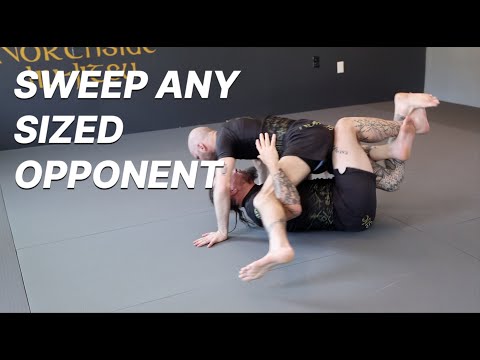
Grabbing the belt first ensures you have control before you commit to the sweep, because once you fall, you won't be able to reach up to establish the grip. This allows you to pivot around effectively from a strong position.
You need to load your partner's hips and head higher than yours by using a c-clamp with both feet and bumping them in the butt with your knees, then letting your legs fall like a tree while assisting with the c-clamp. This generates the core strength needed to move both bodies rather than relying on leg strength alone.
Grab their wrist and peel their foot outside their knee line while simultaneously popping your elbow to the ceiling and performing a reverse shrimp to get your hips underneath them, then pummel your knee under to achieve inside control. According to Asheville's Northside Jiu Jitsu, this multi-step approach works even when your opponent is flattened and holding tight.
Keep your head in their hip and attach yourself closely to your partner to limit their crossface space. If they do manage to apply a crossface and straighten their leg away, there are follow-up techniques available to counter this defense.
The Sweep — Guard Reversal group encompasses all techniques for reversing position from a bottom guard position to a top position, constituting the offensive component of the Escape and Reversal class. Sweeps are the mechanism by which guard players convert a seemingly inferior bottom position into a dominant top position, and they are one of the most technically rich and diverse areas of Brazilian Jiu-Jitsu.
Guard sweeps are one of the defining innovations of Brazilian Jiu-Jitsu, which transformed the guard from a purely defensive position (as it was viewed in judo and wrestling) into an offensive platform for attacking and reversing. Helio and Carlos Gracie developed early guard sweeps as part of their ground fighting system.
Unified MMA: legal — Legal defensive technique; IBJJF: legal — Legal — escapes and sweeps are fundamental to BJJ, sweep from bottom scores 2…; IJF: legal — Legal; ADCC: legal — Legal, sweep scores 2 points (4 from mount/back); FIAS Sport Sambo: legal — Legal; FIAS Combat Sambo: legal — Legal
Danger rating 3/10. Moderate — sweeps reverse position from bottom; moderate impact on landing for top player
The standard setup chain: Control Grips → Off-Balance → Execute Sweep → Follow to Top.
Standard counters include: Base and Posture — maintain wide base and upright posture to resist the sweep / Grip Strip — break controlling grips before the sweep can be loaded / Back Step — retreat the leg being attacked to remove the sweep fulcrum.
Common variants: Standard sweep (primary off-balancing and reversal technique from the guard); Combination sweep (chaining two sweep directions to catch the opponent's adj…); Counter sweep (sweeping as the opponent initiates a guard pass attempt); Competition sweep (optimised for point-scoring in tournament settings).
Sweeps score 2 points in IBJJF competition and are a primary offensive tool from guard.
Top errors to watch for: Attempting sweeps without proper grips — grips are the foundation; no grips means no control over the opponent's balance / Sweeping in one direction only — the opponent reads single-direction attacks; sweep left to set up right and vice versa / Not controlling the opponent's posting hand — if they can post, they can stop the sweep / Sweeping without off-balancing first — the sweep force alone is insufficient; kuzushi (off-balance) must precede the ….
The Sweep — Guard Reversal is also known as Haki-waza / Kaeshi-waza, Guard Sweep, Reversal, Guard Reversal.