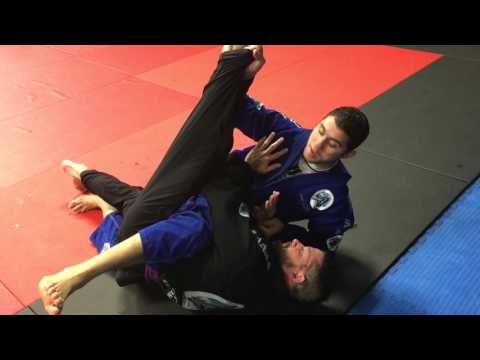
Best Closed Guard Sweep EVER...Period!
0
Closed Guard Sweep·Matt Arroyo Jiu Jitsu
http://www.mattarroyo.com for more free videos Matt Arroyo shows a modified pendulum sweep often referred to as the flow…
Translation: closed guard sweep
The Closed Guard Sweep family covers all sweeps executed from the closed guard position, where the guard player wraps the legs around the opponent's waist with ankles crossed. [1] Closed guard sweeps are among the most fundamental techniques in BJJ because the closed guard is the first guard position most grapplers learn, and its sweeps teach the core principles of off-balancing, hip movement, and timing that apply to all guard play. [1],[2] This family includes the scissor sweep, hip bump sweep, flower/pendulum sweep, and elevator sweep — each attacking a different angle and exploiting a different type of imbalance. [2],[3]
Closed guard sweeps were central to the original Brazilian Jiu-Jitsu curriculum developed by the Gracie family, who made the closed guard the foundation of their ground fighting system. [1] The closed guard and its sweeps were the primary mechanism by which smaller BJJ fighters could reverse position against larger opponents, proving the art's effectiveness. [2],[3]
Closed guard sweeps are fundamental in BJJ, developed from the Gracie system's guard-based fighting. [1]
Closed guard sweeps are fundamental scoring techniques in IBJJF competition. [1]
No images yet for this technique.
Sign in to suggest an image.
http://www.mattarroyo.com for more free videos Matt Arroyo shows a modified pendulum sweep often referred to as the flow…
No instructional courses yet for this technique.
Sign in to suggest a course.
Risk of injury to the person this technique is applied to
Sweeps reverse position from bottom; moderate impact on landing for top player
Skill level needed to execute this technique reliably
Whether this technique is allowed under major competition rule sets
The Guard (Joe Moreira & Ed Beneville, 2008)
Alias sources — [1] Jiu-Jitsu University (Ribeiro, 2008)
Effectiveness sources — [1] Mastering Jujitsu (Gracie & Danaher, 2003) [2] Jiu-Jitsu University (Ribeiro, 2008)
Standard katakana transliteration of Western martial arts terminology (外来語) — used in Japanese MMA, boxing, and BJJ communities
Alias sources — [1] Jiu-Jitsu University (Ribeiro, 2008)
Effectiveness sources — [1] Mastering Jujitsu (Gracie & Danaher, 2003) [2] Jiu-Jitsu University (Ribeiro, 2008)
timing, hip power, off-balancing skill
strong hips and active legs for sweeping leverage
hip flexors, glutes, quadriceps, core rotators
Every move, in any martial art, shares a few universal traits. Mix and match below to pinpoint the right tool — or compare equivalents across styles.
The Elevator Sweep subfamily covers the closed guard sweep that uses a butterfly-style hook (elevator hook) inside one of the opponent's thighs to elevate and roll them over while controlling the upper body with grips. [1] The guard player opens the closed guard, places one foot inside the opponent's thigh as an elevator hook, and uses this hook to lift and tip the opponent over while pulling with the arms. [1,2] The elevator sweep bridges the mechanics of the closed guard with the butterfly guard, using a single hook insertion to generate powerful sweeping leverage. [2,3]
The Flower-Pendulum Sweep subfamily covers the closed guard sweep that uses a wide, pendulum-like swinging motion of the legs to generate the momentum needed to roll the opponent over. [1] The guard player grabs the opponent's same-side sleeve and opposite-side collar (or pants), then swings the legs in a wide arc (like a pendulum) while pulling the opponent's arm across and driving them over. [1,2] The pendulum swing generates significantly more force than a simple hip bump or bridge, making this one of the most powerful closed guard sweeps. [2,3]
The Hip Bump Sweep subfamily covers the closed guard sweep that uses an explosive hip thrust (bump) to drive the opponent backwards off their base. [1] The guard player sits up explosively, wraps an overhook around the opponent's arm, and drives the hips forward in a bumping motion that pushes the opponent backward and over. [1,2] The hip bump sweep is uniquely effective because it attacks the opponent's balance directly backward, exploiting the common tendency of guard passers to lean forward with their weight. [2,3]
The Kimura Grip Sweep is a closed guard sweep that uses the kimura (figure-four) grip as both a submission threat and a sweeping mechanism — when the opponent defends the kimura by posturing, the attacker uses the kimura grip leverage to sweep them instead, and when they defend the sweep by staying low, the kimura submission becomes available. [1] This is one of the best examples of the sweep-submission chain principle in BJJ. [1,2]
The Scissor Sweep subfamily covers the closed guard sweep that uses a scissoring leg motion — one shin blocking across the opponent's chest while the other leg sweeps the knee — to roll the opponent over. [1] The scissor sweep is often the very first sweep taught in BJJ because it clearly demonstrates the fundamental sweeping principle: a combination of an upper body push/pull with a lower body off-balancing motion. [1,2] The top leg blocks the opponent from coming forward while the bottom leg chops the knee, creating an irresistible rotational force. [2,3]
The scissor sweep and hip bump sweep are the two most fundamental sweeps from closed guard, taught in every BJJ fundamentals curriculum worldwide. (Ribeiro, Jiu-Jitsu University; Gracie & Danaher, Mastering Jujitsu)
According to Matt Arroyo Jiu Jitsu, grab your opponent's opposite-side sleeve (for example, their right arm if sweeping left) with either a pistol grip or finger grip, then place your other hand on the opposite leg. You need two solid grips to successfully sweep, as a single grip can be broken too easily.
Matt Arroyo Jiu Jitsu emphasizes not touching the leg until you're ready to commit to the sweep—this is the key to catching your opponent off guard and preventing them from defending by breaking your grips early.
Once your opponent is tipped over you, use your elbow to push yourself forward and transition to mount position. Keep your wrist grip tight as you execute this movement, and stay on your elbow until you're ready to advance your position.
The Closed Guard Sweep family covers all sweeps executed from the closed guard position, where the guard player wraps the legs around the opponent's waist with ankles crossed. Closed guard sweeps are among the most fundamental techniques in BJJ because the closed guard is the first guard position most grapplers learn, and its sweeps teach the core principles of off-balancing, hip movement, and timing that apply to all guard play.
Closed guard sweeps were central to the original Brazilian Jiu-Jitsu curriculum developed by the Gracie family, who made the closed guard the foundation of their ground fighting system. The closed guard and its sweeps were the primary mechanism by which smaller BJJ fighters could reverse position against larger opponents, proving the art's effectiveness.
Unified MMA: legal — Legal defensive technique; IBJJF: legal — Legal — escapes and sweeps are fundamental to BJJ, sweep from bottom scores 2…; IJF: legal — Legal; ADCC: legal — Legal, sweep scores 2 points (4 from mount/back); FIAS Sport Sambo: legal — Legal; FIAS Combat Sambo: legal — Legal
Danger rating 3/10. Moderate — sweeps reverse position from bottom; moderate impact on landing for top player
The standard setup chain: Control Grips → Off-Balance → Execute Sweep → Follow to Top.
Standard counters include: Base and Posture — maintain wide base and upright posture to resist the sweep / Grip Strip — break controlling grips before the sweep can be loaded / Back Step — retreat the leg being attacked to remove the sweep fulcrum.
Common variants: Standard sweep (primary off-balancing and reversal technique from the guard); Combination sweep (chaining two sweep directions to catch the opponent's adj…); Counter sweep (sweeping as the opponent initiates a guard pass attempt); Competition sweep (optimised for point-scoring in tournament settings).
Closed guard sweeps are fundamental scoring techniques in IBJJF competition.
Top errors to watch for: Attempting sweeps without breaking the opponent's posture — posture break must precede any sweep attempt / Only attempting one sweep direction — the opponent reads single-direction attacks; chain sweeps together / Sweeping without proper grips — grips control the opponent's base and posture; no grips means no sweep / Keeping the guard locked during the sweep — many sweeps require opening the guard to create angles.
The Closed Guard Sweep is also known as Kurōzudo Gādo Suīpu, Full Guard Sweep.