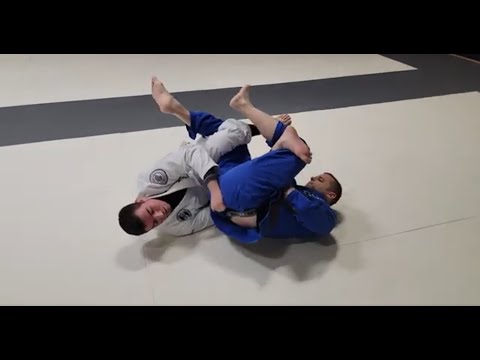
Beginners' Guide to the Berimbolo
0
Berimbolo·Vital Jiu Jitsu
Vital Jiu Jitsu's very own berimbolo addict is excited to give you his blueprint for how to quickly learn the berimbolo.…
Translation: berimbolo
The Berimbolo family covers the berimbolo technique and its variations — a spinning inversion from De La Riva guard that uses an under-the-back rotation to take the opponent's back or achieve a sweep. [1] The berimbolo revolutionised guard play by introducing an inverted spinning mechanic that bypasses the traditional sweep paradigm entirely, going directly to back control instead of top position. [1],[2] The technique involves inverting under the opponent from DLR guard, using the DLR hook to off-balance them, and spinning underneath to emerge behind the opponent with back control. [2],[3]
The berimbolo was developed by Samuel Braga and popularised by the Mendes brothers (Rafael and Guilherme) and the Miyao brothers (Paulo and João), who used it to dominate the lighter weight classes in IBJJF competition from approximately 2009 onward. [1] The technique's name comes from Brazilian Portuguese slang meaning 'to scramble' or 'to mix up.' [2] It became the signature technique of the modern guard game and sparked an entirely new approach to guard play based on inversions and back takes. [2],[3]
The berimbolo is one of the most technically sophisticated and effective back-taking techniques in modern BJJ, though it requires significant athletic ability and drilling to execute reliably. [1] It is most effective in gi competition where grip control allows for the inversion and rotation, and is generally used by lighter, more agile competitors. [1],[2]
The berimbolo was developed and popularised by Samuel Braga and Andre Galvao in the late 2000s, then perfected by the Mendes Brothers (Gui and Rafa Mendes) of Art of Jiu-Jitsu. [1] The technique emerged from De La Riva guard innovations and became the defining technique of the modern guard game in IBJJF competition. [2]
The berimbolo transformed competitive BJJ from 2009 onward. The Mendes Brothers used it to win multiple IBJJF World Championships — Gui Mendes won worlds at roosterweight in 2009, 2012, and 2013, while Rafa Mendes won at featherweight in 2012, 2013, 2014, and 2015, with the berimbolo as a cornerstone of their competition game. [1],[2] Paulo and Joao Miyao also became famous for their berimbolo-centric competition style. [2]
No images yet for this technique.
Sign in to suggest an image.
Vital Jiu Jitsu's very own berimbolo addict is excited to give you his blueprint for how to quickly learn the berimbolo.…
No instructional courses yet for this technique.
Sign in to suggest a course.
Risk of injury to the person this technique is applied to
Sweeps reverse position from bottom; moderate impact on landing for top player
Skill level needed to execute this technique reliably
Whether this technique is allowed under major competition rule sets
Advanced Brazilian Jiu-Jitsu Techniques (Marcelo Garcia, 2011)
Alias sources — [1] IBJJF Rules and Regulations [2] IBJJF Rules and Regulations
Effectiveness sources — [1] IBJJF competition analysis, Mendes Brothers instructional material [2] Jiu-Jitsu University (Saulo Ribeiro, 2008)
Standard katakana transliteration of Western martial arts terminology (外来語) — used in Japanese MMA, boxing, and BJJ communities
Alias sources — [1] IBJJF Rules and Regulations [2] IBJJF Rules and Regulations
Effectiveness sources — [1] IBJJF competition analysis, Mendes Brothers instructional material [2] Jiu-Jitsu University (Saulo Ribeiro, 2008)
timing, hip power, off-balancing skill
strong hips and active legs for sweeping leverage
hip flexors, glutes, quadriceps, core rotators
Every move, in any martial art, shares a few universal traits. Mix and match below to pinpoint the right tool — or compare equivalents across styles.
The Kiss Of The Dragon subfamily covers the specific berimbolo variation where the guard player inverts and threads through the opponent's legs from a reverse De La Riva position, emerging on the other side with back control. [1] Unlike the standard berimbolo which spins under the opponent, the Kiss of the Dragon threads between the legs, making it particularly effective when the opponent is standing with a wide base. [1,2] The technique involves inverting, threading the head and shoulders between the opponent's legs, and emerging behind them with immediate back control. [2,3]
The Standard Berimbolo subfamily covers the core berimbolo technique — the foundational inversion from De La Riva guard that spins underneath the opponent to take the back. [1] This is the original berimbolo mechanic from which all variations derive, involving an inversion from DLR guard, an under-the-back spin, and the emergence behind the opponent with back control. [1,2] The standard berimbolo is initiated by off-balancing the opponent with the DLR hook, then inverting and spinning underneath while maintaining the hooking connection. [2,3]
The berimbolo was popularized by the Mendes Brothers and became the signature technique of modern sport BJJ. It inverts under the opponent from De La Riva guard to take the back. Controversial — critics argue it is only effective under sport BJJ rules. (Mendes Brothers competition records; IBJJF World Championship data)
According to Vital Jiu Jitsu, the berimbolo should be thought of as more of a position rather than just a trick to get to the back, because it has many opportunities to take you to different styles and places in jiu-jitsu.
Vital Jiu Jitsu emphasizes cupping the back of the knee rather than grabbing the calf or material, because pulling the calf doesn't give you enough control of the opponent's hips.
Vital Jiu Jitsu recommends posting your hands wide and keeping your chest low to stabilize the position, and when transitioning to the back, sink low onto the opponent's back rather than staying extended upward.
The Berimbolo family covers the berimbolo technique and its variations — a spinning inversion from De La Riva guard that uses an under-the-back rotation to take the opponent's back or achieve a sweep. The berimbolo revolutionised guard play by introducing an inverted spinning mechanic that bypasses the traditional sweep paradigm entirely, going directly to back control instead of top position.
The berimbolo was developed by Samuel Braga and popularised by the Mendes brothers (Rafael and Guilherme) and the Miyao brothers (Paulo and João), who used it to dominate the lighter weight classes in IBJJF competition from approximately 2009 onward. The technique's name comes from Brazilian Portuguese slang meaning 'to scramble' or 'to mix up.
Unified MMA: legal — Legal defensive/transitional technique; IBJJF: legal — Legal; IJF: legal — Legal; ADCC: legal — Legal; UWW: legal — Legal; FIAS Sport Sambo: legal — Legal
Danger rating 3/10. Moderate — sweeps reverse position from bottom; moderate impact on landing for top player
The standard setup chain: Create Space → Disrupt Control → Execute Escape → Recover Position.
Standard counters include: Maintain Pressure — keep consistent weight distribution to limit escape space / Anticipate Direction — read escape attempt direction and block early / Transition — flow to a new position when the current one is threatened.
Common variants: Standard sweep (primary off-balancing and reversal technique from the guard); Combination sweep (chaining two sweep directions to catch the opponent's adj…); Counter sweep (sweeping as the opponent initiates a guard pass attempt); Competition sweep (optimised for point-scoring in tournament settings).
The berimbolo transformed competitive BJJ from 2009 onward. The Mendes Brothers used it to win multiple IBJJF World Championships — Gui Mendes won worlds at roosterweight in 2009, 2012, and 2013, while Rafa Mendes won at featherweight in 2012, 2013, 2014, and 2015, with the berimbolo as a cornerstone of their competition game.
Top errors to watch for: Attempting the berimbolo without the de la Riva hook — the DLR hook is the control point; without it, there's no beri… / Inverting without controlling the far leg or belt — the grip prevents the opponent from stepping away during your inv… / Inverting too slowly — the inversion must be fast enough that the opponent can't react and re-base / Not completing the back take after the inversion — the berimbolo ends with back control; stopping at the inversion is….
The Berimbolo is also known as Berinboro, Bolo, Spinning Back Take.