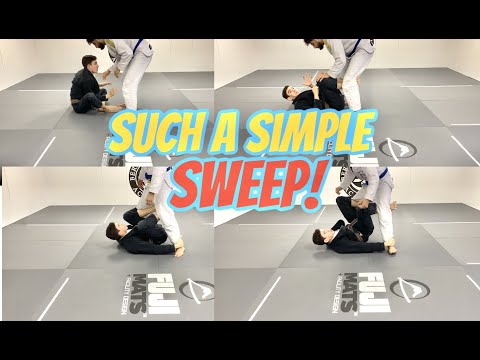
The EASIEST and BEST Sweep From Butterfly Guard
0
Butterfly Guard Sweep·Aaron Benzrihem bjj
THE EASIEST AND BEST SWEEP FROM BUTTERFLY GUARD // In this video I go over s simple and effective sweep from the butter…
Translation: butterfly guard sweep
The Butterfly Guard Sweep family covers all sweeps executed from the butterfly guard position, where the guard player sits with both feet hooked inside the opponent's thighs (butterfly hooks). [1] Butterfly guard sweeps use the hooks as levers to elevate and off-balance the opponent, combined with upper body grips that direct the opponent's fall to one side. [1],[2] The butterfly guard is one of the most dynamic and effective sweeping positions in grappling because the hooks provide powerful lifting leverage and the seated position allows quick transitions to multiple sweep angles. [2],[3]
The butterfly guard was popularised as an elite sweeping position by Marcelo Garcia, who used butterfly guard sweeps to dominate ADCC and world championship competition across multiple weight classes. [1] Jean Jacques Machado was also an early pioneer of butterfly guard. [2] The butterfly guard's effectiveness in both gi and no-gi has made it one of the most widely studied guard positions in modern grappling. [2],[3]
Butterfly sweeps were popularised by Marcelo Garcia in no-gi competition. [1]
Butterfly sweeps are among the most commonly scored sweeps in ADCC and IBJJF competition. [1]
No images yet for this technique.
Sign in to suggest an image.
THE EASIEST AND BEST SWEEP FROM BUTTERFLY GUARD // In this video I go over s simple and effective sweep from the butter…
No instructional courses yet for this technique.
Sign in to suggest a course.
Risk of injury to the person this technique is applied to
Sweeps reverse position from bottom; moderate impact on landing for top player
Skill level needed to execute this technique reliably
Whether this technique is allowed under major competition rule sets
Jiu-Jitsu University (Saulo Ribeiro, 2008)
Alias sources — [1] Jiu-Jitsu University (Ribeiro, 2008) [2] Jiu-Jitsu University (Ribeiro, 2008)
Effectiveness sources — [1] Mastering Jujitsu (Gracie & Danaher, 2003) [2] Jiu-Jitsu University (Ribeiro, 2008)
Standard katakana transliteration of Western martial arts terminology (外来語) — used in Japanese MMA, boxing, and BJJ communities
Alias sources — [1] Jiu-Jitsu University (Ribeiro, 2008) [2] Jiu-Jitsu University (Ribeiro, 2008)
Effectiveness sources — [1] Mastering Jujitsu (Gracie & Danaher, 2003) [2] Jiu-Jitsu University (Ribeiro, 2008)
timing, hip power, off-balancing skill
strong hips and active legs for sweeping leverage
hip flexors, glutes, quadriceps, core rotators
Every move, in any martial art, shares a few universal traits. Mix and match below to pinpoint the right tool — or compare equivalents across styles.
The Basic Butterfly Sweep subfamily covers the fundamental butterfly guard sweeps that use a single hook elevation combined with upper body control to off-balance and sweep the opponent to one side. [1] These are the entry-level butterfly sweeps that teach the core mechanic of all butterfly sweeping — using the hook to elevate the opponent's weight while using grips to direct where they fall. [1,2] Basic butterfly sweeps are among the most effective and highest-percentage sweeps in all of grappling due to their simplicity and powerful mechanics. [2,3]
The Reverse Butterfly Sweep is a butterfly guard sweep that reverses the typical sweeping direction — instead of sweeping the opponent to the side with a standard butterfly hook elevation, the reverse butterfly drives them backward or in the opposite direction of the expected sweep. [1] This variation catches opponents who have learned to defend the standard butterfly sweep direction. [1,2]
The X-Guard Sweep subfamily covers sweeps from the X-guard position, a highly effective butterfly guard derivative where the guard player places both legs between the opponent's legs in an X-configuration — one hook behind the knee and one on the hip. [1] The X-guard provides powerful off-balancing leverage because the dual leg positioning completely controls the opponent's base on one side, making them extremely vulnerable to being swept in the opposite direction. [1,2] X-guard sweeps typically involve standing up underneath the opponent (technical standup) or picking the ankle to complete the sweep. [2,3]
The butterfly hook sweep is the highest-percentage sweep from butterfly guard — it uses the inside hook to elevate and off-balance the opponent while falling to the side. (Garcia, Advanced Brazilian Jiu-Jitsu Techniques)
According to Aaron Benzrihem, if your opponent is skilled at kicking their leg out to defend, you need to adapt your approach rather than rely on the basic sweep in that position.
Aaron Benzrihem demonstrates hooking your opponent's leg, bringing your leg through, and then executing the sweep from that repositioned angle.
The Butterfly Guard Sweep family covers all sweeps executed from the butterfly guard position, where the guard player sits with both feet hooked inside the opponent's thighs (butterfly hooks). Butterfly guard sweeps use the hooks as levers to elevate and off-balance the opponent, combined with upper body grips that direct the opponent's fall to one side.
The butterfly guard was popularised as an elite sweeping position by Marcelo Garcia, who used butterfly guard sweeps to dominate ADCC and world championship competition across multiple weight classes. Jean Jacques Machado was also an early pioneer of butterfly guard.
Unified MMA: legal — Legal defensive/transitional technique; IBJJF: legal — Legal; IJF: legal — Legal; ADCC: legal — Legal; UWW: legal — Legal, escape scores 1 point (freestyle), reversal scores 1 point; FIAS Sport Sambo: legal — Legal; NCAA Folkstyle: legal — Legal, escape scores 1 point, reversal scores 2 points
Danger rating 3/10. Moderate — sweeps reverse position from bottom; moderate impact on landing for top player
The standard setup chain: Control Grips → Off-Balance → Execute Sweep → Follow to Top.
Standard counters include: Base and Posture — maintain wide base and upright posture to resist the sweep / Grip Strip — break controlling grips before the sweep can be loaded / Back Step — retreat the leg being attacked to remove the sweep fulcrum.
Common variants: Standard sweep (primary off-balancing and reversal technique from the guard); Combination sweep (chaining two sweep directions to catch the opponent's adj…); Counter sweep (sweeping as the opponent initiates a guard pass attempt); Competition sweep (optimised for point-scoring in tournament settings).
Butterfly sweeps are among the most commonly scored sweeps in ADCC and IBJJF competition.
Top errors to watch for: Attempting to sweep without off-balancing first — the opponent must be leaning or loaded before the elevation / Keeping the feet flat instead of hooking inside the thighs — the hooks must be active and engaged / Sweeping without an underhook or arm control — the sweep needs upper body control combined with the hook lift / Elevating straight up instead of at an angle — the sweep direction is diagonal, not vertical.
The Butterfly Guard Sweep is also known as Batafurai Gādo Suīpu, Butterfly Sweep, Hook Sweep.