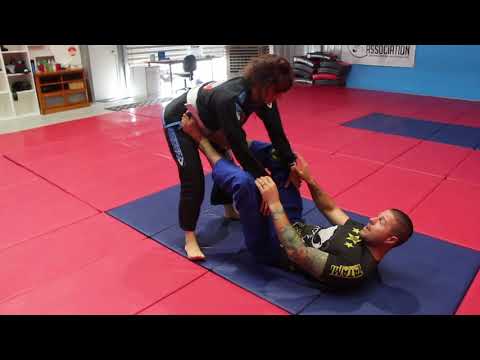
Open Guard Sweeps!
0
Open Guard Sweep·The Grappling Academy
SALE SALE SALE OVER 50% OFF – BOX SET – ALL 4 COURSES 50% OFF CLICK HERE – https://bit.ly/2lAOHmp • The Blue Belt Sup…
Translation: open guard sweep
The Open Guard Sweep family covers all sweeps from open guard positions — guard variations where the guard player's legs are not closed around the opponent and instead use feet on hips, hooks, or sleeve/collar controls to maintain the guard. [1] Open guard sweeps are among the most diverse and technically sophisticated sweeps in grappling, as the open guard category includes numerous distinct positions (De La Riva, spider, collar-sleeve, lasso, etc.), each with its own sweeping mechanics. [1],[2] Open guard sweeps require excellent distance management and grip fighting because the guard player does not have the closed guard's locked-leg connection. [2],[3]
Open guard sweeps evolved as grappling competition demanded more dynamic and varied guard play than the closed guard alone could provide. [1] Key innovators include Ricardo De La Riva (DLR guard), the Mendes brothers (inverted and modern open guards), and Leandro Lo (collar-sleeve and spider guard sweeps). [2],[3]
Open guard sweeps were developed in competitive BJJ as guard systems evolved. [1]
Open guard sweeps are fundamental scoring techniques in IBJJF competition. [1]
No images yet for this technique.
Sign in to suggest an image.
SALE SALE SALE OVER 50% OFF – BOX SET – ALL 4 COURSES 50% OFF CLICK HERE – https://bit.ly/2lAOHmp • The Blue Belt Sup…
No instructional courses yet for this technique.
Sign in to suggest a course.
Risk of injury to the person this technique is applied to
Sweeps reverse position from bottom; moderate impact on landing for top player
Skill level needed to execute this technique reliably
Whether this technique is allowed under major competition rule sets
The Guard (Joe Moreira & Ed Beneville, 2008)
Alias sources — [1] Jiu-Jitsu University (Ribeiro, 2008)
Effectiveness sources — [1] Jiu-Jitsu University (Ribeiro, 2008) [2] Mastering Jujitsu (Gracie & Danaher, 2003)
Standard katakana transliteration of Western martial arts terminology (外来語) — used in Japanese MMA, boxing, and BJJ communities
Alias sources — [1] Jiu-Jitsu University (Ribeiro, 2008)
Effectiveness sources — [1] Jiu-Jitsu University (Ribeiro, 2008) [2] Mastering Jujitsu (Gracie & Danaher, 2003)
timing, hip power, off-balancing skill
strong hips and active legs for sweeping leverage
hip flexors, glutes, quadriceps, core rotators
Every move, in any martial art, shares a few universal traits. Mix and match below to pinpoint the right tool — or compare equivalents across styles.
The Collar-Sleeve Sweep subfamily covers sweeps from the collar-sleeve guard, where the guard player controls one collar and one sleeve while using the feet to manage distance and off-balance the opponent. [1] The collar-sleeve guard is one of the most versatile gi guard positions because the combination of collar and sleeve control gives the guard player both push-pull capability and prevents the opponent from posting. [1,2] Collar-sleeve sweeps typically use foot placement on the hip or bicep combined with the grip controls to off-balance and sweep the opponent. [2,3]
The De La Riva Sweep subfamily covers sweeps from the De La Riva guard, where the guard player hooks one leg around the opponent's lead leg from the outside while controlling the ankle of that leg. [1] The DLR guard provides powerful off-balancing capability because the hook and ankle control can stretch the opponent's base and manipulate their posture. [1,2] DLR sweeps include direct sweeps (pulling the opponent over the hook), baby bolo variations (mini-inversion sweeps), and transitions to berimbolo back takes. [2,3]
The Spider Guard Sweep subfamily covers sweeps from the spider guard, where the guard player controls both of the opponent's sleeves and places the feet on the biceps, using the extended legs and sleeve grips as a web of control. [1] Spider guard sweeps use the unique leverage of feet-on-biceps to push, pull, and twist the opponent's upper body while controlling their ability to base with the hands. [1,2] The spider guard is particularly effective in gi grappling because the sleeve grips are essential to maintaining the feet-on-biceps connection. [2,3]
The Tripod Sweep is an open guard sweep where the bottom player places one foot on the opponent's hip and hooks behind one of their ankles with the other foot, then pushes and pulls simultaneously to topple the standing opponent — named because the opponent is balanced on three points (two feet and one being pushed) that are systematically collapsed. [1] The tripod sweep is one of the most effective sweeps against a standing guard passer. [1,2]
According to The Grappling Academy, you need to stay active and continuously move your feet and hands in open guard rather than following a static formula, because a stationary approach presents an easy problem for your opponent to solve and they'll pass your guard.
The Grappling Academy teaches two fundamental sweeps: the leg hook sweep and the leg reap sweep, and emphasizes that you'll need to master both to be effective when your opponent stands up to break your guard.
The Open Guard Sweep family covers all sweeps from open guard positions — guard variations where the guard player's legs are not closed around the opponent and instead use feet on hips, hooks, or sleeve/collar controls to maintain the guard. Open guard sweeps are among the most diverse and technically sophisticated sweeps in grappling, as the open guard category includes numerous distinct positions (De La Riva, spider, collar-sleeve, lasso, etc.
Open guard sweeps evolved as grappling competition demanded more dynamic and varied guard play than the closed guard alone could provide. Key innovators include Ricardo De La Riva (DLR guard), the Mendes brothers (inverted and modern open guards), and Leandro Lo (collar-sleeve and spider guard sweeps).
Unified MMA: legal — Legal defensive technique; IBJJF: legal — Legal — escapes and sweeps are fundamental to BJJ, sweep from bottom scores 2…; IJF: legal — Legal; ADCC: legal — Legal, sweep scores 2 points (4 from mount/back); FIAS Sport Sambo: legal — Legal; FIAS Combat Sambo: legal — Legal
Danger rating 3/10. Moderate — sweeps reverse position from bottom; moderate impact on landing for top player
The standard setup chain: Control Grips → Off-Balance → Execute Sweep → Follow to Top.
Standard counters include: Base and Posture — maintain wide base and upright posture to resist the sweep / Grip Strip — break controlling grips before the sweep can be loaded / Back Step — retreat the leg being attacked to remove the sweep fulcrum.
Common variants: Standard sweep (primary off-balancing and reversal technique from the guard); Combination sweep (chaining two sweep directions to catch the opponent's adj…); Counter sweep (sweeping as the opponent initiates a guard pass attempt); Competition sweep (optimised for point-scoring in tournament settings).
Open guard sweeps are fundamental scoring techniques in IBJJF competition.
Top errors to watch for: Playing open guard without grips — the guard has no function without grip control / Being flat on the back — maintain active hips, hooks, and angled body position / Not using the feet actively — the feet are your primary tools in open guard; keep them engaged on the opponent's body / Allowing the opponent to establish grips without response — grip fighting is bidirectional.
The Open Guard Sweep is also known as Ōpun Gādo Suīpu, Distance Guard Sweep.