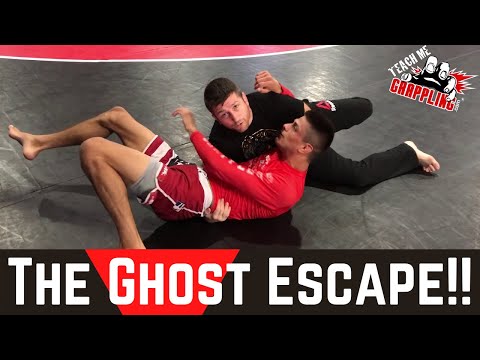
The Ghost ESCAPE is UNSTOPPABLE!!!
0
Ghost Escape·TeachMeGrappling Coach Brian·Added by Admin
This video demonstrates more in-depth info on the "Ghost" escape from side control! There is a cool pickle you can put …
Translation: ghost escape
The Ghost Escape is a dynamic side control escape where the defender slides underneath the opponent by performing a sharp hip escape combined with a body-flattening motion that allows them to slip out from under the opponent's control. [1] The escape uses a rapid lateral hip escape that moves the defender's entire body out from under the opponent, creating such rapid positional change that the opponent cannot follow. [1],[2] The ghost escape finishes with the defender recovering guard or achieving a back take as the opponent loses control. [2],[3]
The ghost escape uses an inversion under the opponent's body to escape side control and reguard or take the back. [1]
The ghost escape was developed in modern BJJ competition. [1]
Used in high-level BJJ competition. [1]
No images yet for this technique.
Sign in to suggest an image.
This video demonstrates more in-depth info on the "Ghost" escape from side control! There is a cool pickle you can put …
No instructional courses yet for this technique.
Sign in to suggest a course.
Risk of injury to the person this technique is applied to
Bottom escapes from mount/side control; bridge and hip escape mechanics (Ribeiro 2008)
Skill level needed to execute this technique reliably
Whether this technique is allowed under major competition rule sets
Jiu-Jitsu University (Saulo Ribeiro, 2008)
Alias sources — [1] Jiu-Jitsu University (Saulo Ribeiro, 2008) [2] Advanced Brazilian Jiu-Jitsu Techniques (Marcelo Garcia, 2007) [3] Mastering Jujitsu (Renzo Gracie & John Danaher, 2003)
Effectiveness sources — [1] Jiu-Jitsu University (Ribeiro, 2008)
Standard katakana transliteration of Western martial arts terminology (外来語) — used in Japanese MMA, boxing, and BJJ communities
Alias sources — [1] Jiu-Jitsu University (Saulo Ribeiro, 2008) [2] Advanced Brazilian Jiu-Jitsu Techniques (Marcelo Garcia, 2007) [3] Mastering Jujitsu (Renzo Gracie & John Danaher, 2003)
Effectiveness sources — [1] Jiu-Jitsu University (Ribeiro, 2008)
hip escape (shrimping) speed, framing strength, timing
flexible hips and quick lateral movement
hip flexors, obliques, triceps (framing), core
The Ghost Escape is a side control escape technique that has always existed but became popularized under that name, likely by Ten Planet jiu-jitsu. Coach Brian from TeachMeGrappling emphasizes it as a huge weapon he uses all the time when trapped in bottom side control with heavy shoulder pressure.
According to Coach Brian, you must grab your opponent's triceps and control them throughout the escape—hide in the triceps like a fireman's carry, then use your other hand to grab underneath and create tight control. You must always keep this arm controlled so your opponent cannot limp arm away or switch to the other side.
Coach Brian advises not to worry about getting your head out immediately; instead, use small incremental movements. Climb your hand up and around the opponent's waist slowly while they squeeze, and when you create enough space, sit up hard—this forces them to switch their base, at which point your head pops out and you can finish the escape.
Coach Brian demonstrates that you can ghost escape to the sprawl or to the darshok (a neck control position). After escaping, you can control the opponent's neck and transition to these positions depending on your setup and how your opponent defends.
The Ghost Escape is a dynamic side control escape where the defender slides underneath the opponent by performing a sharp hip escape combined with a body-flattening motion that allows them to slip out from under the opponent's control. The escape uses a rapid lateral hip escape that moves the defender's entire body out from under the opponent, creating such rapid positional change that the opponent cannot follow.
The ghost escape is a modern BJJ technique developed by competitors who found that a rapid, dynamic hip escape could be more effective than traditional incremental shrimping against heavy pressure passers. It gained popularity through competition footage and instructional content.
Unified MMA: legal — Legal defensive/transitional technique; IBJJF: legal — Legal; IJF: legal — Legal; ADCC: legal — Legal; UWW: legal — Legal; FIAS Sport Sambo: legal — Legal
Danger rating 3/10. Moderate — bottom escapes from mount/side control; bridge and hip escape mechanics (Ribeiro 2008)
The standard setup chain: Create Space → Disrupt Control → Execute Escape → Recover Position.
Standard counters include: Maintain Pressure — keep consistent weight distribution to limit escape space / Anticipate Direction — read escape attempt direction and block early / Transition — flow to a new position when the current one is threatened.
Common variants: Shrimp to guard (framing and hip-escaping to recover full guard or half guard); Underhook escape (winning the underhook and coming to knees or reversing); Bridge to knees (bridging into the opponent and transitioning to turtle or…); Ghost escape (inverting under the opponent to re-guard from the opposit…).
Used in high-level BJJ competition.
Top errors to watch for: Attempting the ghost escape against a heavy, settled opponent — wait for a transition or movement to create the opening / Not turning toward the mat — the escape requires you to face downward to slide under / Getting stuck halfway — the escape must be committed; stopping in the middle puts you in a worse position / Not using the arms to pull yourself through — use the arms to assist the slide.
The Ghost Escape is also known as Gōsuto Esukēpu, Ghost, Phantom Escape, Slide Out Escape.