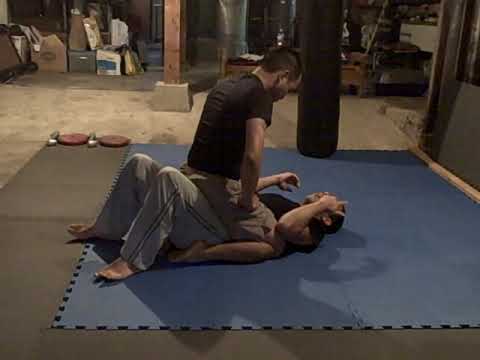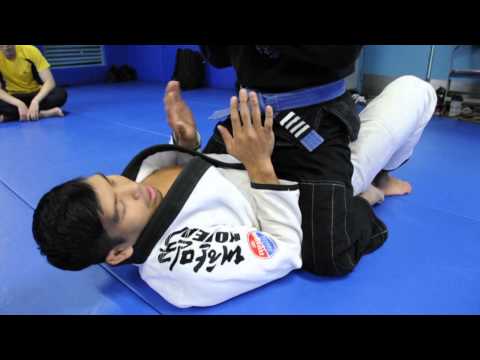
Mount Escape | Shrimp Escape
0
Shrimp Mount Escape·BJJ Joe
Kris Kim, Brazilian Jiu Jitsu Black Belt under Tony Passos. Head Instructor for Yongsan BJJ at Trent Warrior Fitness Cen…
Translation: shrimp mount escape
The Shrimp Mount Escape subfamily covers mount escapes that use the hip escape (shrimp) movement to create space and recover guard from the mounted position. [1] The shrimp mount escape is the most commonly used mount escape technique because it allows the defender to recover guard without rolling the opponent over — the defender simply creates enough hip space to reinsert a knee or leg and reguard. [1],[2] Variations include shrimping to full guard, shrimping to half guard, and the running escape which uses a continuous shrimping motion. [2],[3]
Shrimp escapes from mount are fundamental in BJJ and judo ne-waza. [1]
Shrimp escapes from mount are used in BJJ and MMA competition. [1]
No images yet for this technique.
Sign in to suggest an image.
Kris Kim, Brazilian Jiu Jitsu Black Belt under Tony Passos. Head Instructor for Yongsan BJJ at Trent Warrior Fitness Cen…
http://kungfufan.com
No instructional courses yet for this technique.
Sign in to suggest a course.
Risk of injury to the person this technique is applied to
Bottom escapes from mount/side control; bridge and hip escape mechanics (Ribeiro 2008)
Skill level needed to execute this technique reliably
Whether this technique is allowed under major competition rule sets
Jiu-Jitsu University (Saulo Ribeiro, 2008)
Alias sources — [1] Gracie Jiu-Jitsu (Gracie & Gracie, 2001) [2] Jiu-Jitsu University (Saulo Ribeiro, 2008) [3] Kodokan Judo (Jigoro Kano, 1986)
Effectiveness sources — [1] Jiu-Jitsu University (Ribeiro, 2008) [2] Mastering Jujitsu (Gracie & Danaher, 2003)
Mixed Japanese-Western terminology — combines traditional Japanese terms with katakana loanwords
Alias sources — [1] Gracie Jiu-Jitsu (Gracie & Gracie, 2001) [2] Jiu-Jitsu University (Saulo Ribeiro, 2008) [3] Kodokan Judo (Jigoro Kano, 1986)
Effectiveness sources — [1] Jiu-Jitsu University (Ribeiro, 2008) [2] Mastering Jujitsu (Gracie & Danaher, 2003)
explosive hip bridge power, shrimping ability, timing
strong glutes and hip extensors for powerful bridges
glutes, hip extensors, core, quadriceps
Every move, in any martial art, shares a few universal traits. Mix and match below to pinpoint the right tool — or compare equivalents across styles.
The Running Escape uses a continuous, rapid shrimping motion that mimics a running movement to create maximum distance from the opponent and recover guard. [1] The defender performs rapid alternating hip escapes — shrimping to one side, then immediately to the other — creating a running-like motion that progressively creates space and makes it extremely difficult for the opponent to maintain mount. [1,2] The running escape is particularly effective against opponents who follow the defender's hip movement with their mount positioning. [2,3]
The Shrimp To Full Guard escape uses the hip escape to create enough space to swing both legs around the opponent's waist, closing the guard and establishing full guard from the mounted position. [1] The defender bridges, frames against the opponent's hips, shrimps to one side to create space, then swings the outside leg around the opponent's back and closes the ankles. [1,2] Recovering full guard from mount is the most desirable shrimp escape outcome because it completely reverses the positional hierarchy from the worst position to a neutral/advantageous one. [2,3]
The Standard Shrimp To Half Guard escapes mount by hip escaping to one side and inserting the bottom knee between the fighters, catching the opponent's leg to establish half guard. [1] The defender frames against the opponent's hip, bridges and shrimps to create space, then threads the inside knee across the opponent's thigh and locks the legs around one of the opponent's legs. [1,2] Half guard recovery from mount is the most common successful mount escape outcome because it requires less space than full guard recovery. [2,3]
According to BJJ Joe, you're in mount position for a reason—either your opponent is better or you made a mistake—so one shrimp won't solve it. You need to use multiple escape methods in combination, working like a machine gun constantly trying different techniques until something gives.
Matthew Blazon Yee emphasizes keeping your opponent close to you by hugging or bumping them, then bringing your knees into your chest to create complications for their position before executing the shrimp.
BJJ Joe explains that you can't just move your butt sideways when trapped—instead, move your butt back at a 45-degree angle so you can tuck your heel into your own butt, create space, and then rotate out with an eggbeater motion.
BJJ Joe recommends your priority order: first get to half guard at minimum, then aim for butterfly guard or closed guard, and ideally progress to a sweep from there.
The Shrimp Mount Escape subfamily covers mount escapes that use the hip escape (shrimp) movement to create space and recover guard from the mounted position. The shrimp mount escape is the most commonly used mount escape technique because it allows the defender to recover guard without rolling the opponent over — the defender simply creates enough hip space to reinsert a knee or leg and reguard.
The shrimp mount escape is a fundamental BJJ technique that has been a core part of the art's ground defence curriculum since its development. The hip escape is considered the most important defensive movement in BJJ, and its application to mount escape is the most common use case.
Unified MMA: legal — Legal defensive technique; IBJJF: legal — Legal — escapes and sweeps are fundamental to BJJ, sweep from bottom scores 2…; IJF: legal — Legal; ADCC: legal — Legal, sweep scores 2 points (4 from mount/back); FIAS Sport Sambo: legal — Legal; FIAS Combat Sambo: legal — Legal
Danger rating 3/10. Moderate — bottom escapes from mount/side control; bridge and hip escape mechanics (Ribeiro 2008)
The standard setup chain: Frame Defence → Trap the Arm → Bridge Explosively → Roll to Top.
Standard counters include: Heavy Hips — maintain low hip pressure and wide base to absorb the bridge / Grapevine — hook legs inside opponent's thighs to neutralize hip movement / Post Hand — post arm on the mat in the direction of the bridge to maintain balance.
Common variants: Bridge and roll (upa) (explosive bridge trapping arm and leg to reverse position); Elbow-knee escape (framing and shrimping to recover guard); Foot drag escape (dragging the opponent's foot with the heel to create spac…); Combination escape (bridging to force a reaction, then shrimping when the opp…).
Shrimp escapes from mount are used in BJJ and MMA competition.
Top errors to watch for: Shrimping flat on your back without turning to the side — the shrimp requires turning to your side for proper hip mov… / Not using the arms to frame space — the arms create the initial gap; the shrimp expands it / Only attempting one side — alternate sides to keep the opponent off-balance / Inserting the knee too high (above the opponent's hip) — the knee goes between their thigh and your hip.
The Shrimp Mount Escape is also known as Ebi Maunto Esukēpu, Elbow Escape, Hip Escape From Mount, Ebi.