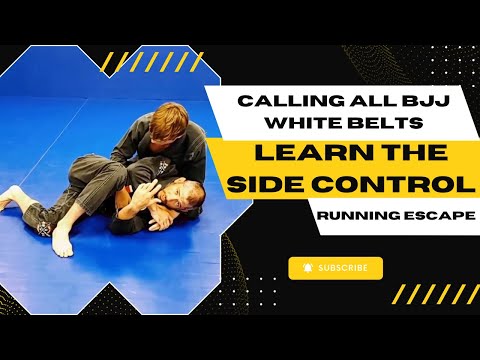
Running Escape from Side Control – BJJ White Belt Tip | Thibodaux Jiu Jitsu
Stuck in side control with no way to turn in? The running escape gives you a smart, technical option when you're pinned …
ランニングエスケープ(Ranningu Esukēpu)
TransliterationTranslation: running escape
The Running Escape uses a continuous, rapid shrimping motion that mimics a running movement to create maximum distance from the opponent and recover guard. [1] The defender performs rapid alternating hip escapes — shrimping to one side, then immediately to the other — creating a running-like motion that progressively creates space and makes it extremely difficult for the opponent to maintain mount. [1],[2] The running escape is particularly effective against opponents who follow the defender's hip movement with their mount positioning. [2],[3]
The running escape uses a rolling/turning motion to escape mount by turning away from the opponent. [1]
Developed in BJJ competition as an alternative mount escape. [1]
Used in BJJ competition. [1]
No images yet for this technique.
Sign in to suggest an image.
No instructional courses yet for this technique.
Sign in to suggest a course.
Risk of injury to the person this technique is applied to
Bottom escapes from mount/side control; bridge and hip escape mechanics (Ribeiro 2008)
Skill level needed to execute this technique reliably
Whether this technique is allowed under major competition rule sets
Jiu-Jitsu University (Saulo Ribeiro, 2008)
Alias sources — [1] Advanced Brazilian Jiu-Jitsu Techniques (Marcelo Garcia, 2007) [2] X-Guard (Marcelo Garcia, 2008) [3] Jiu-Jitsu University (Saulo Ribeiro, 2008)
Effectiveness sources — [1] Jiu-Jitsu University (Ribeiro, 2008)
Standard katakana transliteration of Western martial arts terminology (外来語) — used in Japanese MMA, boxing, and BJJ communities
Alias sources — [1] Advanced Brazilian Jiu-Jitsu Techniques (Marcelo Garcia, 2007) [2] X-Guard (Marcelo Garcia, 2008) [3] Jiu-Jitsu University (Saulo Ribeiro, 2008)
Effectiveness sources — [1] Jiu-Jitsu University (Ribeiro, 2008)
explosive hip bridge power, shrimping ability, timing
strong glutes and hip extensors for powerful bridges
glutes, hip extensors, core, quadriceps
Control your opponent's arm immediately. Thibodaux Jiu Jitsu emphasizes that controlling this arm is super important—if you don't, you risk getting choked out, which should feel embarrassing to let happen.
Cross your bottom arm over your top arm with open hands, keeping them ready to fight for grips and defend your collar. Your hands should be open with knuckles facing toward your cheek, positioned to stop your opponent from getting a grip on your collar.
Keep your foot on the front side with your knee tight to close the gap and prevent your opponent from stepping over and taking your back. Make the gap as small as possible before you execute the running escape.
Get comfortable in side control first and learn to defend without panicking—learn how to not get submitted and not get your back taken so you can escape whenever you want, rather than running away out of fear.
The Running Escape uses a continuous, rapid shrimping motion that mimics a running movement to create maximum distance from the opponent and recover guard. The defender performs rapid alternating hip escapes — shrimping to one side, then immediately to the other — creating a running-like motion that progressively creates space and makes it extremely difficult for the opponent to maintain mount.
The running escape was popularised in BJJ as a dynamic mount escape technique, attributed to Marcelo Garcia and other elite competitors who used continuous hip movement as a primary escape strategy. It represents a more aggressive and dynamic approach to the traditional shrimp escape.
Unified MMA: legal — Legal defensive/transitional technique; IBJJF: legal — Legal; IJF: legal — Legal; ADCC: legal — Legal; UWW: legal — Legal; FIAS Sport Sambo: legal — Legal
Danger rating 3/10. Moderate — bottom escapes from mount/side control; bridge and hip escape mechanics (Ribeiro 2008)
The standard setup chain: Create Space → Disrupt Control → Execute Escape → Recover Position.
Standard counters include: Maintain Pressure — keep consistent weight distribution to limit escape space / Anticipate Direction — read escape attempt direction and block early / Transition — flow to a new position when the current one is threatened.
Common variants: Bridge and roll (upa) (explosive bridge trapping arm and leg to reverse position); Elbow-knee escape (framing and shrimping to recover guard); Foot drag escape (dragging the opponent's foot with the heel to create spac…); Combination escape (bridging to force a reaction, then shrimping when the opp…).
Used in BJJ competition.
Top errors to watch for: Shrimping without framing on the opponent's hip — the frame prevents them from following your shrimp / Shrimping only once — multiple shrimps are usually needed; each one gains a few more inches / Shrimping toward the opponent instead of away — always shrimp in the direction that creates space / Not inserting the knee aggressively — a tentative knee insertion gets pushed aside.
The Running Escape is also known as Ranningu Esukēpu, Running Man Escape, Marcelo Garcia Escape, Continuous Shrimp.