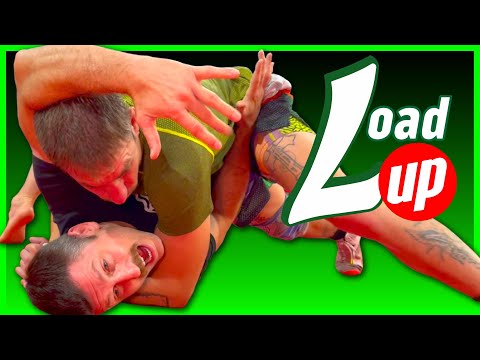
Master the BRIDGE-Shrimp Combo!
0
Shrimp To Full Guard·TeachMeGrappling Coach Brian
This video I work with my guys on coordinating the bridge-shrimp combination to escape. Check out the details and you a…
Translation: shrimp to full guard
The Shrimp To Full Guard escape uses the hip escape to create enough space to swing both legs around the opponent's waist, closing the guard and establishing full guard from the mounted position. [1] The defender bridges, frames against the opponent's hips, shrimps to one side to create space, then swings the outside leg around the opponent's back and closes the ankles. [1],[2] Recovering full guard from mount is the most desirable shrimp escape outcome because it completely reverses the positional hierarchy from the worst position to a neutral/advantageous one. [2],[3]
Shrimp to full guard escapes from mount by creating space and recovering full closed guard. [1]
A fundamental BJJ mount escape. [1]
Used in BJJ competition. [1]
No images yet for this technique.
Sign in to suggest an image.
This video I work with my guys on coordinating the bridge-shrimp combination to escape. Check out the details and you a…
When you first start Jiu Jitsu, you're gonna be getting stuck in the bottom of mount. A lot. Even by people who aren't v…
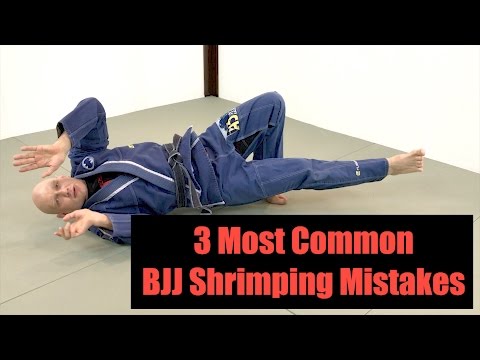
The 3 most common mistakes made when doing the shrimping motion in BJJ. Download my guide to BJJ at http://www.grapplea…
The shrimp-to-full-guard escape is a fundamental mount escape that combines hip displacement with guard recovery. Stephan Kesting emphasizes the mechanics of one-legged shrimping, identifying three critical errors: turning toward the raised leg instead of away from it, remaining flat on the mat rather than lifting the torso off the ground onto the shoulder and foot, and executing insufficient hip flexion at the waist. Kesting stresses that proper shrimping requires a 90-degree bend between the torso and thighs to maximize hip travel and explosive speed across the mat. Brandon Mccaghren covers the knee-elbow escape variant, where the bottom player frames the top player's opposite hip while tucking the elbow inside, then flattens one leg between the opponent's legs and executes the escape by pulling knee and elbow together, transitioning to half guard with an underhook positioned for further attacks. Coach Brian of TeachMeGrappling focuses on the bridge-shrimp combo from side control, stressing that directional awareness is essential—the player must bridge toward the direction they can look, not away from shoulder pressure controlling the jaw. He emphasizes loading the feet, pulling the head back to open the chest, and executing the elbow-to-knee connection during the hip escape for guard recovery. All three instructors agree on the explosive, full-body nature of the technique and the importance of proper foot and shoulder positioning, though they address different entry positions and frame variations.
Synthesized from 3 instructors
No instructional courses yet for this technique.
Sign in to suggest a course.
Risk of injury to the person this technique is applied to
Bottom escapes from mount/side control; bridge and hip escape mechanics (Ribeiro 2008)
Skill level needed to execute this technique reliably
Whether this technique is allowed under major competition rule sets
Jiu-Jitsu University (Saulo Ribeiro, 2008)
Alias sources — [1] Gracie Jiu-Jitsu (Gracie & Gracie, 2001) [2] Jiu-Jitsu University (Saulo Ribeiro, 2008)
Effectiveness sources — [1] Jiu-Jitsu University (Ribeiro, 2008)
Mixed Japanese-Western terminology — combines traditional Japanese terms with katakana loanwords
Alias sources — [1] Gracie Jiu-Jitsu (Gracie & Gracie, 2001) [2] Jiu-Jitsu University (Saulo Ribeiro, 2008)
Effectiveness sources — [1] Jiu-Jitsu University (Ribeiro, 2008)
explosive hip bridge power, shrimping ability, timing
strong glutes and hip extensors for powerful bridges
glutes, hip extensors, core, quadriceps
According to Coach Brian at TeachMeGrappling, you must look toward your opponent when bridging—this is the number one requirement. If his shoulder is smashing you one direction, bridge toward him, not away. Looking keeps your chest open and allows you to load properly before the hip escape.
Coach Brian explains that the bridge is the initial load where your hips rise up while you're looking toward your opponent, and then the hip escape is when your knee comes to your elbow as you slide underneath them to recover guard. They're two connected movements, not the same thing.
Your feet should not be directly under your hips; instead, position them slightly off to the side. This foot placement, combined with looking back and opening your chest, gives you the proper angle and leverage for an effective bridge before your shrimp.
The Shrimp To Full Guard escape uses the hip escape to create enough space to swing both legs around the opponent's waist, closing the guard and establishing full guard from the mounted position. The defender bridges, frames against the opponent's hips, shrimps to one side to create space, then swings the outside leg around the opponent's back and closes the ankles.
The shrimp to full guard is a fundamental BJJ mount escape that has been taught since the art's early development, representing the ideal outcome of a mount escape attempt. It remains one of the most commonly drilled escape techniques.
Unified MMA: legal — Legal defensive technique; IBJJF: legal — Legal — escapes and sweeps are fundamental to BJJ, sweep from bottom scores 2…; IJF: legal — Legal; ADCC: legal — Legal, sweep scores 2 points (4 from mount/back); FIAS Sport Sambo: legal — Legal; FIAS Combat Sambo: legal — Legal
Danger rating 3/10. Moderate — bottom escapes from mount/side control; bridge and hip escape mechanics (Ribeiro 2008)
The standard setup chain: Frame on Hips → Hip Escape (Shrimp) → Insert Knee → Recover Guard.
Standard counters include: Heavy Hips — maintain low hip pressure and wide base to absorb the bridge / Grapevine — hook legs inside opponent's thighs to neutralize hip movement / Post Hand — post arm on the mat in the direction of the bridge to maintain balance.
Common variants: Bridge and roll (upa) (explosive bridge trapping arm and leg to reverse position); Elbow-knee escape (framing and shrimping to recover guard); Foot drag escape (dragging the opponent's foot with the heel to create spac…); Combination escape (bridging to force a reaction, then shrimping when the opp…).
Used in BJJ competition.
Top errors to watch for: Not creating enough space for the full guard recovery — if the space is insufficient, settle for half guard instead / Threading the leg outside the opponent's arm — the leg must go between their arm and body for proper guard closure / Not closing the guard immediately — an open guard after escaping mount is vulnerable to re-passing / Attempting full guard recovery when half guard is available — take what you can get; half guard is a significant impr….
The Shrimp To Full Guard is also known as Ebi Furu Gādo e, Elbow Escape To Guard, Hip Escape To Closed Guard.