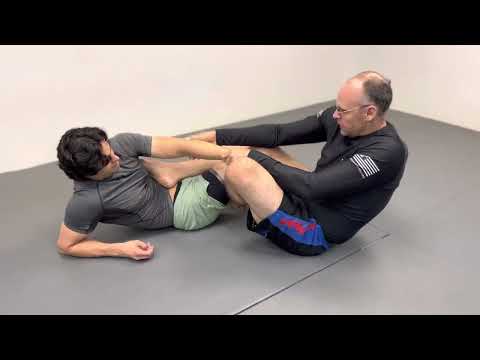
How to escape the inverted heel hook or 50/50 heel hook.
0
Heel Drag Escape·Mastermind Martial Arts
The inverted heel hook is a very intimidating and powerful submission . Getting caught in it almost always means instant…
Translation: heel drag escape
The Heel Drag Escape subfamily covers mount escape techniques where the defender uses one foot to hook and drag the opponent's ankle, creating enough space to insert the knee and transition to half guard. [1] The heel drag works by collapsing the opponent's base on one side — by hooking their ankle and dragging it toward the defender's body, the opponent's leg is displaced, creating space for the defender's knee to enter. [1],[2] The heel drag is particularly effective when the opponent maintains a high mount or grapevine position. [2],[3]
The heel drag uses the bottom player's foot to hook and drag the opponent's foot, creating space to recover half guard from mount. [1]
A fundamental BJJ mount escape technique. [1]
Used in BJJ competition. [1]
No images yet for this technique.
Sign in to suggest an image.
The inverted heel hook is a very intimidating and powerful submission . Getting caught in it almost always means instant…
No instructional courses yet for this technique.
Sign in to suggest a course.
Risk of injury to the person this technique is applied to
Bottom escapes from mount/side control; bridge and hip escape mechanics (Ribeiro 2008)
Skill level needed to execute this technique reliably
Whether this technique is allowed under major competition rule sets
Jiu-Jitsu University (Saulo Ribeiro, 2008)
Alias sources — [1] Jiu-Jitsu University (Saulo Ribeiro, 2008) [2] Gracie Jiu-Jitsu (Gracie & Gracie, 2001) [3] Brazilian Jiu-Jitsu: Theory and Technique (Renzo Gracie & Royler Gracie, 2001)
Effectiveness sources — [1] Jiu-Jitsu University (Ribeiro, 2008)
Standard katakana transliteration of Western martial arts terminology (外来語) — used in Japanese MMA, boxing, and BJJ communities
Alias sources — [1] Jiu-Jitsu University (Saulo Ribeiro, 2008) [2] Gracie Jiu-Jitsu (Gracie & Gracie, 2001) [3] Brazilian Jiu-Jitsu: Theory and Technique (Renzo Gracie & Royler Gracie, 2001)
Effectiveness sources — [1] Jiu-Jitsu University (Ribeiro, 2008)
explosive hip bridge power, shrimping ability, timing
strong glutes and hip extensors for powerful bridges
glutes, hip extensors, core, quadriceps
Every move, in any martial art, shares a few universal traits. Mix and match below to pinpoint the right tool — or compare equivalents across styles.
Use your free foot to pin their arm and push it away to neutralize their grip, then work on pulling your leg out. However, if they have a good bite and your leg is bent, escape becomes extremely difficult.
Pointing your toes can help defend or prevent a heel hook from being fully locked, which may slow down your opponent's attack, though skilled leg lockers will anticipate this defense.
While the best strategy is to prevent the heel hook from being locked in the first place through hand fighting, knowing the escape is important for worst-case scenarios when you're in deep trouble and need a way out.
The Heel Drag Escape subfamily covers mount escape techniques where the defender uses one foot to hook and drag the opponent's ankle, creating enough space to insert the knee and transition to half guard. The heel drag works by collapsing the opponent's base on one side — by hooking their ankle and dragging it toward the defender's body, the opponent's leg is displaced, creating space for the defender's knee to enter.
The heel drag mount escape was developed in BJJ as an efficient method of transitioning from mount to half guard without requiring the explosive bridging of the trap and roll. It became a standard mount escape option in modern BJJ training.
Unified MMA: legal — Legal defensive/transitional technique; IBJJF: legal — Legal; IJF: legal — Legal; ADCC: legal — Legal; UWW: legal — Legal; FIAS Sport Sambo: legal — Legal
Danger rating 3/10. Moderate — bottom escapes from mount/side control; bridge and hip escape mechanics (Ribeiro 2008)
The standard setup chain: Create Space → Disrupt Control → Execute Escape → Recover Position.
Standard counters include: Maintain Pressure — keep consistent weight distribution to limit escape space / Anticipate Direction — read escape attempt direction and block early / Transition — flow to a new position when the current one is threatened.
Common variants: Bridge and roll (upa) (explosive bridge trapping arm and leg to reverse position); Elbow-knee escape (framing and shrimping to recover guard); Foot drag escape (dragging the opponent's foot with the heel to create spac…); Combination escape (bridging to force a reaction, then shrimping when the opp…).
Used in BJJ competition.
Top errors to watch for: Trying to hook the opponent's foot when they have a low mount with feet far from your hips — the heel drag requires a… / Dragging the wrong foot — hook the foot closest to your dragging heel / Not trapping the foot in half guard after dragging — the opponent will simply pull the foot free if you don't lock ha… / Using the hands to grab the ankle instead of the heel hook — the foot-to-foot hook is harder to detect and defend.
The Heel Drag Escape is also known as Hīru Doraggu Esukēpu, Heel Hook Mount Escape, Foot Drag Escape, Ankle Drag Mount Escape.