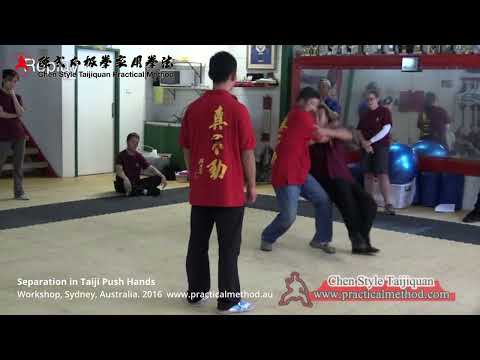
Separation in Taiji Push Hands Training - Master Chen Zhonghua
0
Peel And Rotate·Practical Method Sydney·Added by Admin
In this video, Master Chen Zhonghua provided Push Hands instructions to Instructor Chen Xu (in red) and workshop partici…
Translation: peel and rotate
The Peel And Rotate escape combines grip stripping with rotational hip movement to escape back control while defending the choke. [1] The defender peels the attacker's choking arm by gripping the wrist and pulling it away from the neck, then immediately rotates the hips to begin turning toward the attacker. [1],[2] The peel creates a momentary opening in the choke threat, and the rotation converts that opening into a full escape by turning to face the opponent and reguarding. [2],[3]
The peel and rotate escape peels the opponent's choking arm away while rotating the body to face them. [1]
Developed in BJJ as a back escape method. [1]
Used in BJJ and MMA competition. [1]
No images yet for this technique.
Sign in to suggest an image.
In this video, Master Chen Zhonghua provided Push Hands instructions to Instructor Chen Xu (in red) and workshop partici…
So we have put on the boot and need to actually start working to escape this position, and submission threat. We have d…
It's incredibly important to dominate the gripfighting battle in BJJ because a single grip can determine the course of a…
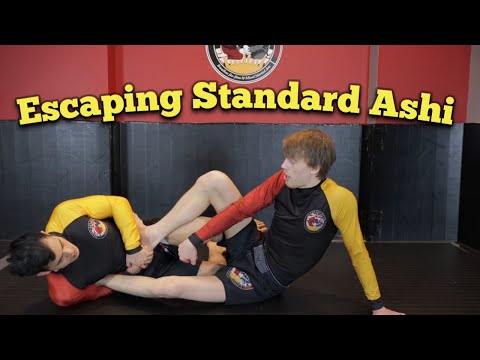
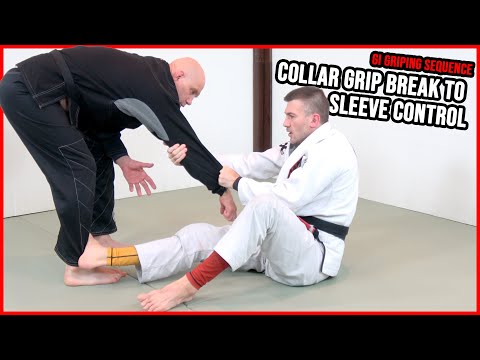
The Peel and Rotate technique is a hand-fighting escape method that leverages differential control and strategic body positioning to break opponent dominance. Master Chen Zhonghua of Practical Method Sydney teaches this through a Taiji push hands framework, emphasizing the metaphor of peeling an apple—the practitioner must separate the opponent's grip layer-by-layer using two distinct contact points rather than applying undifferentiated force. Chen stresses that power control must migrate downward through the body; when the opponent's upper body loses contact, their base remains vulnerable. Stephan Kesting demonstrates a modern Brazilian Jiu-Jitsu application, where internally rotating the opponent's shoulder via frame extension and lever control allows the defender to escape a collar grip and transition to preferred guard positions. Kesting notes that internal rotation—rotating the arm from thumb-up to thumb-down orientation—amplifies mechanical advantage and makes re-gripping difficult. RVV BJJ applies analogous principles in leg lock defense, describing how peeling the opponent's foot off the hip via lever control and strategic hip positioning creates mobility for escape. All three instructors agree on the core mechanism: isolating and controlling an opponent's limb at its lever point, managing distance through frames, and exploiting the mobility gap created by that control. Where they differ is application context: Chen emphasizes continuous power flow and body alignment; Kesting focuses on grip transitions and guard establishment; RVV BJJ prioritizes hip mobility and positional stacking to prevent submission.
Synthesized from 3 instructors
No instructional courses yet for this technique.
Sign in to suggest a course.
Risk of injury to the person this technique is applied to
Back escapes must address choke threat while escaping; urgency increases injury risk
Skill level needed to execute this technique reliably
Whether this technique is allowed under major competition rule sets
Jiu-Jitsu University (Saulo Ribeiro, 2008)
Alias sources — [1] Back Attacks: Enter the System (John Danaher, 2018) [2] Brazilian Jiu-Jitsu: Theory and Technique (Renzo Gracie & Royler Gracie, 2001)
Effectiveness sources — [1] Jiu-Jitsu University (Ribeiro, 2008)
Standard katakana transliteration of Western martial arts terminology (外来語) — used in Japanese MMA, boxing, and BJJ communities
Alias sources — [1] Back Attacks: Enter the System (John Danaher, 2018) [2] Brazilian Jiu-Jitsu: Theory and Technique (Renzo Gracie & Royler Gracie, 2001)
Effectiveness sources — [1] Jiu-Jitsu University (Ribeiro, 2008)
explosive hip bridge power, shrimping ability, timing
strong glutes and hip extensors for powerful bridges
glutes, hip extensors, core, quadriceps
According to Stephan Kesting, internal rotation of the shoulder is critical because without it, the technique simply doesn't work—the grip break fails if you try to execute the move with just external rotation or neutral position.
Stephan Kesting explains that peel and rotate works significantly better from standing than kneeling because standing allows you to create a greater height difference and level change, which generates the leverage needed for the rotation to be effective.
Stephan Kesting emphasizes that breaking the grip using this technique immediately opens doors to whatever guard assault you want to launch—your skill level determines what you do with the position you've created.
The Peel And Rotate escape combines grip stripping with rotational hip movement to escape back control while defending the choke. The defender peels the attacker's choking arm by gripping the wrist and pulling it away from the neck, then immediately rotates the hips to begin turning toward the attacker.
The peel and rotate technique was developed as a reliable back escape method that addresses both the choke threat and the positional escape simultaneously. It is widely taught in BJJ and MMA as a high-percentage back escape.
Unified MMA: legal — Legal defensive/transitional technique; IBJJF: legal — Legal; IJF: legal — Legal; ADCC: legal — Legal; UWW: legal — Legal; FIAS Sport Sambo: legal — Legal
Danger rating 4/10. Moderate — back escapes must address choke threat while escaping; urgency increases injury risk
The standard setup chain: Create Space → Disrupt Control → Execute Escape → Recover Position.
Standard counters include: Maintain Pressure — keep consistent weight distribution to limit escape space / Anticipate Direction — read escape attempt direction and block early / Transition — flow to a new position when the current one is threatened.
Common variants: Bridge and roll (upa) (explosive bridge trapping arm and leg to reverse position); Elbow-knee escape (framing and shrimping to recover guard); Foot drag escape (dragging the opponent's foot with the heel to create spac…); Combination escape (bridging to force a reaction, then shrimping when the opp…).
Used in BJJ and MMA competition.
Top errors to watch for: Peeling the top hook instead of the bottom — the bottom hook is more accessible and its removal opens the escape angle / Using one hand to peel — two hands on the ankle provide the force needed to remove it / Peeling without bridging first — the bridge creates space between your hip and the hook / Not rotating immediately after peeling — the window to turn is small; rotate instantly.
The Peel And Rotate is also known as Pīru Ando Rōtēto, Grip Strip And Turn, Peel And Turn Escape.