A Better Back Escape?
0
Back Escape·The Art of Skill
OLD GRAPPLER SUMMIT IS HAPPENING! An all-inclusive immersion retreat on Halloween weekend 2025. https://oldgrapplersummi…
Translation: back escape
The Back Escape group encompasses all techniques for escaping when an opponent has achieved back control — one of the most dominant and dangerous positions in grappling. [1] Back control gives the attacker access to rear naked chokes and other strangulations while the defender faces away and cannot effectively counter-attack, making back escapes among the most critical survival skills in grappling. [1],[2] This group includes rear mount escapes (escaping hooks-in back control), crucifix escapes (escaping the fully immobilised crucifix position), and the various mechanical strategies for dislodging an opponent from the back. [2],[3]
Back escape success rate is a critical survival metric in MMA; fighters with poor back escape skills are highly vulnerable to rear choke finishes. [1]
No images yet for this technique.
Sign in to suggest an image.
OLD GRAPPLER SUMMIT IS HAPPENING! An all-inclusive immersion retreat on Halloween weekend 2025. https://oldgrapplersummi…
Bmac discusses some key deets to keep in mind when escaping the back position. The bottom hook is the most important on…
No instructional courses yet for this technique.
Sign in to suggest a course.
Risk of injury to the person this technique is applied to
Back escapes must address choke threat while escaping; urgency increases injury risk
Skill level needed to execute this technique reliably
Whether this technique is allowed under major competition rule sets
Jiu-Jitsu University (Saulo Ribeiro, 2008)
Alias sources — [1] Jiu-Jitsu University (Ribeiro, 2008) [2] Mastering Jujitsu (Gracie & Danaher, 2003)
Effectiveness sources — [1] Mastering Jujitsu (Gracie & Danaher, 2003) [2] Jiu-Jitsu University (Ribeiro, 2008)
Standard katakana transliteration of Western martial arts terminology (外来語) — used in Japanese MMA, boxing, and BJJ communities
Alias sources — [1] Jiu-Jitsu University (Ribeiro, 2008) [2] Mastering Jujitsu (Gracie & Danaher, 2003)
Effectiveness sources — [1] Mastering Jujitsu (Gracie & Danaher, 2003) [2] Jiu-Jitsu University (Ribeiro, 2008)
explosive hip bridge power, shrimping ability, timing
strong glutes and hip extensors for powerful bridges
glutes, hip extensors, core, quadriceps
Every move, in any martial art, shares a few universal traits. Mix and match below to pinpoint the right tool — or compare equivalents across styles.
The Crucifix Escape family covers techniques for escaping the crucifix position, where the opponent controls the back while trapping one arm with the legs and the other arm with their arms, leaving the defender completely immobilised. [1] The crucifix is one of the most dominant control positions in grappling because the defender has both arms trapped and cannot defend against strikes or chokes. [1,2] Crucifix escapes focus on freeing one arm to begin the escape sequence, typically through rolling or hip movement that disrupts the attacker's leg control. [2,3]
The Mount Escape family within the Back Escape group covers techniques for escaping when the opponent achieves mount from a back-control transition — addressing the specific challenge of an opponent who has moved from behind you to a mounted position. [1] When an opponent transitions from back control to mount, the escape dynamics differ from a standard mount escape because the opponent's grips, hooks, and body positioning carry over from back control, and the bottom player may already be flattened and fatigued from defending back attacks. [1,2] These escapes must account for the residual seatbelt grip, the transition momentum, and the opponent's established weight distribution that comes from having already controlled the back. [2,3] The fundamental escapes (trap and roll, elbow-knee) apply but often require modification to address the specific control remnants of the back-to-mount transition. [3]
The Rear Mount Escape family covers all techniques for escaping back control when the opponent has established hooks (feet inside the defender's thighs) or a body triangle from behind. [1] Rear mount escape is one of the most important skill sets in grappling because back control is the highest-scoring and most dangerous position — the attacker has access to the rear naked choke while the defender cannot see or effectively counter-attack. [1,2] Escape strategies include hand fighting (preventing the choke while working to escape), shoulder walking (sliding down and out), scooting and turning (moving the hips to face the opponent), and body triangle-specific escapes. [2,3]
The Seatbelt Escape family covers techniques for breaking the seatbelt grip (over-under arm control from behind) — the most critical first step in any back escape, because the seatbelt grip enables the rear naked choke, bow and arrow, and all other back attacks. [1] The seatbelt is the opponent's primary control tool from back mount: one arm goes over the shoulder (choking arm) and one under the armpit (control arm), with hands clasped on the chest. [1,2] Escaping the seatbelt involves hand fighting to strip the choking-side grip, turning toward the underhook side, and sliding the hips to the mat — a precise sequence that must be executed before the opponent can transition from seatbelt control to a choking grip. [2,3] Every back escape begins with addressing the seatbelt; if the seatbelt remains intact, no positional escape is possible. [3]
Back escapes are the most critical escapes in grappling — back control with hooks gives the opponent access to the rear naked choke, the highest-percentage submission. RNC appears in 139 passages across 23 books. Danaher's Back Attacks system documents both attacking and escaping back control. (23+ books; Danaher, Back Attacks: Enter the System; Ribeiro, Jiu-Jitsu University)
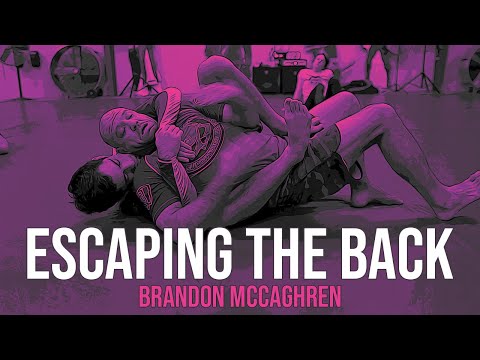
According to Brandon McCaghren, the hook on the opposite hip is the most important one to keep—if that hook is out, the person on bottom has many more escape options. The key is keeping it tucked tight at the opposite hip rather than down in the middle, where it's easier for your opponent to clear.
You need to create a disconnection between your chest and your opponent's back. Brandon McCaghren emphasizes that once you have even a little bit of separation and feel laziness in the hook, that's your opportunity to shake it and work the escape—positioning matters more than how tight the control is.
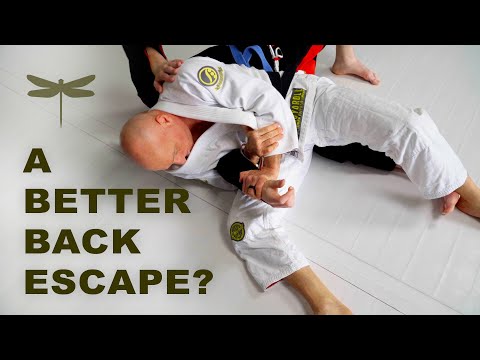
According to The Art of Skill, any escape attempt should do two things: give you a reasonable chance of actually escaping, and put you in a better position than you were in before. A quality escape should improve your situation even if it doesn't result in a full escape.
The Art of Skill recommends getting your hip into your opponent's hip and controlling their sleeve—this positioning allows you to free your leg even if they have a strong hook, and prevents them from easily retaking your back once you turn into them.
The Back Escape group encompasses all techniques for escaping when an opponent has achieved back control — one of the most dominant and dangerous positions in grappling. Back control gives the attacker access to rear naked chokes and other strangulations while the defender faces away and cannot effectively counter-attack, making back escapes among the most critical survival skills in grappling.
Back escape techniques developed alongside the recognition of back control as a dominant position in grappling. BJJ's competitive evolution, where back control became the highest-value scoring position, drove the development of increasingly sophisticated back escape methodology.
Unified MMA: legal — Legal defensive/transitional technique; IBJJF: legal — Legal; IJF: legal — Legal; ADCC: legal — Legal; UWW: legal — Legal, escape scores 1 point (freestyle), reversal scores 1 point; FIAS Sport Sambo: legal — Legal; NCAA Folkstyle: legal — Legal, escape scores 1 point, reversal scores 2 points
Danger rating 4/10. Moderate — back escapes must address choke threat while escaping; urgency increases injury risk
The standard setup chain: Create Space → Disrupt Control → Execute Escape → Recover Position.
Standard counters include: Maintain Pressure — keep consistent weight distribution to limit escape space / Anticipate Direction — read escape attempt direction and block early / Transition — flow to a new position when the current one is threatened.
Common variants: Bridge and roll (upa) (explosive bridge trapping arm and leg to reverse position); Elbow-knee escape (framing and shrimping to recover guard); Foot drag escape (dragging the opponent's foot with the heel to create spac…); Combination escape (bridging to force a reaction, then shrimping when the opp…).
Back escape success rate is a critical survival metric in MMA; fighters with poor back escape skills are highly vulnerable to rear choke finishes.
Top errors to watch for: Fighting the choke without working to escape the position — hand fighting alone doesn't escape; you must also address… / Turning away from the opponent — this exposes the neck further; turn toward the opponent to face them / Trying to peel both hooks at once — clear one hook at a time; the bottom hook first, then the top / Bridging backward into the opponent — this tightens their control; bridge to the side and slide down.
The Back Escape is also known as Bakku Esukēpu, Back Control Escape, Rear Escape.