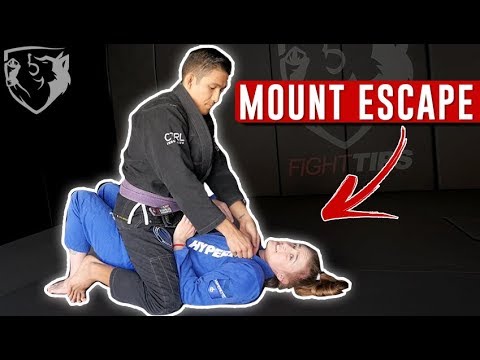
3 Ways to Escape Full Mount
0
Hand Fighting Escape·fightTIPS
BJJ blackbelt Erin Herle is back with a tutorial showing 3 ways to escape full mount -- a dominant position when someone…
Translation: hand fighting escape
The Hand Fighting Escape subfamily covers back escape techniques that prioritise defending against the choke through hand fighting while systematically working to clear hooks and turn to face the opponent. [1] Hand fighting escapes recognise that the primary threat from back control is the rear naked choke, so the first priority is preventing the choke grip while the secondary priority is escaping the position entirely. [1],[2] These escapes use two-on-one hand control, peeling grips, and shoulder rotation to manage the choking threat while creating escape opportunities. [2],[3]
Hand fighting from back control has been a fundamental defensive skill in BJJ since the art's development, with the priority of choke prevention before positional escape being a core defensive principle. [1] The hand fighting approach became more systematised as back control and RNC attacks grew more sophisticated in competition. [2],[3]
Hand fighting from back control draws from wrestling hand-fighting principles adapted for BJJ and MMA. [1]
Hand fighting is a critical survival skill in MMA when in back control. [1]
No images yet for this technique.
Sign in to suggest an image.
BJJ blackbelt Erin Herle is back with a tutorial showing 3 ways to escape full mount -- a dominant position when someone…
No instructional courses yet for this technique.
Sign in to suggest a course.
Risk of injury to the person this technique is applied to
Back escapes must address choke threat while escaping; urgency increases injury risk
Skill level needed to execute this technique reliably
Whether this technique is allowed under major competition rule sets
Jiu-Jitsu University (Saulo Ribeiro, 2008)
Alias sources — [1] Back Attacks: Enter the System (John Danaher, 2018) [2] Mastering Jujitsu (Renzo Gracie & John Danaher, 2003) [3] Jiu-Jitsu University (Saulo Ribeiro, 2008)
Effectiveness sources — [1] Mastering Jujitsu (Gracie & Danaher, 2003) [2] Wrestling Physical Conditioning Encyclopedia (Petrov, 1977)
Standard katakana transliteration of Western martial arts terminology (外来語) — used in Japanese MMA, boxing, and BJJ communities
Alias sources — [1] Back Attacks: Enter the System (John Danaher, 2018) [2] Mastering Jujitsu (Renzo Gracie & John Danaher, 2003) [3] Jiu-Jitsu University (Saulo Ribeiro, 2008)
Effectiveness sources — [1] Mastering Jujitsu (Gracie & Danaher, 2003) [2] Wrestling Physical Conditioning Encyclopedia (Petrov, 1977)
explosive hip bridge power, shrimping ability, timing
strong glutes and hip extensors for powerful bridges
glutes, hip extensors, core, quadriceps
Every move, in any martial art, shares a few universal traits. Mix and match below to pinpoint the right tool — or compare equivalents across styles.
The Peel And Rotate escape combines grip stripping with rotational hip movement to escape back control while defending the choke. [1] The defender peels the attacker's choking arm by gripping the wrist and pulling it away from the neck, then immediately rotates the hips to begin turning toward the attacker. [1,2] The peel creates a momentary opening in the choke threat, and the rotation converts that opening into a full escape by turning to face the opponent and reguarding. [2,3]
The Two On One Hand Fighting escape uses both hands to control the attacker's choking arm, creating a two-against-one advantage on the most dangerous arm while working to clear hooks and turn. [1] The defender secures the attacker's choking wrist with both hands, pulling it below the chin line while simultaneously working the hips to clear the bottom hook. [1,2] The two-on-one control provides the strongest possible defence against the choke while the hip movement creates the escape angle. [2,3]
Keep your elbows tight and inside to protect against armbars and chokes. Create a frame by using your forearm as a guard with your hand on your wrist and elbow inside to keep your opponent at bay while you work on escape. Never leave your arms up or expose your neck.
You have three primary options: the hip escape (turning to your side to create space and moving to half guard or butterfly guard), the bridge escape (using an explosive hip thrust while keeping your opponent's arm trapped to recover full guard), or reversing your opponent completely by bridging high and trapping an arm. Choose the option that works best for your position and follow up with additional attacks.
A high bridge creates more momentum and space, making it harder for your opponent to post and defend. According to fightTIPS, many people don't do the bridge escape correctly because they don't bridge high enough, which allows the opponent to post their arm and prevent the reversal.
No—you should turn to your side and avoid staying flat on your back, as this leaves you vulnerable. After creating space with the hip escape, turn toward your opponent and move to half guard with an underhook or transition to butterfly guard to advance your position.
The Hand Fighting Escape subfamily covers back escape techniques that prioritise defending against the choke through hand fighting while systematically working to clear hooks and turn to face the opponent. Hand fighting escapes recognise that the primary threat from back control is the rear naked choke, so the first priority is preventing the choke grip while the secondary priority is escaping the position entirely.
Hand fighting from back control has been a fundamental defensive skill in BJJ since the art's development, with the priority of choke prevention before positional escape being a core defensive principle. The hand fighting approach became more systematised as back control and RNC attacks grew more sophisticated in competition.
Unified MMA: legal — Legal defensive/transitional technique; IBJJF: legal — Legal; IJF: legal — Legal; ADCC: legal — Legal; UWW: legal — Legal; FIAS Sport Sambo: legal — Legal
Danger rating 4/10. Moderate — back escapes must address choke threat while escaping; urgency increases injury risk
The standard setup chain: Create Space → Disrupt Control → Execute Escape → Recover Position.
Standard counters include: Maintain Pressure — keep consistent weight distribution to limit escape space / Anticipate Direction — read escape attempt direction and block early / Transition — flow to a new position when the current one is threatened.
Common variants: Bridge and roll (upa) (explosive bridge trapping arm and leg to reverse position); Elbow-knee escape (framing and shrimping to recover guard); Foot drag escape (dragging the opponent's foot with the heel to create spac…); Combination escape (bridging to force a reaction, then shrimping when the opp…).
Hand fighting is a critical survival skill in MMA when in back control.
Top errors to watch for: Fighting both hands equally instead of prioritizing the choking hand — identify and control the more dangerous hand / Gripping the opponent's forearm instead of the wrist — wrist control is more precise and effective / Letting go of the wrist to reposition — maintain constant wrist contact; any gap allows the choke to advance / Using one hand to fight a two-handed choke entry — both hands must be on defence when the choke is being set.
The Hand Fighting Escape is also known as Hando Faitingu Esukēpu, Grip Fighting Escape, Hand Fight Back Escape, Choke Defense Escape.