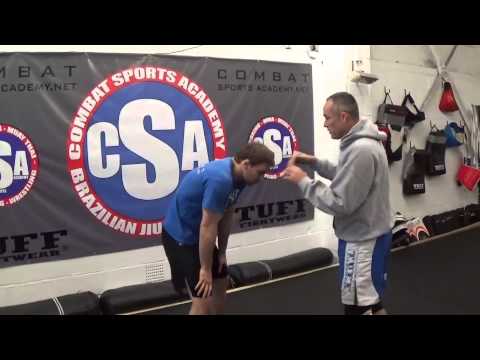
The Grovit Neck Crank to Crucifix Neck Crank / Double leg Takedown
0
Crossface Face Crank·MMA Media
I demonstrate some old school techniques which can be used in pro Grappling events that allow neck crank/locks and pro M…
Перевод: Face Crank (katakana loanword)
The crossface face crank from crucifix uses the crossface forearm to drive across the opponent's face while the crucifix position traps both arms, preventing any defensive action. [1] The attacker controls both of the opponent's arms with the legs in a crucifix configuration, then drives the forearm across the face — typically pressing the chin toward one shoulder, creating cervical rotation and lateral flexion stress. [1],[2] The crucifix removes all hand-based defence options, leaving the opponent unable to grab the attacking arm or protect the face. [2] This combination of immobilisation and neck torque can produce both pain-compliance taps and legitimate cervical spine damage if applied aggressively. [2],[3]
The crucifix position with face cranks has roots in catch wrestling, where trapping both arms while attacking the neck was a standard technique chain. [1] BJJ adopted the crucifix as both a controlling position and a platform for face cranks and chokes during competition evolution in the 2000s. [2],[3]
Effective pain-based submission that pressures the jaw and cervical spine; often used as a control tool to create openings rather than a primary finish [1]
A fundamental wrestling-to-submission technique present in catch wrestling and adapted to BJJ ground fighting. The crossface principle is universal in grappling [1]
Commonly used for control at all competition levels; occasionally produces tap-outs from jaw pain, particularly in no-gi and MMA events where neck cranks are legal [1]
Изображений для этой техники пока нет.
Войдите, чтобы предложить изображение.
I demonstrate some old school techniques which can be used in pro Grappling events that allow neck crank/locks and pro M…
Учебных курсов по этой технике пока нет.
Войдите, чтобы предложить курс.
Риск травмы для человека, к которому применяется техника
Extension cranks force the head backward; risk of vertebral disc and ligament damage
Уровень мастерства, необходимый для надёжного выполнения техники
Разрешена ли техника по основным соревновательным правилам
Japanese MMA/BJJ standard terminology
Japanese MMA/BJJ standard terminology
Standard katakana transliteration of Western martial arts terminology (外来語) — used in Japanese MMA, boxing, and BJJ communities
Japanese terminology sourced from Japanese MMA/BJJ standard terminology
grip or squeeze strength, positional control
strong upper body for sustained compression
forearms, biceps, pectorals, core stabilisers
Bring your forearm across your opponent's jaw with one hand, and place your other hand on the outside of their shoulder. This positioning allows you to turn their head while maintaining control through shoulder pressure.
Flex your wrist to apply pressure while keeping pressure on the shoulder simultaneously, then step in and lift slightly while twisting the head to the side and upward in a combined motion.
Rather than backing off when they create escape pressure, capitalize on the moment by redirecting their head in the direction they were looking and follow up with strikes like an elbow or knee.
The crossface face crank from crucifix uses the crossface forearm to drive across the opponent's face while the crucifix position traps both arms, preventing any defensive action. The attacker controls both of the opponent's arms with the legs in a crucifix configuration, then drives the forearm across the face — typically pressing the chin toward one shoulder, creating cervical rotation and lateral flexion stress.
The crucifix position with face cranks has roots in catch wrestling, where trapping both arms while attacking the neck was a standard technique chain. BJJ adopted the crucifix as both a controlling position and a platform for face cranks and chokes during competition evolution in the 2000s.
IBJJF: разрешён — Legal at all belt levels, gi and no-gi — chokes are the safest submission cat…; IJF: разрешён — Legal (shime-waza) — strangulation techniques are one of three permitted subm…; ADCC: разрешён — Legal; Unified MMA: разрешён — Legal — choke submissions are among the most common finishes in MMA; FIAS Sport Sambo: запрещён — All chokes prohibited in Sport Sambo; FIAS Combat Sambo: разрешён — Legal
Оценка опасности 9/10. Extension cranks force the head backward; risk of vertebral disc and ligament damage
Стандартная цепочка подготовки: Control Position → Isolate the Arm → Lock the Figure-Four → Apply Rotation.
Стандартные контрприёмы: Straighten the Arm — extend the arm to break the figure-four grip angle / Roll Toward — roll in the direction of the lock to relieve rotational pressure / Grip the Belt/Shorts — anchor the hand to prevent the arm from being isolated.
Распространённые варианты: Standard grip variation (primary hand configuration for maximum choking pressure); Gi variation (uses the lapel or collar as an anchor for additional fric…); No-gi variation (adapted grip and positioning for submission grappling wit…); Transition finish (applied during a positional change to catch the opponent …).
Commonly used for control at all competition levels; occasionally produces tap-outs from jaw pain, particularly in no-gi and MMA events where neck cranks are legal
Основные ошибки, на которые стоит обратить внимание: Applying explosive force — the cervical rotation is dangerous; the crucifix position amplifies the force since the op… / Not maintaining the crucifix while applying the crossface — the arm traps must be secure throughout; losing the cruci… / Pressing into the eyes or nose — target the jaw line for the crossface; eye/nose contact is dangerous and illegal / Using the crossface as a standalone submission — it's most effective as a setup for rear chokes; use the crank to ope….
Crossface Face Crank также известен как Feisu Kuranku, Crucifix Crossface Crank, Crossface Lock from Crucifix.