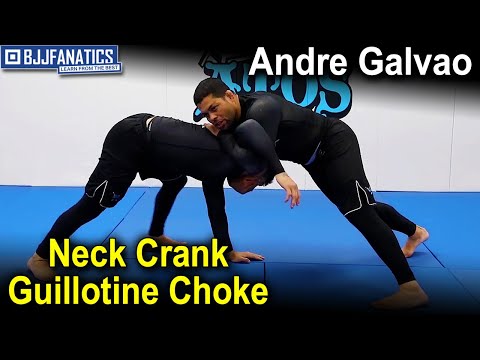
Neck Crank Guillotine Choke by Andre Galvao
0
Neck Crank Choke·BJJ Fanatics
THE NECK CRANK GUILLOTINE CHOKE https://bjjfanatics.com In this BJJ Techniques video, Andre Galvao teaches how to do th…
Перевод: Neck Joint Techniques
Neck crank chokes are hybrid submissions that combine cervical spine manipulation with vascular or airway restriction. [4] Unlike pure chokes (which target blood/air) or pure cranks (which target the spine), neck crank chokes apply both mechanisms simultaneously — twisting or laterally flexing the neck while also compressing the throat or carotids. This family includes the can opener (cranking the neck from inside closed guard), the twister (lateral spine rotation from back control), cervical neck locks, and various headlock-based cranking chokes. [1] Neck crank chokes are considered high-risk techniques because the cervical spine is vulnerable to serious injury from rotational and compressive forces. The IBJJF prohibits cervical locks (neck cranks) at all belt levels [1]; judo prohibits them; but ADCC and MMA under Unified Rules permit them. [2],[3]
Neck cranking techniques have deep roots in catch wrestling and classical jujutsu. [4],[5] In catch wrestling, the 'neck crank' and 'crossface' were standard finishing holds; Frank Gotch's famous 'toe hold to neck crank' combination was a feared finishing sequence in early 20th century professional wrestling. In Japanese jujutsu, kubi-hishigi (neck crush) techniques appear in several koryu curricula. [4] The twister, modernized by Eddie Bravo from wrestling's guillotine ride, became the most well-known spinal submission in modern BJJ competition. Neck crank chokes remain controversial due to injury risk and the thin line between a crank and a choke.
Neck crank chokes combine strangulation pressure with cervical spine torque, creating a submission that attacks both the blood supply and the neck simultaneously. [1]
Neck crank choke combinations are seen in MMA and submission grappling events where neck cranks are permitted under the rules. [1]
Изображений для этой техники пока нет.
Войдите, чтобы предложить изображение.
THE NECK CRANK GUILLOTINE CHOKE https://bjjfanatics.com In this BJJ Techniques video, Andre Galvao teaches how to do th…
Учебных курсов по этой технике пока нет.
Войдите, чтобы предложить курс.
Риск травмы для человека, к которому применяется техника
Neck cranks apply rotational or lateral force to the cervical spine; high injury potential
Уровень мастерства, необходимый для надёжного выполнения техники
Разрешена ли техника по основным соревновательным правилам
Shooto Official Rules — Neck Submission Classification
Japanese terminology sourced from Shooto Official Rules — Neck Submission Classification
Japanese MMA pioneer organization — technique classification
Standard Japanese martial arts terminology (kanji/hiragana)
Established Japanese martial arts naming convention — native Japanese term (和語/漢語)
Japanese terminology sourced from Shooto Official Rules — Neck Submission Classification
grip or squeeze strength, positional control
strong upper body for sustained compression
forearms, biceps, pectorals, core stabilisers
Каждое движение в любом боевом искусстве обладает рядом универсальных свойств. Комбинируйте параметры ниже, чтобы найти нужный инструмент или сравнить аналоги из разных стилей.
Cervical extension cranks force the opponent's head backward, hyperextending the cervical spine. [1,2] The can opener (from inside closed guard) is the most common example — the attacker clasps hands behind the opponent's head and drives downward, forcing the chin toward the chest and the cervical spine into extension. Cervical extension cranks are prohibited in most grappling rule sets due to spinal injury risk. [3,4]
Cervical flexion cranks force the opponent's chin toward their chest, compressing the anterior cervical spine and intervertebral discs. [1,2] These cranks are often applied from front headlock positions or top mount, using body weight to drive the head downward. Cervical flexion can also restrict airway by tucking the chin, creating a hybrid choke-crank. [3,4]
Cervical rotation cranks twist the head laterally, applying torsional force to the cervical vertebrae. [1,2] The twister is the most well-known example: from back control, the attacker traps a leg, controls the head, and rotates the opponent's upper body against the trapped lower body, creating extreme rotational stress on the thoracic and cervical spine. Cervical rotation cranks carry the highest injury risk of all neck crank variants. [3,4]
Do Jime is a body scissors technique where the attacker wraps their legs around the opponent's torso and squeezes, compressing the ribcage and diaphragm. [1] It restricts breathing and can cause significant pain to the floating ribs. [1] Do Jime is one of the four kinshi waza (prohibited techniques) in IJF judo competition due to the risk of rib fractures and organ compression, but it remains legal in sambo and MMA. [1]
Neck cranks target the cervical spine through extension, rotation, or lateral flexion — they are more dangerous than blood chokes because the spine has less tolerance for error than the carotid arteries. Banned in some rulesets (IBJJF bans spinal locks without choke at lower belts). (IBJJF Rules v6.0)
Keep your forearm under the opponent's neck and maintain control by underhooting their arm. Andre Galvao emphasizes scrolling under to hook properly, then turning them to set up the finish.
You can scissor your legs for additional pressure, push with your tiptoes against the opponent's ribs, and close your elbow to complete the choke. Andre Galvao notes this is very effective and simple to execute.
Andre Galvao avoids putting his knees on the floor during the finish, as this can compromise foot positioning and create vulnerabilities.
Neck crank chokes are hybrid submissions that combine cervical spine manipulation with vascular or airway restriction. Unlike pure chokes (which target blood/air) or pure cranks (which target the spine), neck crank chokes apply both mechanisms simultaneously — twisting or laterally flexing the neck while also compressing the throat or carotids.
Neck cranking techniques have deep roots in catch wrestling and classical jujutsu. In catch wrestling, the 'neck crank' and 'crossface' were standard finishing holds; Frank Gotch's famous 'toe hold to neck crank' combination was a feared finishing sequence in early 20th century professional wrestling.
IBJJF: запрещён — Neck cranks and spinal locks prohibited at all belt levels; IJF: запрещён — Neck cranks prohibited; ADCC: разрешён — Legal; Unified MMA: разрешён — Legal — choke submissions are among the most common finishes in MMA; FIAS Sport Sambo: запрещён — All chokes prohibited in Sport Sambo; FIAS Combat Sambo: разрешён — Legal
Оценка опасности 9/10. Neck cranks apply rotational or lateral force to the cervical spine; high injury potential
Стандартная цепочка подготовки: Achieve Controlling Position → Isolate the Neck → Set the Grip → Apply Pressure.
Стандартные контрприёмы: Tuck Chin — protect the neck by lowering the chin to prevent the choke from sinking / Two-on-One Grip Fight — use both hands to strip the choking grip before it locks / Turn Into — rotate toward the choking arm to relieve carotid pressure / Posture Up — straighten the spine and create distance to break the choking angle.
Распространённые варианты: Standard grip variation (primary hand configuration for maximum choking pressure); Gi variation (uses the lapel or collar as an anchor for additional fric…); No-gi variation (adapted grip and positioning for submission grappling wit…); Transition finish (applied during a positional change to catch the opponent …).
Neck crank choke combinations are seen in MMA and submission grappling events where neck cranks are permitted under the rules.
Основные ошибки, на которые стоит обратить внимание: Applying neck cranks explosively — the cervical spine is vulnerable; cranks should be applied progressively to allow … / Confusing a neck crank with a choke — pure chokes target blood flow and airway; cranks target the spine; recognise wh… / Ignoring tap signals during neck cranks — because cranks can cause structural damage, releasing immediately on a tap … / Cranking without controlling the body — a neck crank without body control allows the opponent to roll with the force,….
Neck Crank Choke также известен как Kubi-kansetsu-waza, Neck Crank, Cervical Lock, Kubi-hishigi.