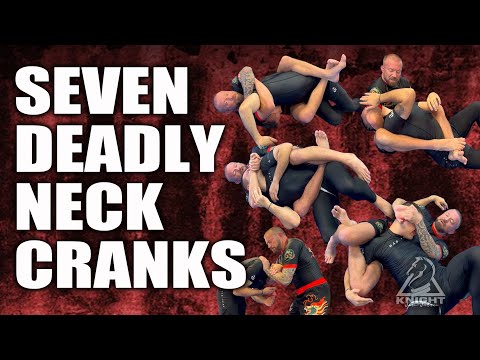
Seven Deadly Neck Cranks | Jiu-Jitsu & Submission Grappling
0
Face Crank From Crucifix·Knight Jiu-Jitsu
There are obviously more than 7 neck cranks in grappling, but the title has to be catchy... Neck cranks are some of the …
Перевод: Face Crank (katakana loanword)
The face crank from crucifix is applied when the attacker has secured the crucifix position — trapping one of the opponent's arms with the legs (typically the far arm threaded between the legs) while controlling the second arm with the hands or shoulder pin — and then places a hand or forearm across the opponent's face, pulling upward to hyperextend the cervical spine. [1],[2] The crucifix eliminates the opponent's ability to use their hands for defense, leaving the face and neck completely exposed to cranking pressure. [1] The attacker can grip under the nose, chin, or forehead and lever the head backward against the trapped body, creating intense spinal extension pressure. [1],[2]
Face cranks from the crucifix position draw from catch wrestling's use of the crucifix as a finishing position, where the immobilization of both arms made the face and neck vulnerable to manipulation. [1],[2] In modern submission grappling, the face crank from crucifix became recognized as a practical option when rear naked choke attempts from the crucifix are defended by chin-tucking. [1] The technique is legal in many no-gi rulesets including ADCC, though face cranks remain controversial due to the spinal injury risk involved. [1],[2]
Highly effective from crucifix position — the opponent's arms are trapped, leaving them unable to defend the face crank. One of the most reliable crucifix finishes [1]
The crucifix face crank combines elements from catch wrestling's crucifix system with Japanese jujutsu neck manipulation. Popularized in MMA by fighters like Matt Hughes [1]
Regular finish in MMA and no-gi competition from crucifix position; Matt Hughes and other wrestlers with crucifix expertise have demonstrated its effectiveness [1]
Изображений для этой техники пока нет.
Войдите, чтобы предложить изображение.
There are obviously more than 7 neck cranks in grappling, but the title has to be catchy... Neck cranks are some of the …
I demonstrate some old school techniques which can be used in pro Grappling events that allow neck crank/locks and pro M…
Caution! Be extremely careful. Only train this with a certified professional. This is for information only.
The face crank from crucifix is a neck crank submission executed from the crucifix position, wherein the aggressor isolates one or both of the opponent's arms while applying pressure to the face and neck through cervical extension and lateral rotation. Knight Jiu-Jitsu describes the fundamental setup: from crucifix control, the aggressor blocks the opponent's bicep, hooks it with their own bicep to turn the opponent, then scoops behind the neck with the free hand while capturing the trapped arm. The crank is applied by positioning the hand high on the face near the hairline—not low on the neck—and pulling the opponent's head toward the aggressor's body while extending the hips into the opponent, creating severe pressure that traps both arms and prevents escape. MMA Media emphasizes wrist flexion and shoulder pressure combined with hip positioning to maximize submission force, noting the submission can be applied with minimal finger pressure due to the structural advantage. AZ Battle School highlights specific anatomical targets: the orbital ridge (eye socket), bridge of nose, and jawline, explaining that the crank works by pulling the face into the aggressor's "cloud of power"—a position of maximal mechanical advantage—while rotating and collapsing via chest and lat engagement. All three instructors stress the technique's danger: it can cause severe neck injury, jaw dislocation, and prolonged damage if applied without control. Instructors uniformly recommend slow, careful practice with willing partners, early tapping, and awareness of tournament legality restrictions.
Сформировано на основе 3 инструкторов
Учебных курсов по этой технике пока нет.
Войдите, чтобы предложить курс.
Риск травмы для человека, к которому применяется техника
Extension cranks force the head backward; risk of vertebral disc and ligament damage
Уровень мастерства, необходимый для надёжного выполнения техники
Разрешена ли техника по основным соревновательным правилам
Japanese MMA/BJJ standard terminology
Japanese MMA/BJJ standard terminology
Standard katakana transliteration of Western martial arts terminology (外来語) — used in Japanese MMA, boxing, and BJJ communities
Japanese terminology sourced from Japanese MMA/BJJ standard terminology
grip or squeeze strength, positional control
strong upper body for sustained compression
forearms, biceps, pectorals, core stabilisers
Каждое движение в любом боевом искусстве обладает рядом универсальных свойств. Комбинируйте параметры ниже, чтобы найти нужный инструмент или сравнить аналоги из разных стилей.
According to Knight Jiu-Jitsu, the placement of the forearm is crucial—you want to position it on the side of the jaw rather than around the neck itself, and use a butterfly grip with your hands to create compression while cranking toward the temple or hairline.
Knight Jiu-Jitsu explains that if your opponent passes their arm between your bodies to escape, you can capitalize on that movement by picking them up and converting it into a back take.
Knight Jiu-Jitsu emphasizes that regularly defending against neck cranks can cause cumulative neck damage over time, so maintaining neck strength through prehab and rehab exercises is essential for a long jiu-jitsu career.
According to Knight Jiu-Jitsu, in the crucifix position both of your opponent's arms are trapped, making it very difficult for them to defend using their upper body—their legs and hips provide minimal help in escaping.
The face crank from crucifix is applied when the attacker has secured the crucifix position — trapping one of the opponent's arms with the legs (typically the far arm threaded between the legs) while controlling the second arm with the hands or shoulder pin — and then places a hand or forearm across the opponent's face, pulling upward to hyperextend the cervical spine. The crucifix eliminates the opponent's ability to use their hands for defense, leaving the face and neck completely exposed to cranking pressure.
Face cranks from the crucifix position draw from catch wrestling's use of the crucifix as a finishing position, where the immobilization of both arms made the face and neck vulnerable to manipulation. In modern submission grappling, the face crank from crucifix became recognized as a practical option when rear naked choke attempts from the crucifix are defended by chin-tucking.
IBJJF: разрешён — Legal at all belt levels, gi and no-gi — chokes are the safest submission cat…; IJF: разрешён — Legal (shime-waza) — strangulation techniques are one of three permitted subm…; ADCC: разрешён — Legal; Unified MMA: разрешён — Legal — choke submissions are among the most common finishes in MMA; FIAS Sport Sambo: запрещён — All chokes prohibited in Sport Sambo; FIAS Combat Sambo: разрешён — Legal
Оценка опасности 9/10. Extension cranks force the head backward; risk of vertebral disc and ligament damage
Стандартная цепочка подготовки: Establish Position → Create the Threat → Secure the Hold → Finish.
Стандартные контрприёмы: Early Recognition — identify the submission attempt early and begin defence immediately / Posture and Base — maintain strong posture and base to prevent submission setups / Grip Fight — deny the attacker their preferred gripping configuration.
Распространённые варианты: Standard grip variation (primary hand configuration for maximum choking pressure); Gi variation (uses the lapel or collar as an anchor for additional fric…); No-gi variation (adapted grip and positioning for submission grappling wit…); Transition finish (applied during a positional change to catch the opponent …).
Regular finish in MMA and no-gi competition from crucifix position; Matt Hughes and other wrestlers with crucifix expertise have demonstrated its effectiveness
Основные ошибки, на которые стоит обратить внимание: Using the crucifix face crank purely for pain — it should serve a technical purpose (opening the neck, creating a sub… / Applying without securing the arm traps — both arms must be immobilised before attacking the face; one free arm can d… / Targeting the eyes or nose — the jaw and forehead are the cranking surfaces; eye/nose contact is dangerous / Not maintaining the crucifix throughout — the arm traps require active engagement; they can slip during the face cran….
Face Crank From Crucifix также известен как Feisu Kuranku, Crucifix Face Crank, Crucifix Neck Lock.