Cervical Rotation Crank

Подсемейство

Перевод: Cervical Spine Rotation Twist

Дистанция и классификация

Категория
Удар и защитаЗамкиБлижний бойБой против нескольких
Дистанция
БлижняяСредняяДальняя
Целевая зона
Верхняя частьСредняя частьНижняя часть

Обзор

Cervical rotation cranks twist the head laterally, applying torsional force to the cervical vertebrae. [1],[2] The twister is the most well-known example: from back control, the attacker traps a leg, controls the head, and rotates the opponent's upper body against the trapped lower body, creating extreme rotational stress on the thoracic and cervical spine. Cervical rotation cranks carry the highest injury risk of all neck crank variants. [3],[4]

Также известна как
Spinal Twist[1]Rotational Neck Crank[2]Twister Family[3]
Используется в

История и происхождение

Rotational neck attacks were standard in catch wrestling finishing sequences. [1],[2] The twister was modernized by Eddie Bravo, adapted from wrestling's guillotine ride position, and incorporated into the 10th Planet Jiu-Jitsu curriculum. [3],[4]

Страна происхождения· показано в случайном порядке

  • БразилияБразильское джиу-джитсу, Сабмишн-грэпплинг, ММА
  • Япония頸椎回旋捻り(Keitsui Kaisen Hineri)Бразильское джиу-джитсу, Дзюдо, Сабмишн-грэпплинг
  • СШАСабмишн-грэпплинг, ММА
  • РоссияСамбо

Эффективность

Cervical rotation cranks force the neck into extreme rotation, targeting the cervical vertebrae, intervertebral discs, and surrounding ligaments. [1] They produce immediate intense pain and carry significant injury risk, which is why many rulesets classify them as illegal or grey-area techniques. [1],[2]

Родословная

Cervical rotation cranks twist the head and neck, appearing in catch wrestling (twister), jūjutsu, and MMA. Eddie Bravo popularised the twister variation. [1]

Соревновательные результаты

The twister (a cervical rotation crank) was popularised by Eddie Bravo and has been finished in MMA, notably by Korean Zombie at UFC. [1]

Изображения

Изображений для этой техники пока нет.

Войдите, чтобы предложить изображение.

Биомеханический механизм

Primary ActionCompression of the neck structures — restricts blood flow or airway depending on technique application
Joints InvolvedCervical spine, surrounding musculature, and vascular structures of the neck
Force VectorDirected compression against the neck from the choking limb or body position
Finishing MechanicSustained pressure causes either vascular occlusion (unconsciousness) or tracheal restriction (breathing difficulty)

Позиция и вход

From back control with seatbeltEstablish hooks or body triangle, slide choking arm under the chin, connect hands and squeeze
From turtle top (back take)Break down the turtle, insert hooks, secure seatbelt grip, slide to back control and apply the choke
From standing back clinchSecure rear body lock, drag opponent to the mat while inserting hooks, transition to choking position

Видео

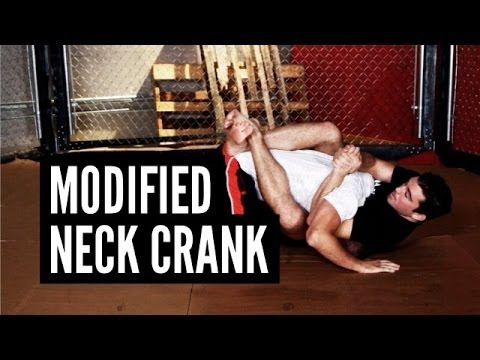
Modified Neck Crank

0
Cervical Rotation Crank·mahalodotcom

Top 10 MMA Knockouts of 2012: http://bit.ly/VLMFtM Benson Henderson's Axe Kick: http://bit.ly/VIRyBE Armbar Defense: ht

1 video

Изучить технику

Учебных курсов по этой технике пока нет.

Войдите, чтобы предложить курс.

Оценки

Уровень опасности

Риск травмы для человека, к которому применяется техника

9
Экстремальный9/10

Cervical rotation cranks twist the neck; the twister is among the most dangerous submissions in grappling

Сложность

Уровень мастерства, необходимый для надёжного выполнения техники

Эксперт
Допустимость на соревнованиях

Разрешена ли техника по основным соревновательным правилам

Запрещено
IBJJF — Neck cranks and spinal locks prohibited at all be...
IBJJF Rules Book v6.0, June 2024PDF
IJF — Neck cranks prohibited
IJF Sport and Organisation Rules 2025, Article 27PDF
FIAS Sport Sambo — All chokes prohibited in Sport Sambo
FIAS International Sambo Competition RulesPDF
Разрешено
ADCC — Legal
ADCC Rules Update, April 2025PDF
Unified MMA — Legal — choke submissions are among the mos...
Unified Rules of MMA, August 2025PDF
FIAS Combat Sambo — Legal
FIAS Combat Sambo RulesPDF

Заметки по тренировке

The cervical rotation crank forces the opponent's head to rotate beyond its comfortable range — twisting the neck laterally to stress the rotational ligaments and cervical joints (Paulson, Shoot Wrestling, 2007)
The rotation crank targets the facet joints, rotational ligaments, and vertebral arteries — forced rotation compresses structures on one side while stretching them on the other
From back control or front headlock: grip the head and twist it laterally while anchoring the body — the head rotates while the shoulders remain fixed, focusing torque on the cervical spine
Cervical rotation cranks are among the most dangerous submissions: the vertebral arteries run through the transverse foramina of the cervical vertebrae — forced rotation can compress or damage these vessels
The 'twister' submission is a rotation crank: the attacker controls the body and forces the head to rotate, creating extreme cervical torsion
In catch wrestling, rotation cranks are traditional submissions: the 'neck wrench' and 'head twist' are part of the historical catch wrestling curriculum
Medical literature identifies forced cervical rotation as a risk factor for vertebral artery dissection — this is a technique that demands respect and controlled application

Типичные ошибки

!Twisting the neck explosively — cervical rotation cranks can damage vertebral arteries, facet joints, and ligaments; never apply these rapidly
!Using rotation cranks in casual training — these are advanced submissions that should only be practised with experienced partners who understand the risks
!Not controlling the body — rotation cranks require the torso to be fixed; without body control, the entire body rotates and the cervical stress is reduced
!Ignoring the risk of vertebral artery injury — forced rotation can cause stroke-inducing arterial damage; treat this technique as one of the most dangerous in grappling
!Confusing rotation with a neck twist for control — controlling head position with moderate rotation is different from a rotation crank intended to submit; be clear about intent
!Holding rotation at end range — release immediately on tap; holding end-range rotation risks catastrophic injury
!Not understanding when to abandon the crank — if the opponent can rotate their body with the crank, the technique isn't effective; reposition rather than increase force

Связанные техники

Контрприёмы

Цепочка подготовки

1Establish Positionachieve the controlling position needed for this submission
2Create the Threatbegin the submission setup to force a defensive reaction
3Secure the Holdlock the submission grip with proper body mechanics
4Finishapply increasing pressure until the opponent taps or the joint/choke takes effect

Источники и ссылки

Основной источник

Shooto Official Rules — anatomical terminology

1СоревнованиеShooto Official Rules

Japanese MMA pioneer organization — technique classification

2Учебная программаKodokan Judo Institute — Official Waza Names

Standard Japanese martial arts terminology (kanji/hiragana)

3ДругоеJapanese Martial Arts Standard Terminology (武道用語)

Established Japanese martial arts naming convention — native Japanese term (和語/漢語)

4ЦитатаShooto Official Rules — anatomical terminology

Japanese terminology sourced from Shooto Official Rules — anatomical terminology

Сообщество

Атлетизм

Requires

grip or squeeze strength, positional control

Favours

strong upper body for sustained compression

Key muscles

forearms, biceps, pectorals, core stabilisers

Подтехники

Ищите по тому, что делает техника, — а не по её названию

Каждое движение в любом боевом искусстве обладает рядом универсальных свойств. Комбинируйте параметры ниже, чтобы найти нужный инструмент или сравнить аналоги из разных стилей.

Категория
Дистанция
Целевая зона

Часто задаваемые вопросы

What's the ideal position to set up a cervical rotation crank?

The ideal position is when your opponent has guard on you. From there, you slap their hands off and get your hand around their neck to set up the crank.

How do you lock in and finish the cervical rotation crank?

Use a thumbs-up grip, lock your feet together, and roll their head under while pulling back and squeezing. The instructor emphasizes sitting forward to make everything tight before applying pressure.

How dangerous is the cervical rotation crank?

This technique causes significant pain and should be applied carefully. Proper communication is essential—the person being submitted should tap loudly or verbally say 'I quit' to ensure safety.

Как работает Cervical Rotation Crank?

Cervical rotation cranks twist the head laterally, applying torsional force to the cervical vertebrae. The twister is the most well-known example: from back control, the attacker traps a leg, controls the head, and rotates the opponent's upper body against the trapped lower body, creating extreme rotational stress on the thoracic and cervical spine.

Откуда происходит Cervical Rotation Crank?

Rotational neck attacks were standard in catch wrestling finishing sequences. The twister was modernized by Eddie Bravo, adapted from wrestling's guillotine ride position, and incorporated into the 10th Planet Jiu-Jitsu curriculum.

Разрешён ли Cervical Rotation Crank на соревнованиях?

IBJJF: запрещён — Neck cranks and spinal locks prohibited at all belt levels; IJF: запрещён — Neck cranks prohibited; ADCC: разрешён — Legal; Unified MMA: разрешён — Legal — choke submissions are among the most common finishes in MMA; FIAS Sport Sambo: запрещён — All chokes prohibited in Sport Sambo; FIAS Combat Sambo: разрешён — Legal

Насколько опасен Cervical Rotation Crank?

Оценка опасности 9/10. Cervical rotation cranks twist the neck; the twister is among the most dangerous submissions in grappling

Как подготовить Cervical Rotation Crank?

Стандартная цепочка подготовки: Establish Position → Create the Threat → Secure the Hold → Finish.

Как защититься от Cervical Rotation Crank?

Стандартные контрприёмы: Early Recognition — identify the submission attempt early and begin defence immediately / Posture and Base — maintain strong posture and base to prevent submission setups / Grip Fight — deny the attacker their preferred gripping configuration.

Какие есть варианты Cervical Rotation Crank?

Распространённые варианты: Standard grip variation (primary hand configuration for maximum choking pressure); Gi variation (uses the lapel or collar as an anchor for additional fric…); No-gi variation (adapted grip and positioning for submission grappling wit…); Transition finish (applied during a positional change to catch the opponent …).

Насколько эффективен Cervical Rotation Crank на соревнованиях?

The twister (a cervical rotation crank) was popularised by Eddie Bravo and has been finished in MMA, notably by Korean Zombie at UFC.

Какие типичные ошибки при выполнении Cervical Rotation Crank?

Основные ошибки, на которые стоит обратить внимание: Twisting the neck explosively — cervical rotation cranks can damage vertebral arteries, facet joints, and ligaments; … / Using rotation cranks in casual training — these are advanced submissions that should only be practised with experien… / Not controlling the body — rotation cranks require the torso to be fixed; without body control, the entire body rotat… / Ignoring the risk of vertebral artery injury — forced rotation can cause stroke-inducing arterial damage; treat this ….

Какие ещё названия есть у Cervical Rotation Crank?

Cervical Rotation Crank также известен как Keitsui Kaisen Hineri, Spinal Twist, Rotational Neck Crank, Twister Family.