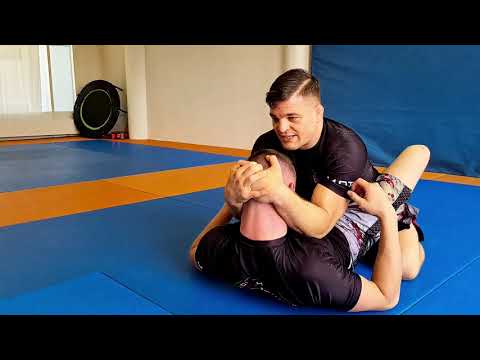
Can Opener - Illegal BJJ Submission Neck Crank from Top Guard advanced Grappling for MMA - CanOpener
0
Cervical Flexion Crank·Peter Mettler Martial Arts
Перевод: Cervical Spine Flexion Twist
Cervical flexion cranks force the opponent's chin toward their chest, compressing the anterior cervical spine and intervertebral discs. [1],[2] These cranks are often applied from front headlock positions or top mount, using body weight to drive the head downward. Cervical flexion can also restrict airway by tucking the chin, creating a hybrid choke-crank. [3],[4]
The cervical flexion crank forces the chin toward the chest, compressing the anterior cervical spine. [1]
Cervical flexion cranks (can opener, neck crank) appear in catch wrestling and early MMA. [1]
Cervical flexion cranks are legal in MMA and some grappling events. [1]
Изображений для этой техники пока нет.
Войдите, чтобы предложить изображение.
Учебных курсов по этой технике пока нет.
Войдите, чтобы предложить курс.
Риск травмы для человека, к которому применяется техника
Cervical flexion cranks force the chin toward the chest, compressing the anterior cervical spine
Уровень мастерства, необходимый для надёжного выполнения техники
Разрешена ли техника по основным соревновательным правилам
Shooto Official Rules — anatomical terminology
Japanese MMA pioneer organization — technique classification
Standard Japanese martial arts terminology (kanji/hiragana)
Established Japanese martial arts naming convention — native Japanese term (和語/漢語)
Japanese terminology sourced from Shooto Official Rules — anatomical terminology
grip or squeeze strength, positional control
strong upper body for sustained compression
forearms, biceps, pectorals, core stabilisers
Каждое движение в любом боевом искусстве обладает рядом универсальных свойств. Комбинируйте параметры ниже, чтобы найти нужный инструмент или сравнить аналоги из разных стилей.
The can opener is a cervical flexion crank applied from inside the opponent's closed guard by clasping both hands behind the opponent's head and forcefully driving the chin toward the chest. [1,2,3] The attacker interlaces the fingers behind the head and curls the opponent's neck forward, creating intense pressure on the cervical vertebrae and posterior neck muscles. [1,4] While primarily used as a guard-opening technique — forcing the opponent to uncross their ankles due to spine pain — the can opener can also force a tap from pure neck crank pressure. [1,5]
The chin strap neck crank uses a cupping grip under the opponent's chin to force cervical flexion — driving the chin toward the chest. [1,2] The attacker places one or both hands under the chin in a 'strap' configuration and pushes or pulls the head downward and forward. [1] Unlike the can opener which uses interlaced fingers behind the head, the chin strap applies direct upward pressure under the jaw to flex the neck. [1,3] It is commonly used from top position to break posture or force a submission. [1]
The cradle neck crank combines a wrestling cradle — where the attacker links the opponent's head and leg together — with cervical flexion pressure. [1,2,3] The attacker clasps hands connecting the head and knee, then squeezes to fold the opponent, driving the chin toward the knee and creating intense flexion pressure on the cervical spine. [1,4] The cradle position provides exceptional control because the linked head-to-leg connection immobilizes the torso while the cranking force is applied to the neck. [1,5]
You need head control and then roll your opponent into position. Peter Mettler emphasizes that all you need is to grab the back of the head fairly high, lift slightly, and drive your elbow in to apply the crank.
Use your knees to control your opponent's hips by pulling them toward your hips and keeping your knees tight, which allows you to maintain the crank even if they try to push your head off or push against your face.
According to Peter Mettler, this technique is so effective that it was outlawed in many competitions specifically because of its danger and the difficulty opponents have defending it from top guard.
Cervical flexion cranks force the opponent's chin toward their chest, compressing the anterior cervical spine and intervertebral discs. These cranks are often applied from front headlock positions or top mount, using body weight to drive the head downward.
Flexion-based neck attacks appear in multiple grappling traditions, used in wrestling as control techniques and in jujutsu as finishing submissions.
IBJJF: запрещён — Neck cranks and spinal locks prohibited at all belt levels; IJF: запрещён — Neck cranks prohibited; ADCC: разрешён — Legal; Unified MMA: разрешён — Legal — choke submissions are among the most common finishes in MMA; FIAS Sport Sambo: запрещён — All chokes prohibited in Sport Sambo; FIAS Combat Sambo: разрешён — Legal
Оценка опасности 8/10. Cervical flexion cranks force the chin toward the chest, compressing the anterior cervical spine
Стандартная цепочка подготовки: Achieve Controlling Position → Isolate the Neck → Set the Grip → Apply Pressure.
Стандартные контрприёмы: Tuck Chin — protect the neck by lowering the chin to prevent the choke from sinking / Two-on-One Grip Fight — use both hands to strip the choking grip before it locks / Turn Into — rotate toward the choking arm to relieve carotid pressure / Posture Up — straighten the spine and create distance to break the choking angle.
Распространённые варианты: Standard grip variation (primary hand configuration for maximum choking pressure); Gi variation (uses the lapel or collar as an anchor for additional fric…); No-gi variation (adapted grip and positioning for submission grappling wit…); Transition finish (applied during a positional change to catch the opponent …).
Cervical flexion cranks are legal in MMA and some grappling events.
Основные ошибки, на которые стоит обратить внимание: Using the flexion crank as a finishing technique exclusively — it's often more effective as a positional tool that cr… / Applying excessive force in training — flexion cranks can injure the cervical discs and ligaments; use controlled force / Not differentiating between flexion for control and flexion for submission — control requires moderate pressure; subm… / Cranking from a position without body control — the body must be anchored so the flexion force concentrates on the neck.
Cervical Flexion Crank также известен как Keitsui Kukkyoku Hineri, Neck Flexion Lock, Anterior Cervical Crank, Chin-to-Chest Crank.