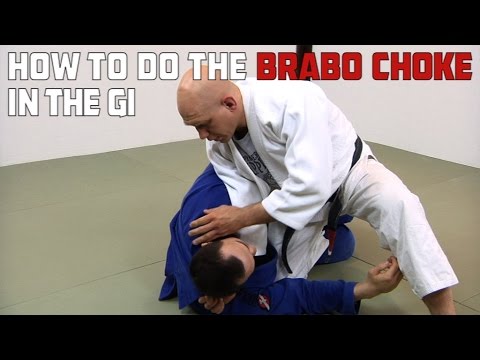
How To Do the Brabo Choke In The Gi
0
Standard Brabo Choke·Stephan Kesting
Step-by-step instructions for doing the Brabo Choke from half guard (or side mount) in the gi. Find out more about Step…
Перевод: Brabo Choke (katakana loanword)
The standard brabo choke from closed guard is a gi-based head-and-arm strangle where the attacker uses the opponent's own lapel to thread around the neck and arm from bottom guard. [1] The attacker feeds the opponent's lapel across the neck, threads it under the far armpit, and retrieves it with the other hand, creating a loop of gi fabric around the neck and one arm. [1],[2] Tightening the lapel loop while squeezing the knees and pulling with the legs creates bilateral carotid compression similar to a D'Arce choke but using fabric instead of the bare arm. [2] The brabo choke from guard is a powerful counter-attack against opponents who drive forward aggressively during guard passing. [2],[3]
The brabo choke is attributed to Brazilian BJJ competitor Leonardo 'Leozinho' Vieira, who developed lapel-based head-and-arm strangles in the early 2000s. [1] The guard application became popular among competitors who specialised in lapel guard systems and wanted offensive choking options from bottom position. [2],[3]
Effective variation that uses the opponent's own lapel to create a choking loop from closed guard; highly dependent on gi grips and lapel access [1]
Named after Leo Vieira's nickname 'Brabo'; the closed guard version was developed by Brazilian gi competitors exploring lapel-based submissions in the 2000s [1]
Regular finish at IBJJF worlds and Pan championships in gi competition; particularly effective at brown and black belt levels where lapel manipulation is refined [1]
Изображений для этой техники пока нет.
Войдите, чтобы предложить изображение.
Step-by-step instructions for doing the Brabo Choke from half guard (or side mount) in the gi. Find out more about Step…
Учебных курсов по этой технике пока нет.
Войдите, чтобы предложить курс.
Риск травмы для человека, к которому применяется техника
Lapel overhook chokes from guard use the gi collar combined with overhook control
Уровень мастерства, необходимый для надёжного выполнения техники
Разрешена ли техника по основным соревновательным правилам
Shrapnel BJJ Academy (shrapnel-bjj.com); Let'sBJJ (letsbjj.site)
Japanese BJJ academy — technique terminology
Japanese BJJ technique resource
Standard katakana transliteration of Western martial arts terminology (外来語) — used in Japanese MMA, boxing, and BJJ communities
Japanese terminology sourced from Shrapnel BJJ Academy (shrapnel-bjj.com); Let'sBJJ (letsbjj.site)
long arms for threading under armpit and around neck
longer limbs, lean build
biceps, deltoids, forearm flexors, core (for sprawl pressure)
According to Stephan Kesting, when your opponent's hand comes up to defend, grab their elbow, rotate slightly, and pull the elbow across their body to hook them more securely before finishing the choke by driving your weight down while pulling up on the choking grip.
Stephan Kesting demonstrates the Brabo choke as one of his preferred submissions from inside half guard, using lapel control and positioning to create the choking mechanism.
In the Brabo choke, your wrist cuts up into the opponent's neck from below, and when they defend with their hand, you hook and pull their arm across to intensify the choke while driving your weight down on the choking side.
The standard brabo choke from closed guard is a gi-based head-and-arm strangle where the attacker uses the opponent's own lapel to thread around the neck and arm from bottom guard. The attacker feeds the opponent's lapel across the neck, threads it under the far armpit, and retrieves it with the other hand, creating a loop of gi fabric around the neck and one arm.
The brabo choke is attributed to Brazilian BJJ competitor Leonardo 'Leozinho' Vieira, who developed lapel-based head-and-arm strangles in the early 2000s. The guard application became popular among competitors who specialised in lapel guard systems and wanted offensive choking options from bottom position.
IBJJF: разрешён — Legal at all belt levels, gi and no-gi — chokes are the safest submission cat…; IJF: разрешён — Legal (shime-waza) — strangulation techniques are one of three permitted subm…; ADCC: разрешён — Legal; Unified MMA: разрешён — Legal — choke submissions are among the most common finishes in MMA; FIAS Sport Sambo: запрещён — All chokes prohibited in Sport Sambo; FIAS Combat Sambo: разрешён — Legal
Оценка опасности 8/10. Lapel overhook chokes from guard use the gi collar combined with overhook control
Стандартная цепочка подготовки: Achieve Controlling Position → Isolate the Neck → Set the Grip → Apply Pressure.
Стандартные контрприёмы: Tuck Chin — protect the neck by lowering the chin to prevent the choke from sinking / Two-on-One Grip Fight — use both hands to strip the choking grip before it locks / Turn Into — rotate toward the choking arm to relieve carotid pressure / Posture Up — straighten the spine and create distance to break the choking angle.
Распространённые варианты: Standard D'Arce (arm threaded under the far armpit and around the neck fro…); Marce (short choke) (tighter, shorter threading for compact body types); Standing D'Arce (applied during a scramble without going to the ground); D'Arce from turtle (threaded as the opponent attempts to re-guard from turtle…).
Regular finish at IBJJF worlds and Pan championships in gi competition; particularly effective at brown and black belt levels where lapel manipulation is refined
Основные ошибки, на которые стоит обратить внимание: Not feeding the lapel deep enough — the lapel must cross the neck past the midline; a shallow feed only creates colla… / Feeding over the arm instead of under — the lapel must pass under the trapped arm to create the arm-triangle geometry… / Not maintaining guard while feeding — the guard must stay closed to prevent the opponent from retreating; opening the… / Pulling the lapel without hip extension — the hips must extend to tighten the choke; lapel-pulling alone is insufficient.
Standard Brabo Choke также известен как Burabō Chōku, Classic Brabo, Standard Lapel Overhook Choke.