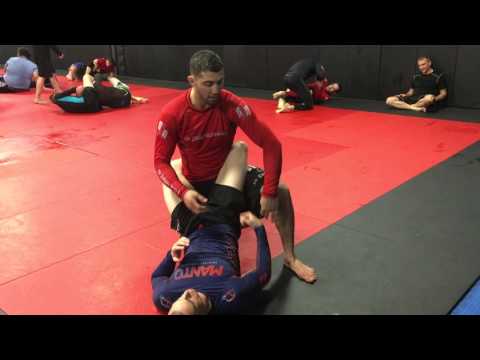
Technique Of The Week: How To Open The Guard In No Gi
0
Open Guard·Matt Arroyo Jiu Jitsu
http://www.NoGiLibrary.com Matt Arroyo shows how to open the guard the easiest way in no gi. Some people who train only…
Перевод: open guard
The Open Guard family covers all guard positions where the guard player's legs are not closed around the opponent, instead using feet on hips, hooks, or grip-and-foot combinations to maintain guard control. [1] Open guard is the most diverse and technically sophisticated guard category in grappling, encompassing dozens of distinct positions including De La Riva, spider, collar-sleeve, lasso, sit-up, and shin-on-shin guards. [1],[2] Open guards require superior grip fighting and distance management because they lack the closed guard's inherent security of locked legs. [2],[3]
The open guard encompasses the broadest category of guard positions, providing more mobility and sweeping angles than the closed guard at the cost of less direct control. [1] Open guard mastery is essential for modern competitive BJJ, as most high-level matches involve extensive open guard play. [2]
Open guard systems are the most commonly played guards at the highest levels of BJJ competition. [1]
Изображений для этой техники пока нет.
Войдите, чтобы предложить изображение.
http://www.NoGiLibrary.com Matt Arroyo shows how to open the guard the easiest way in no gi. Some people who train only…
Учебных курсов по этой технике пока нет.
Войдите, чтобы предложить курс.
Риск травмы для человека, к которому применяется техника
Guard positions are defensive; injury risk comes from transitions, not the position itself
Уровень мастерства, необходимый для надёжного выполнения техники
Разрешена ли техника по основным соревновательным правилам
Jiu-Jitsu University (Saulo Ribeiro, 2008)
Alias sources — [1] Jiu-Jitsu University (Ribeiro, 2008) [2] Jiu-Jitsu University (Ribeiro, 2008) [3] Jiu-Jitsu University (Ribeiro, 2008)
Effectiveness sources — [1] Jiu-Jitsu University (Ribeiro, 2008) [2] The Guard (Moreira & Beneville, 2003)
Standard katakana transliteration of Western martial arts terminology (外来語) — used in Japanese MMA, boxing, and BJJ communities
Alias sources — [1] Jiu-Jitsu University (Ribeiro, 2008) [2] Jiu-Jitsu University (Ribeiro, 2008) [3] Jiu-Jitsu University (Ribeiro, 2008)
Effectiveness sources — [1] Jiu-Jitsu University (Ribeiro, 2008) [2] The Guard (Moreira & Beneville, 2003)
hip flexibility, active legs, grip management
long legs for distance control and guard retention
hip flexors, adductors, quadriceps, core, grip
Каждое движение в любом боевом искусстве обладает рядом универсальных свойств. Комбинируйте параметры ниже, чтобы найти нужный инструмент или сравнить аналоги из разных стилей.
The Collar-Sleeve Guard subfamily covers the open guard position where the guard player controls one collar and one sleeve while using the feet to manage distance and create attacking angles. [1] The collar-sleeve guard is one of the most versatile gi guard positions because the combination of collar and sleeve control provides push-pull capability while preventing the opponent from posting or gripping. [1,2] The guard player typically places one foot on the hip and the other on the bicep of the controlled arm. [2,3]
The De La Riva Guard subfamily covers the open guard position where the guard player hooks one leg around the opponent's lead leg from the outside, wrapping the foot behind the knee, while controlling the ankle of that leg with the hand. [1] The DLR guard provides powerful off-balancing leverage through the hook and ankle control combination, which can stretch the opponent's base and create sweep, back take, and submission opportunities. [1,2] The DLR guard is one of the most important and widely used open guard positions in modern BJJ. [2,3]
The Lasso Guard subfamily covers the open guard position where the guard player wraps one leg over the opponent's arm and threads it through, creating a 'lasso' that entangles the arm and provides powerful control. [1] The lasso guard is a gi-dependent position because the foot must grip or hook the gi material to maintain the lasso wrap. [1,2] The lasso provides very strong one-sided control that can be used for sweeps, omoplata entries, and triangle set-ups. [2,3]
The Shin-On-Shin Guard subfamily covers the guard position where the guard player places the shin across the opponent's shin, using the bone-on-bone contact as a frame and lever for sweeps and transitions. [1] Shin-on-shin guard is a highly transitional position that serves as a gateway to single leg X-guard, X-guard, and butterfly guard entries. [1,2] The shin-on-shin contact provides a stable connection point that can be used to elevate, off-balance, and redirect the opponent's movement. [2,3]
The Sit-Up Guard subfamily covers the open guard position where the guard player sits up with one foot on the opponent's hip and the other leg positioned for sweeps or transitions, with hands controlling grips. [1] The sit-up guard is a dynamic, upright open guard position that provides excellent transitional mobility for single leg entries, arm drags, and guard pulls. [1,2] The upright posture allows the guard player to quickly change levels and angles, making it one of the most versatile guard entry positions. [2,3]
Spider guard is a gi-dependent open guard where the bottom player grips both of the opponent's sleeves and places their feet on the opponent's biceps, creating a web of control that manages distance, prevents passing, and sets up sweeps and submissions. [1] Named for the way the guard player's limbs extend outward like a spider's legs, the position offers exceptional distance management and one of the widest attack repertoires of any guard — triangles, omoplatas, lasso entries, and various sweeps are all accessible from the spider guard framework. [1,2] Spider guard requires significant grip endurance because maintaining bilateral sleeve control against a resisting opponent is physically demanding, but when maintained, it is one of the most difficult guards to pass. [2,3] The position was popularised by competitors like Romulo Barral, Leandro Lo, and Michael Langhi, who built World Championship careers around spider guard mastery. [3]
Open guard encompasses all guard positions where the legs are not closed around the opponent — spider guard, lasso guard, De La Riva, reverse De La Riva, and others. Modern BJJ competition is dominated by open guard play. (Ribeiro, Jiu-Jitsu University)
Use your core instead of your triceps to apply pressure. Control your opponent's wrist and knee, then drive your core down to open the guard, which allows you to transition into any pass you want.
If they pull you in by grabbing your head, you can either circle your hand out while controlling their shoulder and elbow, or put your chin to your chest and swipe their grip off your head to maintain control.
Keep one foot up to prevent sweeps and leg locks, and if you're getting over the guard, hug them with your head and give them your head free while stepping over to avoid them re-closing.
Many practitioners trained primarily in gi are often unfamiliar with no-gi open guard specifics, particularly regarding grips, posturing, and guard opening techniques, which differ significantly between the two formats.
The Open Guard family covers all guard positions where the guard player's legs are not closed around the opponent, instead using feet on hips, hooks, or grip-and-foot combinations to maintain guard control. Open guard is the most diverse and technically sophisticated guard category in grappling, encompassing dozens of distinct positions including De La Riva, spider, collar-sleeve, lasso, sit-up, and shin-on-shin guards.
Open guard systems evolved as BJJ competition demanded more dynamic and varied guard play. Key innovators include Ricardo De La Riva (DLR guard), the Mendes brothers (modern open guard systems), Leandro Lo (collar-sleeve), and Romulo Barral (spider guard).
IBJJF: разрешён — Legal — guard is fundamental to BJJ, sweeps from guard score 2 points; IJF: ограничен — Guard pulling penalized as non-combativity — groundwork from guard permitted …; ADCC: разрешён — Legal, guard pull penalized -1 point in points portion; Unified MMA: разрешён — Legal — no penalty for playing guard; FIAS Sport Sambo: разрешён — Legal
Оценка опасности 2/10. Low — guard positions are defensive; injury risk comes from transitions, not the position itself
Стандартная цепочка подготовки: Achieve Guard Contact → Control Grips → Manage Distance → Threaten Submissions/Sweeps.
Стандартные контрприёмы: Guard Pass — systematically work to clear the legs and establish a dominant position / Leg Pin — control one or both legs to neutralize guard retention / Pressure Passing — use heavy chest pressure to flatten and immobilize the guard player.
Распространённые варианты: High closed guard (legs high on the back for tighter control and more submis…); Low closed guard (ankles locked at the waist, controlling posture with grips); Body-lock closed guard (wrapping with both overhooks for tight breaking mechanics).
Open guard systems are the most commonly played guards at the highest levels of BJJ competition.
Основные ошибки, на которые стоит обратить внимание: Playing open guard without grips — gripless open guard is easily passed / Using only one guard variation — develop multiple open guard systems for different situations / Playing open guard flat on the back — stay active with elevated hips and constant movement / Not retaining guard when grips are broken — guard retention drills must be practised separately.
Open Guard также известен как Ōpun Gādo, Open Guard System, Distance Guard, Feet-On-Hips Guard.