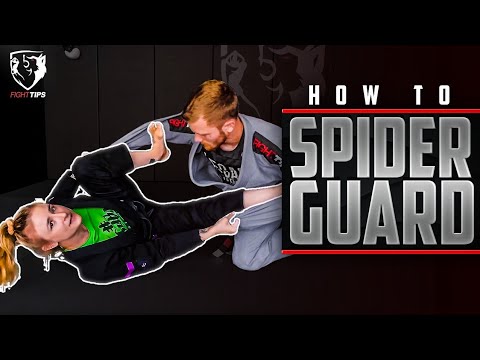
How to Spider Guard (+ 3 Sweeps!)
0
Spider Guard·fightTIPS
Coach Erin Herle is back with 3 sweeps from spider guard, a position from the back that manipulates the opponent's arms …
Перевод: Spider guard
Spider guard is a gi-dependent open guard where the bottom player grips both of the opponent's sleeves and places their feet on the opponent's biceps, creating a web of control that manages distance, prevents passing, and sets up sweeps and submissions. [1] Named for the way the guard player's limbs extend outward like a spider's legs, the position offers exceptional distance management and one of the widest attack repertoires of any guard — triangles, omoplatas, lasso entries, and various sweeps are all accessible from the spider guard framework. [1],[2] Spider guard requires significant grip endurance because maintaining bilateral sleeve control against a resisting opponent is physically demanding, but when maintained, it is one of the most difficult guards to pass. [2],[3] The position was popularised by competitors like Romulo Barral, Leandro Lo, and Michael Langhi, who built World Championship careers around spider guard mastery. [3]
Spider guard developed in the 1990s–2000s as gi-based open guard play became increasingly sophisticated. [1] The position was popularised and refined by Brazilian competitors including Romulo Barral (multiple-time World Champion with spider guard-dominant game), Leandro Lo (dynamic spider guard with toreando-style sweeps), and Michael Langhi (defensive spider guard specialist). [1],[2] Spider guard has become one of the most commonly played guards in gi BJJ competition at all belt levels. [2],[3]
Spider guard is one of the most effective defensive guards in gi BJJ — when grips are maintained, it is extremely difficult to pass. [1] Romulo Barral won multiple IBJJF World Championship titles using spider guard as his primary position. [2] The position is particularly effective against taller opponents because the extended legs create maximum distance. [3]
Изображений для этой техники пока нет.
Войдите, чтобы предложить изображение.
Coach Erin Herle is back with 3 sweeps from spider guard, a position from the back that manipulates the opponent's arms …
Учебных курсов по этой технике пока нет.
Войдите, чтобы предложить курс.
Риск травмы для человека, к которому применяется техника
Spider guard is very safe for the bottom player; the primary risk is forearm fatigue from sustained grip fighting and the rare occurrence of finger injuries from sleeve grips being forcefully broken
Уровень мастерства, необходимый для надёжного выполнения техники
Разрешена ли техника по основным соревновательным правилам
The Guard (Ed Beneville & Joe Moreira, 2003)
Description sources — [1] The Guard (Beneville & Moreira, 2003) on open guard taxonomy [2] Romulo Barral competition analysis [3] IBJJF competition trends
History sources — [1] BJJ competition evolution 1990s-2010s [2] Romulo Barral, Leandro Lo, Michael Langhi career records
Description sources — [1] The Guard (Beneville & Moreira, 2003) on open guard taxonomy [2] Romulo Barral competition analysis [3] IBJJF competition trends
History sources — [1] BJJ competition evolution 1990s-2010s [2] Romulo Barral, Leandro Lo, Michael Langhi career records
forearm endurance (the #1 physical requirement — sustained sleeve gripping is exhausting), hip mobility (angle changes and guard retention), flexible hamstrings (extended leg positioning)
long legs (more reach and distance management), strong grip, hip flexibility
forearms (grip — the limiting factor), hip flexors (maintaining feet on biceps), core (hip movement and angle changes), hamstrings (leg extension)
Каждое движение в любом боевом искусстве обладает рядом универсальных свойств. Комбинируйте параметры ниже, чтобы найти нужный инструмент или сравнить аналоги из разных стилей.
The One-Sleeve Spider Guard uses the spider guard on one side only — one foot on the bicep with sleeve control — while the other leg is positioned differently (on the hip, in DLR, or on the mat). [1] The single-sided spider guard provides asymmetric control that opens up different sweep and submission angles compared to the full spider guard. [1,2] It is frequently used as a transitional position between spider guard and other guard configurations. [2,3]
The Standard Spider Guard establishes the full spider guard with both hands gripping the opponent's sleeves, both feet placed on the biceps, and the legs extended to create maximum distance and control. [1] The standard spider guard is the base position from which all spider guard attacks originate — sweeps using leg push-pull mechanics, triangle choke entries by pulling one arm in, and omoplata set-ups. [1,2] The four-point control (two grips, two feet) provides a comprehensive framework for attacking from the back. [2,3]
Spider guard appears in 85 passages across 9 books — one of the most documented open guard systems. Uses sleeve grips with feet on the opponent's biceps for distance control. Jiu Jitsu Style (2015) competition analysis shows spider guard as one of the highest-percentage sweep-starting positions for top female competitors. (9 books in corpus; Jiu Jitsu Style 29, 2015)
You should never be straight in spider guard—if your hips are up and straight, you're weighing your opponent down but making it harder to defend. Instead, choose a side, drop your hips down to the center, and angle your body so that whichever hip you're on corresponds to your extended leg.
Create tension by spreading your knee outward; if you don't, your opponent can easily circle his hand in and break the hook. When you pull and maintain tension, it's much harder for him to find room to escape.
Keep control of both sleeves throughout the sweep and get your hips up in the air—work it as one continuous motion. Keep the sleeves to staple your opponent down and transition into position once you've swept them over.
Spider guard is a gi-dependent open guard where the bottom player grips both of the opponent's sleeves and places their feet on the opponent's biceps, creating a web of control that manages distance, prevents passing, and sets up sweeps and submissions. Named for the way the guard player's limbs extend outward like a spider's legs, the position offers exceptional distance management and one of the widest attack repertoires of any guard — triangles, omoplatas, lasso entries, and various sweeps are all accessible from the spider guard framework.
Spider guard developed in the 1990s–2000s as gi-based open guard play became increasingly sophisticated. The position was popularised and refined by Brazilian competitors including Romulo Barral (multiple-time World Champion with spider guard-dominant game), Leandro Lo (dynamic spider guard with toreando-style sweeps), and Michael Langhi (defensive spider guard specialist).
IBJJF: разрешён — Legal — guard is fundamental to BJJ, sweeps from guard score 2 points; IJF: ограничен — Guard pulling penalized as non-combativity — groundwork from guard permitted …; ADCC: разрешён — Legal, guard pull penalized -1 point in points portion; Unified MMA: разрешён — Legal — no penalty for playing guard; FIAS Sport Sambo: разрешён — Legal
Оценка опасности 2/10. Low — spider guard is very safe for the bottom player; the primary risk is forearm fatigue from sustained grip fighting and the rare occurrence of finger injuries from sleeve grips being forcefully broken
Стандартная цепочка подготовки: Grip Sleeves → Place Feet → Extend → Manage Distance → Off-Balance → Attack.
Стандартные контрприёмы: Grip Break — systematically stripping the guard player's sleeve grips eliminates spider guard entirely / Bull Rush — driving forward aggressively to collapse the extended legs / Stacking — driving the guard player's legs over their head / Backstep — stepping backward and around the spider guard legs.
Распространённые варианты: Full spider guard (both feet on biceps with bilateral sleeve control; the st…); Lasso spider guard (one leg lassoed around the opponent's arm, one foot on bi…); One-foot spider (one foot on bicep, one foot on hip or in DLR hook; transi…); Cross spider (gripping the opposite-side sleeve (right hand grips left …); Spider-to-DLR (transitional framework between spider guard and De La Riv…).
Spider guard is one of the most commonly played guards in IBJJF gi competition. Romulo Barral won multiple World Championship titles with spider guard as his primary position.
Основные ошибки, на которые стоит обратить внимание: Letting both grips break simultaneously — losing one grip is recoverable; losing both means losing the guard entirely / Pulling the opponent too close — spider guard works at extended range; pulling the opponent in collapses the position… / Not moving the hips — static spider guard with no hip movement is passed by walking around the legs / Ignoring the lasso option — when the opponent pressures forward, transitioning to lasso guard (wrapping the leg aroun….
Spider Guard также известен как Supaidā Gādo, Spider Guard, Spider Web Guard, Lasso Spider Guard.