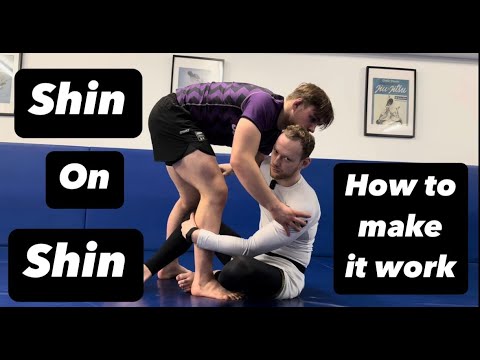
Shin-on-shin guard: weaknesses and how to play it.
0
Shin-On-Shin Guard·Dima Murovanni Bjj
This is a Video from my Patreon: https://www.patreon.com/c/dimamurovanni Coach Dima Murovanni discusses the weaknesses a…
Перевод: shin-on-shin guard
The Shin-On-Shin Guard subfamily covers the guard position where the guard player places the shin across the opponent's shin, using the bone-on-bone contact as a frame and lever for sweeps and transitions. [1] Shin-on-shin guard is a highly transitional position that serves as a gateway to single leg X-guard, X-guard, and butterfly guard entries. [1],[2] The shin-on-shin contact provides a stable connection point that can be used to elevate, off-balance, and redirect the opponent's movement. [2],[3]
The shin-on-shin guard developed in modern BJJ as a transitional guard position, particularly associated with the guard systems of Marcelo Garcia and other no-gi specialists who used it as an entry to X-guard and single leg X. [1] It has become a widely used transitional guard in both gi and no-gi competition. [2],[3]
Shin-on-shin guard places the bottom player's shin against the opponent's shin, controlling distance and setting up single-leg X entries and sweeps. [1]
Shin-on-shin guard was developed in modern no-gi BJJ as an entry to X-guard and single-leg X. [1]
Shin-on-shin guard is widely used in both gi and no-gi competition. [1]
Изображений для этой техники пока нет.
Войдите, чтобы предложить изображение.
This is a Video from my Patreon: https://www.patreon.com/c/dimamurovanni Coach Dima Murovanni discusses the weaknesses a…
Учебных курсов по этой технике пока нет.
Войдите, чтобы предложить курс.
Риск травмы для человека, к которому применяется техника
Guard positions are defensive; injury risk comes from transitions, not the position itself
Уровень мастерства, необходимый для надёжного выполнения техники
Разрешена ли техника по основным соревновательным правилам
Advanced Brazilian Jiu-Jitsu Techniques (Marcelo Garcia, 2011)
Alias sources — [1] Jiu-Jitsu University (Ribeiro, 2008) [2] The Guard (Moreira & Beneville, 2003) [3] Marcelo Garcia: Advanced BJJ Techniques (2011)
Effectiveness sources — [1] Mastering Jujitsu (Gracie & Danaher, 2003)
Standard katakana transliteration of Western martial arts terminology (外来語) — used in Japanese MMA, boxing, and BJJ communities
Alias sources — [1] Jiu-Jitsu University (Ribeiro, 2008) [2] The Guard (Moreira & Beneville, 2003) [3] Marcelo Garcia: Advanced BJJ Techniques (2011)
Effectiveness sources — [1] Mastering Jujitsu (Gracie & Danaher, 2003)
hip flexibility, active legs, grip management
long legs for distance control and guard retention
hip flexors, adductors, quadriceps, core, grip
Каждое движение в любом боевом искусстве обладает рядом универсальных свойств. Комбинируйте параметры ниже, чтобы найти нужный инструмент или сравнить аналоги из разных стилей.
The main weakness is that you're positioned very close to your partner, which makes it easy for them to get an underhook and immediately attack with a knee cut pass. Dima Murovanni emphasizes that you can easily open yourself up and give your opponent this opportunity.
You need to establish a self-frame on your other knee with a knee post or hip post to make it much harder for your opponent to secure the underhook. Additionally, Dima Murovanni recommends staying connected and using hand/grip control—such as grabbing your opponent's hand with a robust grip and connecting your lower body with your elbow—to prevent underhook entries.
You need to maintain connection with your partner at all times while managing your positioning carefully. Dima Murovanni also suggests that combining upper body control (like hand grips in the gi) with your lower body positioning gives you the best defensive structure in shin-on-shin guard.
The Shin-On-Shin Guard subfamily covers the guard position where the guard player places the shin across the opponent's shin, using the bone-on-bone contact as a frame and lever for sweeps and transitions. Shin-on-shin guard is a highly transitional position that serves as a gateway to single leg X-guard, X-guard, and butterfly guard entries.
The shin-on-shin guard developed in modern BJJ as a transitional guard position, particularly associated with the guard systems of Marcelo Garcia and other no-gi specialists who used it as an entry to X-guard and single leg X. It has become a widely used transitional guard in both gi and no-gi competition.
IBJJF: разрешён — Legal — guard is fundamental to BJJ, sweeps from guard score 2 points; IJF: ограничен — Guard pulling penalized as non-combativity — groundwork from guard permitted …; ADCC: разрешён — Legal, guard pull penalized -1 point in points portion; Unified MMA: разрешён — Legal — no penalty for playing guard; FIAS Sport Sambo: разрешён — Legal
Оценка опасности 2/10. Low — guard positions are defensive; injury risk comes from transitions, not the position itself
Стандартная цепочка подготовки: Achieve Guard Contact → Control Grips → Manage Distance → Threaten Submissions/Sweeps.
Стандартные контрприёмы: Guard Pass — systematically work to clear the legs and establish a dominant position / Leg Pin — control one or both legs to neutralize guard retention / Pressure Passing — use heavy chest pressure to flatten and immobilize the guard player.
Распространённые варианты: Standard butterfly guard (both feet hooked inside the opponent's thighs); Single butterfly hook (one hook in while the other leg posts or controls); Butterfly with overhook (combining the hooks with an overhook for sweep setups).
Shin-on-shin guard is widely used in both gi and no-gi competition.
Основные ошибки, на которые стоит обратить внимание: Playing shin-on-shin as a final position — it is a transition guard; move to X-guard or single-leg X / Not controlling the opponent's upper body while playing shin-on-shin — sleeve or wrist control is necessary / Placing the shin too high or too low — the shin should contact the opponent's shin at mid-level / Sitting too far from the opponent — the shin contact requires proximity.
Shin-On-Shin Guard также известен как Shin On Shin Gādo, Shin-to-Shin Guard, Shin Guard, Shin Hook Guard.