Foundation of Effective Takedowns
For practitioners without prior wrestling or judo experience, Greco-Roman style upper body takedowns provide the essential foundation for learning proper technique. Understanding body manipulation teaches critical principles including off-balancing, hip connection, and lower body finishing mechanics. The body lock takedown from double under hooks serves as the optimal starting point for developing these foundational skills.
The Double Under Hook: Most Dominant Clinch Position
Among all available clinch grips—collar tie, wrist control, and single under hook—the double under hook represents the most dominant and controlling position. This superior grip establishes the strongest mechanical advantage for executing takedowns efficiently while minimizing energy expenditure. Mastering this position should precede exploration of leg attacks and trips.
Establishing the Double Under Hook
From a typical upright jiu-jitsu stance, the practitioner initiates contact by tucking the elbows and driving into the opponent's frame to access the underhook position. An alternative entry involves a high-guard crash into the opponent's shoulder, which typically forces them to reach for a collar tie and creates access to both underhooks. Both methods prove effective for establishing control before securing the grip.
Hand Lock and Hip Management
Once double underhooks are established, the practitioner locks the hands using an S-grip or gable grip around the opponent's upper back. Experienced opponents will immediately pinch their elbows to their ribs and scoot their hips backward to relieve pressure on the locked position. The practitioner must respond by taking an angle toward the opponent's head side to shuck toward the rear body lock.
Countering the Over Hook Defense
As the practitioner shuffles their feet to shuck, experienced opponents will block the pathway to the rear body lock by establishing an over hook. The critical mistake at this point is reaching the chest forward, which creates space for the opponent to execute a throw. Instead, the practitioner must immediately crowd the hips forward, leading with the hips rather than the chest to eliminate this throwing lane.
The Hip-Driven Finish
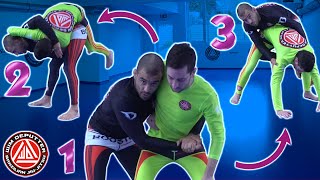
The most efficient finish involves pulling oneself into the opponent rather than pulling the opponent toward oneself—a subtle but mechanically significant distinction. The practitioner brings their hips in close while pulling their own upper body toward the opponent, forcing the opponent's posture upright and backward. From this controlled position, a hip pop combined with a rear leg bump lifts the opponent's feet off the ground, allowing the practitioner to shelf them across their hip.
Defeating the Chest-Forward Posture
When an opponent folds their chest downward to increase weight and create heaviness during the finish, the mechanics of the lift break down. The practitioner responds by stepping in front of the opponent and scooping their leg forward while pulling their upper body backward. This step-and-pull sequence intercepts the opponent's weight distribution and generates the necessary lift to complete the takedown.
Progression and Cage Application
The body lock takedown principles extend to cage environments, where practitioners can step and pull the opponent off the fence before dragging them to the ground. Mastering the fundamental mechanics in open space translates directly to cage applications and variations. This technique serves as the cornerstone from which more advanced takedown systems develop.
THE KING OF ALL TAKEDOWNS: THE BODY LOCK TAKEDOWN FOR ALL GRAPPLING SYSTEMS.
Key Takeaways
- •Foundation of Effective Takedowns
- •The Double Under Hook: Most Dominant Clinch Position
- •Establishing the Double Under Hook
- •Hand Lock and Hip Management
When building skills in the standing position, the first place every practitioner should start is the body lock takedown. Of the many variations of the body lock, the king of all of them is the body lock takedown with double underhooks in BJJ, wrestling, MMA, and grappling in general. Double underhooks are by far the most dominant grips you can achieve in the standing position because they allow you to build a strong connection in the clinch and create maximum leverage with the hips while exposing an opening to the back. If one is able to secure double underhooks, the foundation of their attacks should revolve around locking the hands and off-balancing with the hips. In this video, we discuss the importance of double underhooks in the standing position, how to leverage the grips once achieving the body lock, and a system of attacks based on the defending player’s reactions in Brazilian Jiu Jitsu, grappling, and MMA. We're building this channel to share high-level insights on Brazilian Jiu-Jitsu, No-Gi grappling, wrestling, Judo, and MMA training. If you find this breakdown helpful, please like, subscribe, and drop a comment with any questions or future video requests. https://www.youtube.com/@KataJiuJitsu www.instagram.com/katalosangeles Book a private or Q&A - [email protected] – KATA #MMA #wrestling #nogi #bjj #grappling #submissiongrappling #judo #jiujitsu #nogigrappling #dagestaniwrestling
Related Techniques
Frequently Asked Questions
What does this video teach about body-lock takedown to back?
This video covers foundation of effective takedowns, the double under hook: most dominant clinch position, establishing the double under hook. It provides detailed instruction from Kata Jiu Jitsu.
How long does it take to learn body-lock takedown to back?
The basic mechanics can be understood in a single session, but developing reliable execution requires consistent drilling over weeks of practice. This 8-part breakdown helps structure your training by isolating each phase of the technique.
What are the key details for finishing body-lock takedown to back?
When an opponent folds their chest downward to increase weight and create heaviness during the finish, the mechanics of the lift break down. The practitioner responds by stepping in front of the opponent and scooping their leg forward while pulling their upper body backward. This step-and-pull sequence intercepts the opponent's weight distribution and generates the necessary lift to complete the takedown.
Related videos
How to Takedown From a Rear Bodylock | #Wrestling for #JiuJitsu
Etienne Duchesne | Victimweight Jiu Jitsu
Back Bend Takedown by John Danaher
BJJ Fanatics
How To Defend Double Jab: Body Lock Takedown To Ground & Pound
TRITAC Martial Arts
3 Simple Takedowns from Rear Body Lock | Nicky Rod B-Team Technique
The B-Team
Hip Throw Setup And Back Take Combo From Body Lock
Wim Deputter BJJ