Setup and Initial Positioning
The instructor begins from butterfly guard by pinching the opponent's legs and driving inward. The hands are brought back to cup the opponent's ankles, establishing control before initiating the pass sequence.
Head Positioning and Lead Direction
The passer leads with the head to the opposite side from where the legs will travel, rather than waiting for the opponent to dictate direction through a push. This proactive head positioning allows the passer to choose their dominant passing side.
Perpendicular Body Orientation
The critical technical element is bringing the body to a perpendicular (90-degree) angle to the opponent rather than attempting to hop laterally over the legs. The instructor recommends holding this perpendicular position briefly during practice to build balance and confidence.
Leg Clearing Mechanism
Once at perpendicular, the inside hand pushes the opponent's legs away to create space for the pass. This pushing action at 90 degrees prevents the opponent from using hip movement to defend, as any counter-movement still results in the passer achieving the pass.
Hand Posting and Weight Distribution
The passer posts the outside hand on the floor to support weight during the cartwheel motion, ensuring shoulder pressure provides stability throughout the technique.
Bicep Drive and Collapse
The bicep of the inside arm drives the opponent's legs outward and downward while the passer falls into side control. This arm drive is emphasized as the primary force that clears the legs effectively.
Common Error: Insufficient Commitment
Jumping with hesitation or insufficient force often results in poor positioning. The instructor recommends jumping with full commitment as though going completely over the legs, using the arm pinch to catch and control the pass if the initial jump is too aggressive.
Bicep-Driven Leg Clearance
The bicep push, rather than a cutting motion, is identified as the essential driving force for a successful pass. This muscular engagement prevents the opponent from regaining position even if they travel far during the technique.
Butterfly Pass Modified Cartwheel
Key Takeaways
- •Setup and Initial Positioning
- •Head Positioning and Lead Direction
- •Perpendicular Body Orientation
- •Leg Clearing Mechanism
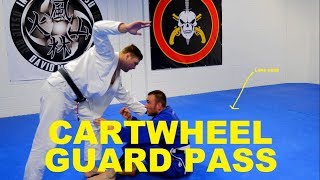
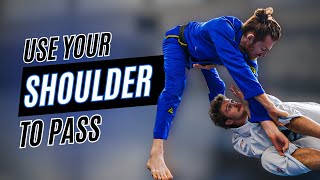
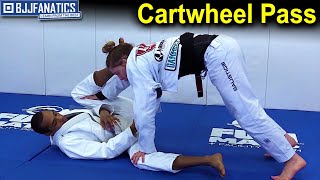
In this video I show one of my highest percentage Butterfly Guard Passes The Modified Cartwheel. This is a great option and works at all levels. I especially like to use it against advanced players as they do not expect a larger player like me to do something like this. This is distinctly different from a regular cartwheel pass as it starts on your knees and does not require you to support your body weight on your arms. As a matter of a fact that is one of the hardest part of this pass, it requires you to transition to a position with your feet high and all your weight should be resting on your shoulder (NOT YOUR HEAD). Once you have brought your opponents ankles into their butt and squeezed (just like every other video I have on Butterfly Guard Passing) it is time to flatten out your opponent and place your head on their chest. Once they are flat on their back you should reach your hands back into the space between their calf and their thigh. You do NOT need to grab anything, just to place your hand in that space. Often you opponent will think you are trying to control their pant legs in order to do the previous pass that I posted. This can result in your opponent pushing down on the back of your head, this is great as it helps with the pass. Whatever side your opponent pushes your head to, you will pass your legs to the opposite side. Make sure that when you hop that you really commit to the hop. You want your legs to go all the way perpendicular (or more) for this pass to be effective. If you do not commit to the jump your pass will not be successful. Once your body is perpendicular it is time to push with the bicep. This is important as it moves both your body, and your opponents body in opposite directions. This is the hardest part, by far, of the move and takes a lot of practice. I highly recommend repping this out before trying to do it during class or a live rolling session.
Related Techniques
Frequently Asked Questions
What does this video teach about cartwheel pass?
This video covers setup and initial positioning, head positioning and lead direction, perpendicular body orientation. It provides detailed instruction from Great Grappling.
How long does it take to learn cartwheel pass?
The basic mechanics can be understood in a single session, but developing reliable execution requires consistent drilling over weeks of practice. This 8-part breakdown helps structure your training by isolating each phase of the technique.
What are the key details for finishing cartwheel pass?
Jumping with hesitation or insufficient force often results in poor positioning. The instructor recommends jumping with full commitment as though going completely over the legs, using the arm pinch to catch and control the pass if the initial jump is too aggressive.