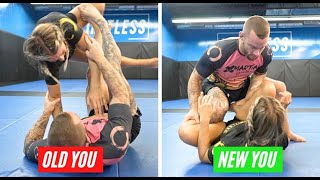
Core Principle: Chest-to-Chest Consolidation
The fundamental objective of the toreando pass is to eliminate space between the attacker's chest and the defender's chest, preventing the defender from re-centering their guard. By creating direct contact before the defender can reposition their legs, the passer controls the consolidation phase. This principle underpins all variations of the technique.
Shoulder Impact and Unpredictability
The toreando pass relies on driving the shoulder directly into the defender's chest along a clear line of approach. This rapid shoulder-driven entry makes the pass difficult to predict and defend. The speed of execution prevents the defender from establishing effective frames or re-establishing guard structure.
Dual Defense Management: Legs and Frames
The passer must address two primary defensive layers: the defender's leg position (feet or knee shield) and their arm frames. These defenses must be neutralized sequentially, with leg clearance preceding the shoulder drive. Managing both simultaneously compromises the effectiveness of the pass.
Clearing the Legs for Direct Access
Creating a direct line to the chest requires moving the defender's legs out of the way through pressing, pulling, or rotation mechanics. The specific method depends on leg placement and positioning. Once the legs are displaced, the passer gains an unobstructed angle for the shoulder drive.
Positional Foundation: Knee Drop vs. Wide Base
The passer can execute the shoulder drive from either a dropped-knee position or a wide leg stance. The wide stance provides greater versatility, allowing the passer to pivot laterally, circle to alternate sides, or consolidate into north-south position. Wide leg positioning also reduces the hinging distance required during approach.
Pant Grip Mechanics for Leg Control
Controlling the defender's legs through cuff grips or external pant grips allows the passer to press or snap the legs out of the passing line. This method is most effective when the defender's pants remain in consistent position. As pants ride up, grip reliability decreases and alternative control methods become necessary.
Pulling Mechanics and Ankle Control
Pulling the defender's legs outward creates space for the shoulder drive and can facilitate lateral repositioning by the passer. When pants become unreliable, ankle grips or knee cups provide direct leg control. These techniques remain functional in both gi and no-gi contexts.
Initial Approach Stance and Level Management
The passer's initial stance should establish width before engaging with the defender's guard, reducing the vertical distance that must be closed during entry. A wide, hinged approach position places the passer's center of mass closer to the defender's torso, improving mechanical efficiency. This positioning minimizes the range the shoulder must travel to establish contact.
Understanding The Toreando Pass
Key Takeaways
- •Core Principle: Chest-to-Chest Consolidation
- •Shoulder Impact and Unpredictability
- •Dual Defense Management: Legs and Frames
- •Clearing the Legs for Direct Access
Free Video on "The Outside Knee Grip System" https://www.mavericksjj.com/courses/take/mavericks-lab/lessons/49456690-outside-knee-grip-destroys-guards Full Courses Here: https://www.mavericksjj.com/
Related Techniques
Frequently Asked Questions
What does this video teach about standard toreando pass?
This video covers core principle: chest-to-chest consolidation, shoulder impact and unpredictability, dual defense management: legs and frames. It provides detailed instruction from JonThomasBJJ.
How long does it take to learn standard toreando pass?
The basic mechanics can be understood in a single session, but developing reliable execution requires consistent drilling over weeks of practice. This 8-part breakdown helps structure your training by isolating each phase of the technique.
What are the key details for finishing standard toreando pass?
Pulling the defender's legs outward creates space for the shoulder drive and can facilitate lateral repositioning by the passer. When pants become unreliable, ankle grips or knee cups provide direct leg control. These techniques remain functional in both gi and no-gi contexts.