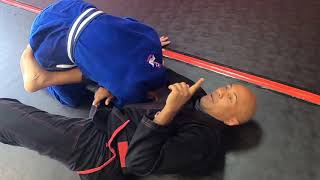
Introduction and Setup
Ty demonstrates the forced arm-in guillotine choke from closed guard, a variation designed to address the common finishing problem with this technique. The instructor begins by establishing Stage One positioning, where the practitioner controls the opponent's head and arm while keeping them pinned tightly to prevent posturing and strikes.
Initial Head and Arm Control
The practitioner maintains a tight grip on both the opponent's head and trapped arm, preventing the opponent from raising their head or creating space. This close control is essential for protection and sets the foundation for the subsequent movements.
Transitioning to the Side
The instructor uses the far hand to push the opponent's head underneath the elbow while placing one foot on the floor and scooting the hips to the side. This positioning creates pressure and prevents the opponent from posturing up while the practitioner transitions their body angle.
Elbow Insertion and Guard Lock
As the practitioner gets fully on their side, they raise the elbow and insert it past the opponent's arm, creating the locked guillotine position in closed guard. The trapped arm now sits across the choke setup, which presents the primary finishing challenge.
The Finishing Problem
The instructor explains that typical finishing attempts fail because practitioners try to squeeze vertically, causing the opponent's head to slip out. The key issue is that the trapped arm remains too close to the practitioner's body, preventing proper wrist positioning under the chin.
Adjusting Hip Position for Finish
To complete the submission, the practitioner places their foot on the ground on the same side as the trapped arm and scoots in that direction. This hip movement allows the wrist and forearm to slip underneath the opponent's chin for a proper choke finish.
Arm Positioning and Fish Hook
The instructor emphasizes raising the elbow, shooting the arm through, and securing an underhook beneath the opponent's arm while the hand creating the choke is described as a 'fish.' Rocking back into guard with proper arm positioning ensures the trapped arm doesn't interfere with the final choke.
Complete Execution and Body Extension
Throughout the technique, maintaining a tight elbow against the opponent's head keeps them clamped down. The practitioner places their foot down, scoots onto their side, extends their body slightly, then continues scooting their hips out before raising the elbow and shooting through to finalize the choke setup.
Arm-In Guillotine: Forced Variation (Guard)
Key Takeaways
- •Introduction and Setup
- •Initial Head and Arm Control
- •Transitioning to the Side
- •Elbow Insertion and Guard Lock
Arm-In Guillotine: Forced Variation (Guard) Ty and Chase show you how to finish with the arm in the guillotine from guard. Website - http://www.redlinebjj.com Redline Instagram - http://bit.ly/2Cykt7w Redline Facebook - https://www.facebook.com/redlinejiujitsu/ Ty Gay Social Media Instagram - http://bit.ly/2ksdi8I Facebook - https://www.facebook.com/ty.gay.12 Chasen Hill Social Media Instagram - http://bit.ly/2yEwBRc Facebook - https://www.facebook.com/chasen.hill.9 Submitting Life Podcast YouTube - http://bit.ly/2BFuZIK Instagram - http://bit.ly/2CCuNvu Facebook - https://www.facebook.com/submittinglifepodcast/
Related Techniques
Frequently Asked Questions
What does this video teach about guillotine choke from closed guard arm-in?
This video covers introduction and setup, initial head and arm control, transitioning to the side. It provides detailed instruction from Redline Jiu-Jitsu.
How long does it take to learn guillotine choke from closed guard arm-in?
The basic mechanics can be understood in a single session, but developing reliable execution requires consistent drilling over weeks of practice. This 8-part breakdown helps structure your training by isolating each phase of the technique.
What are the key details for finishing guillotine choke from closed guard arm-in?
The instructor emphasizes raising the elbow, shooting the arm through, and securing an underhook beneath the opponent's arm while the hand creating the choke is described as a 'fish.' Rocking back into guard with proper arm positioning ensures the trapped arm doesn't interfere with the final choke.