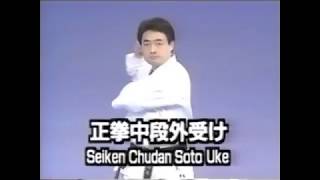
Technique Name and Classification
The technique is called Soto Uke, or outside forearm block, named for its defensive path originating from the outside. This mid-level block (chudan) positions the practitioner's knuckles at approximately shoulder height upon completion. It is typically applied when an opponent delivers a mid-level punch, requiring the defender to step aside while executing the block.
Starting Position and Preparation
Begin in a natural stance with the left hand extended as if delivering a straight punch to the opponent's solar plexus. The right arm prepares for the block by positioning near the body, with the fist facing outward at approximately ear level. This preparation position serves as the foundation for proper technique execution.
Chamber and Formation
From the preparation position, point the right elbow toward the ear while closing the fist in a controlled manner. The arm should remain relatively close to the body during this chamber phase. This positioning ensures efficient power transfer and proper alignment throughout the blocking motion.
Execution and Hip Rotation
As an opponent's punch approaches, rotate the hips and torso inward while extending the blocking arm outward and slightly upward. The body rotation should originate from the core, with the hips turning inward rather than outward. This hip-driven movement generates the power necessary for an effective block.
Wrist and Arm Alignment
Maintain a straight wrist throughout the entire blocking motion, as straight wrists provide superior structural integrity against impact. Avoid flexing or curling the wrist, which weakens the defensive position and increases vulnerability to force redirection. A straight wrist position ensures maximum shock absorption and stability.
Single and Double-Count Variations
The complete technique can be practiced as a continuous flowing motion or broken into two-count intervals for detailed form analysis. While the single continuous execution is standard, the two-count variation allows practitioners to emphasize specific positions and transitions. Both methods develop proficiency, though continuous practice should remain the primary focus.
Multiple Repetition Protocol
Students should execute the technique repeatedly at increasing speeds to develop muscle memory and practical application capability. Performing at least four to five consecutive repetitions at varied tempos builds consistency and endurance. Progressive speed work prepares practitioners for realistic defensive scenarios.
Postural and Stance Maintenance
Throughout the blocking sequence, maintain forward-facing feet, engaged posture, and stable hip position without excessive vertical movement. The upper body should remain composed without bobbing or unnecessary adjustment. Proper stance discipline ensures the technique's effectiveness and prevents energy loss during execution.
How to Do Soto Ude Uke | Shotokan Karate Outside Forearm Block Tutorial
Key Takeaways
- •Technique Name and Classification
- •Starting Position and Preparation
- •Chamber and Formation
- •Execution and Hip Rotation
In this video, we break down the proper technique for Soto Ude Uke (Outside Forearm Block)—a fundamental block in Shotokan Karate used to defend against middle-level attacks. 🥋 You’ll Learn: Correct hand and arm positioning Proper stance and rotation (hip action) Common mistakes to avoid Practical applications Whether you're a beginner refining your basics or a higher rank reviewing fundamentals, this step-by-step breakdown will help you improve your form and effectiveness. 📌 Train with us online anytime, anywhere at: 👉 https://www.OnlineShotokanAcademy.com #ShotokanKarate #SotoUdeUke #KarateBasics #KarateTraining #OnlineKarate #MartialArtsTutorial #KarateForBeginners #KarateBlocks
Frequently Asked Questions
What does this video teach about seiken chudan soto uke?
This video covers technique name and classification, starting position and preparation, chamber and formation. It provides detailed instruction from Online Shotokan Karate Academy.
How long does it take to learn seiken chudan soto uke?
The basic mechanics can be understood in a single session, but developing reliable execution requires consistent drilling over weeks of practice. This 8-part breakdown helps structure your training by isolating each phase of the technique.
What are the key details for finishing seiken chudan soto uke?
Students should execute the technique repeatedly at increasing speeds to develop muscle memory and practical application capability. Performing at least four to five consecutive repetitions at varied tempos builds consistency and endurance. Progressive speed work prepares practitioners for realistic defensive scenarios.