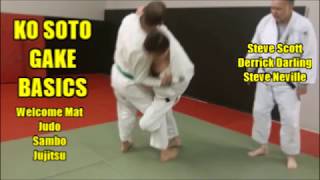
O Soto Otoshi Overview
O Soto Otoshi, known as the Major Outer Drop, is a throwing technique that shares similarities with O Soto Garai and O Soto Garuma but employs a distinct foot placement and popping mechanism. Unlike its counterparts, this technique involves placing the foot on the mat before executing a dynamic pop motion to complete the throw.
Entry and Initial Hand Position
The technique begins with the practitioner stepping in while pulling upward and outward with the left hand to break the opponent's balance. The right hand (surite) is positioned against the opponent's lapel in a standard grip, establishing a solid setup comparable to O Soto Garai's foundational mechanics.
Foot Placement and Stomp Mechanics
The practitioner swings the right leg through and places the foot on the mat with deliberate contact, essentially stomping the toe against the mat. This foot placement is critical, as it serves as the foundation for the explosive popping action that follows, similar to executing a Tai Otoshi toward the rear.
Single or Double Leg Engagement
The technique can be executed by catching either one leg or both legs of the opponent, depending on body type and positioning. Taller practitioners may naturally catch both legs, while others may prefer engaging a single leg; both approaches are viable and effective when properly executed.
Body Type Variations
Different body types produce variations in technique execution; practitioners with longer frames tend to employ a wider Osoto Otoshi with more pronounced hip rotation. Shorter practitioners may favor a more direct downward pop mechanism, demonstrating that successful technique application adapts to individual physical characteristics.
Distinction from O Soto Gari and Garuma
O Soto Otoshi differs fundamentally from O Soto Gari, which involves reaping, and O Soto Garuma, which uses a sweeping motion without foot placement. In O Soto Otoshi, the foot contacts the mat before the pop, creating an upward extension through the leg that generates the throwing force.
Critical Contact Points
The practitioner must achieve thigh-to-thigh contact with the opponent while placing the foot closely to the front of the opponent's feet. This precise positioning ensures that when the leg straightens explosively, the blocking effect creates the downward force necessary to complete the throw.
Foot Positioning Options
Practitioners may position the foot either directly in front of the opponent's leg or across both legs, depending on preference and comfort. Some prefer an immediate pop step following foot placement, while others favor a slightly delayed, more deliberate pressing action before executing the throwing pop.
Balance Breaking with Standard Grip
When using the standard lapel and sleeve grip (kumi kata), balance breaking is achieved through the surikomi action—a lifting and pulling motion executed with the right hand. The right hand maintains a palm-up or fist-up position with the elbow down, creating the upward force that sets up the foot placement and subsequent throw.
O SOTO OTOSHI Using Kumi Kata Grip
Key Takeaways
- •O Soto Otoshi Overview
- •Entry and Initial Hand Position
- •Foot Placement and Stomp Mechanics
- •Single or Double Leg Engagement
O Soto Otoshi (Major Outer Drop) is a powerful throw. In this video, we analyze this throw using a standard Kumi Kata Sleeve and Lapel grip. If you haven't subscribed to our channel yet, please do. Join our premium web site as well at www.grapplingcoach.us. Visit our web sites at http://www.WelcomeMatJudoClub, http://www.judoblackbelt.com and visit our online store at http://www.WelcomeMatStore.com.
Frequently Asked Questions
What does this video teach about standard o soto gake?
This video covers o soto otoshi overview, entry and initial hand position, foot placement and stomp mechanics. It provides detailed instruction from welcomematstevescott.
How long does it take to learn standard o soto gake?
The basic mechanics can be understood in a single session, but developing reliable execution requires consistent drilling over weeks of practice. This 9-part breakdown helps structure your training by isolating each phase of the technique.
What are the key details for finishing standard o soto gake?
Practitioners may position the foot either directly in front of the opponent's leg or across both legs, depending on preference and comfort. Some prefer an immediate pop step following foot placement, while others favor a slightly delayed, more deliberate pressing action before executing the throwing pop.