O SOTO OTOSHI Using Kumi Kata Grip
0
Standard O Soto Gake·welcomematstevescott
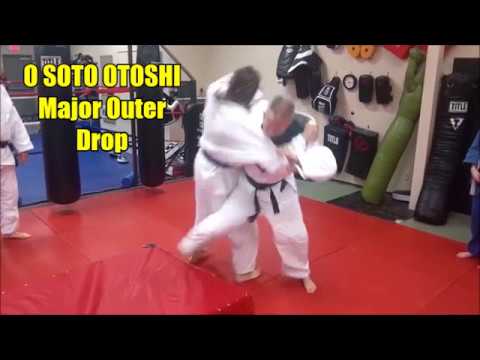
O Soto Otoshi (Major Outer Drop) is a powerful throw. In this video, we analyze this throw using a standard Kumi Kata Sl…
Translation: major outer hook
Standard O Soto Gake executes the classical major outer hook where the thrower steps outside the opponent's lead leg, wraps the calf or hamstring behind the opponent's thigh, and drives the opponent backward over the hooked leg with strong upper-body pressure. [1] The hooking leg maintains contact throughout the throw, preventing the opponent from stepping back, while the hands push the opponent's chest and head rearward. [1],[2] The technique requires close body contact and a powerful forward drive to overcome the opponent's resistance. [2],[3]
O soto gake is classified in the Kodokan nage-waza system as a distinct technique from o soto gari, differentiated by the gake (hooking) leg action. [1]
The standard o soto gake is seen in IJF competition. [1]
No images yet for this technique.
Sign in to suggest an image.
O Soto Otoshi (Major Outer Drop) is a powerful throw. In this video, we analyze this throw using a standard Kumi Kata Sl…
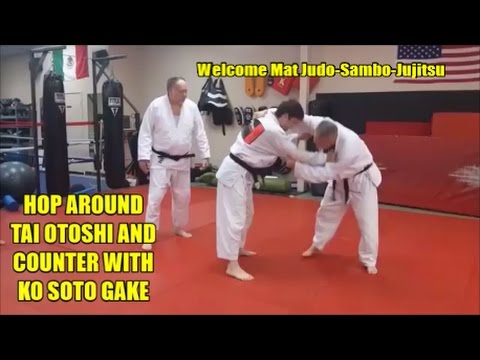
This video shows a standard defense or avoidance move of hopping around an opponent's throwing attack and countering. In…
O Soto Gake (Minor Outer Hook) is a foot-leg throwing technique executed by hooking the opponent's leg from the outside and driving them backward. According to welcomematstevescott's detailed instruction, the technique begins with proper grip setup—typically a standard lapel and sleeve grip with the power hand (surite) positioned palm-up or fist-up with elbow down, employing surikomi (lifting, pulling) action to break balance. The thrower steps in with their non-throwing leg while pulling upward and outward with the upper body, then swings the hooking leg through in a controlled manner. Critically, the foot should make contact with the mat and the thrower should point the toe rather than lead with the heel, maintaining a low, hip-driven posture to generate power. The leg hooks just above or behind the opponent's knee or lower thigh, and the thrower pops off their knees to complete the throw. welcomematstevescott emphasizes that body type influences execution width and hip rotation angle, and stresses that the gripping hands should dictate timing—the grip should secure proximity before the leg hook is committed, preventing the opponent from countering with techniques like uchi mata. O Soto Gake is also effective as a counter to tai otoshi when executed immediately after the opponent's attack is evaded.
Synthesized from 3 instructors
No instructional courses yet for this technique.
Sign in to suggest a course.
Risk of injury to the person this technique is applied to
Hooking action can cause knee/ankle injury if resisted; moderate impact on landing
Skill level needed to execute this technique reliably
Whether this technique is allowed under major competition rule sets
Kodokan Judo — Official Nage-waza Classification
Traditional Judo throwing technique terminology (Kodokan Institute)
Official Kodokan ground technique classification system
Standard Japanese martial arts terminology (kanji/hiragana)
Established Japanese martial arts naming convention — native Japanese term (和語/漢語)
Traditional Judo throwing technique terminology (Kodokan Institute)
single-leg balance, hip flexibility, explosive driving power
long legs for hooking reach, strong standing balance
glutes, hip flexors, hamstrings, core, calves (balance)
You need to counter attack right away—don't just be happy you got out of it. As soon as you get that hop around, pull the trigger and execute your counter; waiting gives your opponent time to recover.
Stay very low, drive with your hips, and point your toe. Let your grips and hand position dictate when you hook the leg—your hands lead the way, so establish your grip first and only hook once you're close enough that your forearm makes contact, which prevents your opponent from countering with uchi mata.
Lead with your hands and grip, not your leg. If you come in leading with your leg, your opponent can counter you with uchi mata. Let your grip establish the connection first, then hook the leg once you're already in close.
You can either place your foot straight on the mat in front of his feet and pop off your knees, or position your foot sideways behind both of his legs. Some prefer the immediate pop step while others prefer the wider base—it's a matter of preference.
Standard O Soto Gake executes the classical major outer hook where the thrower steps outside the opponent's lead leg, wraps the calf or hamstring behind the opponent's thigh, and drives the opponent backward over the hooked leg with strong upper-body pressure. The hooking leg maintains contact throughout the throw, preventing the opponent from stepping back, while the hands push the opponent's chest and head rearward.
The standard form of o soto gake has been part of the Kodokan classification as a distinct technique, taught alongside o-soto-gari to provide students with alternative mechanics for the outside position. The technique is widely used in sambo and wrestling as well as judo.
IJF: legal — Legal throwing technique; IBJJF: legal — Legal at all belt levels; UWW: restricted — Legal in freestyle, banned in Greco-Roman (no leg attacks below waist); Unified MMA: legal — Legal throwing technique; ADCC: legal — Legal; FIAS Sport Sambo: legal — Legal; FIAS Combat Sambo: legal — Legal
Danger rating 5/10. High — hooking action can cause knee/ankle injury if resisted; moderate impact on landing
The standard setup chain: Grip Setup (Kumi-kata) → Off-Balance (Kuzushi) → Entry (Tsukuri) → Execution (Kake).
Standard counters include: Lower Centre of Gravity — bend knees and drop hips to make the throw harder to execute / Grip Break — deny the thrower their preferred gripping configuration / Stiff-Arm — maintain distance with straight arms to prevent the entry.
Common variants: Standard technique (primary execution from standard grip and positioning); No-gi adaptation (modified without gi grips for submission grappling or MMA); Combination entry (entering from a failed attack or chain of techniques); Counter throw (applied as a direct counter to the opponent's throw or at…).
The standard o soto gake is seen in IJF competition.
Top errors to watch for: Not stepping close enough before hooking — the hook must wrap deeply, which requires close range / Hooking and standing still — the forward drive is essential for the throw to work / Wrapping loosely and letting the opponent extract their leg / Driving at an angle instead of straight over the hook — misaligned drive reduces effectiveness.
The Standard O Soto Gake is also known as O Soto Gake, Classical Major Outer Hook, Standard Large Outside Hook.