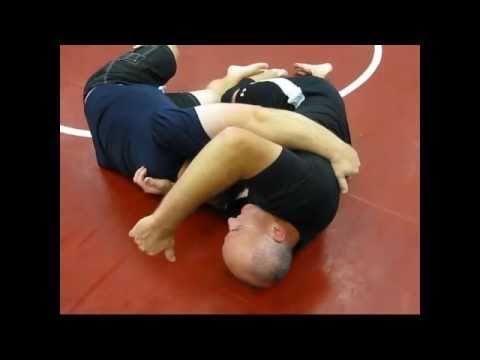
Modesto Grappling Club Instructional #3: Side-Control/Underhook Escape
0
Standard Underhook Escape·Modesto Judo Club·Added by Admin
Wrestling, Grappling, Jiu-Jitsu, Sambo, Judo and Greco-Roman http://www.modestograpplingclub.com
Translation: standard underhook escape
The Standard Underhook Escape establishes a near-side underhook from bottom side control, then uses the underhook to drive into the opponent while rotating to the knees, escaping the pin. [1] The defender threads the inside arm under the opponent's armpit, secures the underhook, then bridges and drives the underhook shoulder forward while rotating the hips to the knees. [1],[2] The escape finishes with the defender on their knees facing the opponent, in a neutral position from which they can wrestle up or re-engage. [2],[3]
The standard underhook escape is the baseline underhook-based side control escape. [1]
Adapted from wrestling into BJJ. [1]
Used in BJJ competition. [1]
No images yet for this technique.
Sign in to suggest an image.
Wrestling, Grappling, Jiu-Jitsu, Sambo, Judo and Greco-Roman http://www.modestograpplingclub.com
No instructional courses yet for this technique.
Sign in to suggest a course.
Risk of injury to the person this technique is applied to
Bottom escapes from mount/side control; bridge and hip escape mechanics (Ribeiro 2008)
Skill level needed to execute this technique reliably
Whether this technique is allowed under major competition rule sets
Jiu-Jitsu University (Saulo Ribeiro, 2008)
Alias sources — [1] Jiu-Jitsu University (Saulo Ribeiro, 2008) [2] Wrestling Physical Conditioning Encyclopedia (John Jesse, 1974)
Effectiveness sources — [1] Mastering Jujitsu (Gracie & Danaher, 2003)
Mixed Japanese-Western terminology — combines traditional Japanese terms with katakana loanwords
Alias sources — [1] Jiu-Jitsu University (Saulo Ribeiro, 2008) [2] Wrestling Physical Conditioning Encyclopedia (John Jesse, 1974)
Effectiveness sources — [1] Mastering Jujitsu (Gracie & Danaher, 2003)
hip escape (shrimping) speed, framing strength, timing
flexible hips and quick lateral movement
hip flexors, obliques, triceps (framing), core
Start by getting into a good position with your opponent's head tight. Take one hand and place it directly under their armpit to establish your initial underhook grip.
Once you have a deep underhook with your hand under their back and feet pushed down, perform three simultaneous movements: push on their hip, lift up, and arch your body. This combination creates space and generates power to escape side control.
Lead with your fingers, not your elbow, when threading the underhook under your opponent. This hand position creates more power and makes it harder for your opponent to control you by holding down.
After popping up from the underhook escape, you can transition into attacking a single leg takedown, though your opponent may try to regain their position.
The Standard Underhook Escape establishes a near-side underhook from bottom side control, then uses the underhook to drive into the opponent while rotating to the knees, escaping the pin. The defender threads the inside arm under the opponent's armpit, secures the underhook, then bridges and drives the underhook shoulder forward while rotating the hips to the knees.
The standard underhook escape is a fundamental technique in both wrestling and BJJ, representing an aggressive escape approach that transitions from defence to a neutral or offensive position. It is widely taught as a primary side control escape option.
Unified MMA: legal — Legal defensive/transitional technique; IBJJF: legal — Legal; IJF: legal — Legal; ADCC: legal — Legal; UWW: legal — Legal, escape scores 1 point (freestyle), reversal scores 1 point; FIAS Sport Sambo: legal — Legal; NCAA Folkstyle: legal — Legal, escape scores 1 point, reversal scores 2 points
Danger rating 3/10. Moderate — bottom escapes from mount/side control; bridge and hip escape mechanics (Ribeiro 2008)
The standard setup chain: Create Space → Disrupt Control → Execute Escape → Recover Position.
Standard counters include: Heavy Hips — maintain low hip pressure and wide base to absorb the bridge / Grapevine — hook legs inside opponent's thighs to neutralize hip movement / Post Hand — post arm on the mat in the direction of the bridge to maintain balance.
Common variants: Shrimp to guard (framing and hip-escaping to recover full guard or half guard); Underhook escape (winning the underhook and coming to knees or reversing); Bridge to knees (bridging into the opponent and transitioning to turtle or…); Ghost escape (inverting under the opponent to re-guard from the opposit…).
Used in BJJ competition.
Top errors to watch for: Swimming the arm under without bridging first — the bridge creates the entry window / Not driving the underhook deep enough — a shallow underhook (hand on the ribs) lets the opponent counter / Turning without securing the underhook first — sequence matters: underhook then turn / Coming to the knees with the head up — keep the head tight to the opponent to prevent front headlock attacks.
The Standard Underhook Escape is also known as Sutandādo Andāfukku Nige, Basic Underhook Escape, Underhook To Knees.