Grip Setup and Collar Insertion
The practitioner establishes collar-sleeve control before inserting four fingers deep into the opponent's collar. The controlling hand should remain fairly low, allowing for easier insertion of the second hand. Proper depth is critical—the wrist must be positioned below the earlobe to target the sternocleidomastoideus and carotid artery effectively.
Double Collar Control Positioning
After securing the first hand deep in the collar, the practitioner lifts the elbow slightly to create space for the second hand. The second hand enters below the first one, avoiding the opponent's face and utilizing the free space beneath. Both hands must be positioned identically below the earlobe for optimal pressure distribution.
Pressure Application and Supination
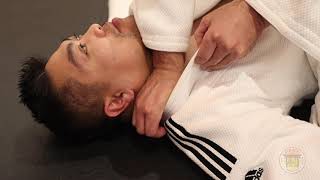
Rather than pulling straight back, the practitioner uses supination—rotating both palms inward—while pulling the opponent close to the chest. This creates a complete noose around the head, with lateral force applied across both collars. The wrists should use the blade (radius) rather than the broad side for maximum cutting efficiency on the carotid artery.
Standard Juji Jime Execution
The standard juji jime from closed guard maintains leg closure and eliminates the need to compromise posture or position. With double collar control established, the practitioner can break the opponent's posture through grip strength alone. If the opponent tucks their chin, one forearm can push the chin away while the other forearm continues cutting into the neck.
Kata Juji Jime Setup
When the opponent prevents insertion of the second hand, the practitioner transitions to kata juji jime by placing the foot on the opponent's hip. From this position, the practitioner reaches around to grab the opponent's trapezius with four fingers. This variation requires a different mechanical approach than the standard technique.
Kata Juji Jime Frame and Compress
Unlike standard juji jime, kata juji jime uses sequential rather than simultaneous elbow pressure. The practitioner frames with one elbow to control the opponent's leg while using the blade of the opposite forearm to cut. The technique is completed through body rotation that lifts the blade into the neck while maintaining the frame.
Managing Chin Tuck Defense
When the opponent tucks their chin to defend against kata juji jime, the practitioner uses the framing forearm to push the chin upward and expose the throat. Even against active resistance, this chin exposure allows the blade to make full contact with the neck. The rotating compression motion then becomes effective regardless of the opponent's chin position.
Strategic Advantages and Applications
Both juji jime and kata juji jime exemplify the strategic use of the gi's collar as a submission tool. These techniques maintain the practitioner's dominant closed guard position while minimizing vulnerability to guard passes. The techniques demonstrate how positional control and structural integrity can be preserved while simultaneously increasing submission threat and opening additional attacking opportunities.
Juji Jime and Kata Juji-Jime from Full Guard - BJJ Cross Collar Choke Submission for MMA Grappling
Key Takeaways
- •Grip Setup and Collar Insertion
- •Double Collar Control Positioning
- •Pressure Application and Supination
- •Standard Juji Jime Execution
Related Techniques
Frequently Asked Questions
What does this video teach about kata juji jime?
This video covers grip setup and collar insertion, double collar control positioning, pressure application and supination. It provides detailed instruction from Peter Mettler Martial Arts.
How long does it take to learn kata juji jime?
The basic mechanics can be understood in a single session, but developing reliable execution requires consistent drilling over weeks of practice. This 8-part breakdown helps structure your training by isolating each phase of the technique.
What are the key details for finishing kata juji jime?
When the opponent tucks their chin to defend against kata juji jime, the practitioner uses the framing forearm to push the chin upward and expose the throat. Even against active resistance, this chin exposure allows the blade to make full contact with the neck. The rotating compression motion then becomes effective regardless of the opponent's chin position.
Related videos
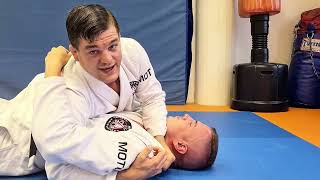
Papercutter Choke from Side Mount - Kata Juji Jime Sidemount PaperCutter BJJ Judo Basics Submission
Peter Mettler Martial Arts
How to Actually FINISH The Cross Collar Choke from Guard
Stephan Kesting
Cross Collar Choke - Fundamentals Made Easy
Jordan Teaches Jiujitsu
Everything You Need to Know About the Cross Collar Choke | Jiu Jitsu Fundamentals #bjj
Matt Arroyo Jiu Jitsu
Nami, Kata and Gyaku Juji Jime Part I: From Mount
Higashi Canada