Ankle Lock Foundation and Position Selection
The ankle lock is presented as a foundational leg submission that builds understanding of leg lock mechanics. The technique is taught from the Imanari Ashigurami (Sinkhole Leg X) position, which establishes control parameters for effective execution.
Weight Distribution Principles
Successful ankle lock control requires two key objectives: applying weight pressure through the opponent's hips while preventing their leg from bearing weight on the ground. The attacker maintains hip pressure while lifting the leg to prevent the defender from establishing base.
Lock Configuration Method
The instructor contrasts the modern approach with the traditional Gracie method of placing the attacker's instep under the opponent's knee and hamstring. The improved technique places the instep across the opponent's hamstring in a cross-body position, allowing the attacker to close their knees for significantly increased hip control.
Deltoid Ligament Anatomy and Targeting
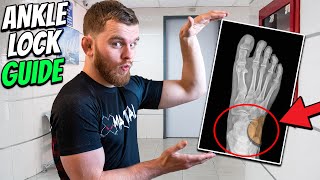
The deltoid ligament on the medial ankle is identified as the target structure for foot lock effectiveness, as it locks at a specific range and ruptures beyond that point. The lateral ligaments provide more give and are less vulnerable than the medial structure, making them less reliable submission targets.
Heel Positioning on the Ribs
Proper positioning places the opponent's heel on the attacker's floating rib with the foot sole facing inward rather than outward to the camera. This positioning aligns the deltoid ligament in its locked range, making inversion pressure maximally effective and painful.
Elbow Width and Maneuverability
Maintaining space between the attacker's elbow and ribs during the figure-four lock enables proper heel positioning rather than relying on cranking strength. A wide elbow position allows the attacker to rotate and adjust the opponent's heel placement on the ribs for optimal ligament targeting.
Hip Repositioning Mechanics
The attacker places their foot on the opponent's hip and uses this contact point to pull their own hips backward, rotating their body to place the opponent's heel precisely on the floating rib. This hip repositioning, combined with the wide elbow, creates the final configuration that stresses the deltoid ligament.
How I Ankle Lock EVERYONE (almost)
Key Takeaways
- •Ankle Lock Foundation and Position Selection
- •Weight Distribution Principles
- •Lock Configuration Method
- •Deltoid Ligament Anatomy and Targeting
For one on one Jiu jitsu coaching and guaranteed results, join my Skool!! https://www.skool.com/ebsayz-online-4305/about?ref=c19137b34aca46c08b86ae35c48a0c50
Related Techniques
Frequently Asked Questions
What does this video teach about ankle lock?
This video covers ankle lock foundation and position selection, weight distribution principles, lock configuration method. It provides detailed instruction from Ebsayz.
How long does it take to learn ankle lock?
The basic mechanics can be understood in a single session, but developing reliable execution requires consistent drilling over weeks of practice. This 7-part breakdown helps structure your training by isolating each phase of the technique.
What are the key details for finishing ankle lock?
Maintaining space between the attacker's elbow and ribs during the figure-four lock enables proper heel positioning rather than relying on cranking strength. A wide elbow position allows the attacker to rotate and adjust the opponent's heel placement on the ribs for optimal ligament targeting.
Related videos
I Made The ULTIMATE Ankle Lock Guide
Tyler Spangler

Small Hand Wrap Chin Na Wrist Locking
Gary Gee

Gooseneck Wrist Lock (Nikyo): Ultimate Self-Defense Technique #aikido #hapkido #martialarts
Weapons Defense Academy

10 Elbow Locks Every Martial Artist Must Know.
Straight Circle Martial Arts
10 Elbow Locks Every Martial Artist Must Know.
Straight Circle Martial Arts