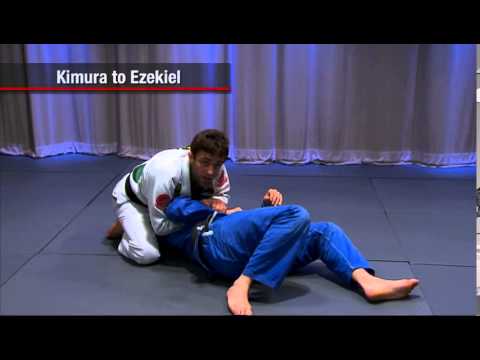
Ryan Hall The Open Elbow - Concepts, Fundamentals, Kimura & the Omoplata
0
Elbow Lock·WorldMartialArts
Buy Now: https://www.groundfighter.com/Ryan-Hall-The-Open-Elbow/ This powerful move is based on a simple yet effective …
Translation: elbow joint technique
Elbow locks are joint lock submissions that hyperextend or hyperrotate the elbow joint, attacking the ligaments and tendons that hold the forearm to the upper arm. [1] The armbar (juji-gatame) — isolating the arm between the legs and hipping upward to hyperextend the elbow — is the most fundamental and highest-percentage elbow lock in all of grappling. Other elbow locks include the Americana (ude-garami with outward shoulder rotation), the kimura (ude-garami with inward rotation), the omoplata (shoulder lock using the legs), and various mounted, guard-based, and back-control armlock variations. [2],[3] Elbow locks are the only joint locks permitted in judo (kansetsu-waza), reflecting their relative safety — the elbow provides clear pain feedback before structural failure, allowing controlled submission. [1] In BJJ, MMA, and ADCC, elbow locks are unrestricted at all levels.
Elbow locks (kansetsu-waza) are among the oldest codified submission techniques in Japanese martial arts. Jigoro Kano included them as the only permitted joint lock category in Kodokan Judo competition, a rule that persists today. [1] Juji-gatame (十字固め, cross armlock) is considered the most universal submission technique, appearing in judo, BJJ, sambo, catch wrestling, and MMA. [2] In BJJ, the armbar from guard became one of the art's signature techniques — Royce Gracie's armbar victories at early UFC events demonstrated its effectiveness against larger opponents. [3] The kimura is named after Masahiko Kimura, who famously broke Helio Gracie's arm with ude-garami in their 1951 match in Rio de Janeiro.
Elbow locks hyperextend or rotate the elbow joint, causing pain and potential ligament/bone damage if not released. [1]
Elbow locks are found in judo (juji-gatame family), BJJ, catch wrestling, and jūjutsu. [1]
Elbow locks (armbars) are the second most common submission in UFC history after the RNC. [1]
No images yet for this technique.
Sign in to suggest an image.
Buy Now: https://www.groundfighter.com/Ryan-Hall-The-Open-Elbow/ This powerful move is based on a simple yet effective …
No instructional courses yet for this technique.
Sign in to suggest a course.
Risk of injury to the person this technique is applied to
Elbow locks hyperextend the arm; risk of ligament tears and fractures if resistance continues
Skill level needed to execute this technique reliably
Whether this technique is allowed under major competition rule sets
Kodokan Judo — Official Katame-waza Classification
Traditional Judo ground technique terminology (Kodokan Institute)
Standard Japanese martial arts terminology (kanji/hiragana)
Established Japanese martial arts naming convention — native Japanese term (和語/漢語)
Traditional Judo ground technique terminology (Kodokan Institute)
hip flexibility, hip bridge power, leg clamping strength
long legs for controlling the opponent's torso
hip extensors (glutes), adductors, quadriceps, hamstrings
Every move, in any martial art, shares a few universal traits. Mix and match below to pinpoint the right tool — or compare equivalents across styles.
The armbar (juji-gatame) is the most fundamental elbow lock in grappling, hyperextending the elbow joint by controlling the opponent's wrist and pressing the hips upward against the back of the elbow. [1,2] The attacker positions perpendicular to the opponent, traps the arm between the legs, and extends the hips while keeping the thumb pointed upward to ensure proper hyperextension alignment. [1] The armbar is applicable from guard, mount, back control, side control, and standing, making it the most versatile joint lock in martial arts. [1,3]
Ashi-gatame (足固め, 'leg hold') is an elbow lock where the attacker uses a leg to pin and isolate the opponent's arm against their own body, then applies hyperextension pressure to the elbow. [1,2] The attacker typically drapes a leg across the opponent's chest or face while trapping the arm, using hip elevation to extend the elbow against the leg as a fulcrum. [1] Ashi-gatame is distinguished from the standard armbar by the specific use of the leg as both the pinning mechanism and the fulcrum rather than using both legs and hips. [1,3]
Hara-gatame (腹固め, 'stomach hold') is an elbow lock where the attacker uses their abdomen or hip as the fulcrum to hyperextend the opponent's elbow. [1,2] The opponent's arm is trapped and extended against the attacker's torso — typically by pressing the back of the elbow against the stomach or hip while pulling the wrist toward the attacker's body. [1] Hara-gatame is often applied from standing or from a controlling position where the arm is isolated against the torso. [1,3]
Hiza-gatame (膝固め, 'knee hold') is an elbow lock where the attacker uses the knee as a fulcrum against the back of the opponent's elbow while controlling the wrist to hyperextend the joint. [1,2] The attacker places their knee against the back of the extended elbow and pulls the wrist toward themselves, creating a lever action with the knee as the pivot point. [1] Hiza-gatame can be applied from guard or when the opponent posts an arm, using the knee's precise positioning to target the elbow joint efficiently. [1,3]
The straight armlock hyperextends the elbow by controlling the wrist and applying force against the back of the fully extended arm. [1,2] Unlike the armbar which uses hip elevation from a perpendicular position, the straight armlock can be applied from various angles using the hands, forearms, or body to press against the elbow while the wrist is pulled. [1] Common entries include from side control (Americana position with the arm straightened), from mount, or as a standing arm lock in self-defense contexts. [1,3]
Waki-gatame (脇固め, 'armpit hold') is a standing or ground armlock where the opponent's extended arm is trapped under the attacker's armpit, and downward pressure is applied to hyperextend the elbow. [1,2] The attacker catches the opponent's wrist or forearm, tucks it under the armpit, and uses body weight or a dropping motion to straighten and hyper-extend the elbow against the armpit as a fulcrum. [1] Waki-gatame is notable for its speed — it can be applied in a single explosive motion during standing exchanges, making it one of the fastest arm locks. [1,3]
Elbow locks (kansetsu-waza in judo) hyperextend the elbow joint. The armbar (juji-gatame) is the most common elbow lock and the second most common submission in MMA history. In judo, elbow locks are the only joint locks permitted — all other joint attacks are banned. (IJF Sport and Organisation Rules 2025; Kano, Kodokan Judo; UFC Stats)
An open elbow is when you get your opponent's arm as far away from their side or hip as possible—ideally at around 90 degrees. According to Ryan Hall, this position creates the vulnerability you need to set up various submissions.
Ryan Hall emphasizes that good fighters don't take themselves out of position, so you must create instability and vulnerabilities to control them. The open elbow is a fundamental way to achieve this, as it opens up multiple submission threats like the Kimura.
Ryan Hall teaches that you should grip the opponent's side while maintaining the open elbow position, forcing them to choose between multiple threats—such as the Kimura or other submissions. This creates a situation where your opponent must navigate carefully or face unfavorable outcomes.
No. According to Ryan Hall, simply bringing your arm down to your side does not make you safe from the threat—if your opponent controls the position, they can still come and get your arm.
Elbow locks are joint lock submissions that hyperextend or hyperrotate the elbow joint, attacking the ligaments and tendons that hold the forearm to the upper arm. The armbar (juji-gatame) — isolating the arm between the legs and hipping upward to hyperextend the elbow — is the most fundamental and highest-percentage elbow lock in all of grappling.
Elbow locks (kansetsu-waza) are among the oldest codified submission techniques in Japanese martial arts. Jigoro Kano included them as the only permitted joint lock category in Kodokan Judo competition, a rule that persists today.
IBJJF: legal — Legal at all belt levels; IJF: banned — Only elbow joint locks (kansetsu-waza) permitted in judo — all other joint lo…; ADCC: legal — Legal — all submissions legal in ADCC; Unified MMA: legal — Legal submission technique; FIAS Sport Sambo: legal — Legal; FIAS Combat Sambo: legal — Legal
Danger rating 7/10. Elbow locks hyperextend the arm; risk of ligament tears and fractures if resistance continues
The standard setup chain: Control the Arm → Position the Hips → Pinch Knees → Extend for the Finish.
Standard counters include: Clasp Hands — grip own wrist to prevent arm extension / Stack — drive forward to compress the attacker and relieve elbow pressure / Hitchhiker Escape — rotate the thumb toward the mat and roll to extract the arm.
Common variants: Standard armbar (hips drive upward against the extended arm with legs clam…); Belly-down armbar (rolling to face the mat to prevent the opponent from stac…); S-mount armbar (transitioned from S-mount position for tighter control be…); Spinning armbar (rapid pivot from guard or side to catch the arm during tr…).
Elbow locks (armbars) are the second most common submission in UFC history after the RNC.
Top errors to watch for: Not controlling the opponent's wrist — the wrist must be secured against your chest; a free wrist allows the opponent… / Squeezing the knees apart — the knees must pinch together to prevent the opponent from pulling the arm out / Not raising the hips — the hips are the fulcrum; they must press upward into the back of the elbow for the lock to work / Crossing the feet incorrectly — the foot nearest the head should be over the opponent's face or neck, not under.
The Elbow Lock is also known as Hiji Kansetsu-waza, Hiji-waza, Arm Lock, Elbow Joint Lock.