Fighting vs. Self-Defense Mentality
The instructor distinguishes between competitive fighting, where the goal is to win decisively, and self-defense, which prioritizes survival and avoiding unnecessary risk. In self-defense scenarios, practitioners should avoid high-risk techniques that could result in disadvantageous positions. The conservative approach prioritizes safety over tactical aggressiveness.
De-escalation and Communication
Effective self-defense includes verbal de-escalation at both the beginning and end of a conflict. Practitioners should attempt to resolve situations through dialogue, offering opponents a clear exit before escalating to physical techniques. Even after establishing control, communicating an opportunity to surrender can resolve confrontations without continued violence.
Controlling Escalation Through Communication
Continuous striking without communication often prevents opponents from conceding, as they may not understand they have an opportunity to stop. Allowing an opponent to verbally surrender can de-escalate situations faster than continued physical pressure. The instructor emphasizes telling a controlled opponent directly about the option to cease fighting.
Verifying Surrender and Escape Planning
Practitioners should remain cautious even when opponents claim to surrender, as verbal capitulation may be dishonest or followed by retrieval of weapons. After any physical altercation, the priority is immediate departure from the scene rather than lingering for social interaction. The instructor cites the case of Leandro Lowe to illustrate the danger of remaining in an altercation location after apparent victory.
Maintaining Control During Ground Striking
When striking from mounted positions, the instructor must maintain connection with the opponent to prevent escape while freeing the arms for strikes. Simply sitting up in mount allows the opponent opportunities to enter guard or create distance. Proper positioning requires maintaining chest contact and hand placement on the mat while generating striking power.
Ground Knee Strike Setup and Execution
From a side control variation, the striker positions the chest across the opponent's shoulders while remaining on the toes for mobility. The knee strike is delivered by kicking the leg back and driving it toward the target, typically the ribs or midsection. If the opponent blocks the initial knee strike, alternative angles can be used while maintaining chest pressure and hand contact.
Preventing Defensive Leg Positioning
The striker uses chest pressure to keep the opponent flat on their back, preventing them from bringing their leg under their body for defensive positioning. Hand contact with the ground reinforces control while allowing the upper body to generate striking force. This combination of pressure points makes it difficult for the grounded opponent to establish defensive barriers against knee strikes.
Patreon Unlocked | Using Knee Strikes on the Ground
Key Takeaways
- •Fighting vs. Self-Defense Mentality
- •De-escalation and Communication
- •Controlling Escalation Through Communication
- •Verifying Surrender and Escape Planning
This is from a class I taught on using strikes on the ground. Here, we covered the use of knees but also some important self-defense advice. If you like my style of teaching and my content, then you can get much more at my Patreon with over 600 videos. You can find it at https://www.patreon.com/roymarshjiujitsu You can also purchase my Long-Form Instructionals at https://roymarshjiujitsu.gumroad.com I am also available for seminars, so please contact me if interested. My Website: https://www.roymarshjiujitsu.com My School: http://www.gracieschwarzwald.com My Affiliate Schools: * Brazilian Jiu-Jitsu Schwerte (Schwerte, Germany) * Kinetics BJJ Soignie (Soignie, Belgium) * Gracie Zug (Zug, Switzerland) * Roy Marsh Jiu Jitsu Nordeifel (Nordeifel, Germany) * KC Bushido (Radolfzell, Germany) You can also find me on Facebook and Instagram. Please Like and Subscribe and Share.
Related Techniques
Frequently Asked Questions
What does this video teach about ground knee?
This video covers fighting vs. self-defense mentality, de-escalation and communication, controlling escalation through communication. It provides detailed instruction from roymarsh jiujitsu.
How long does it take to learn ground knee?
The basic mechanics can be understood in a single session, but developing reliable execution requires consistent drilling over weeks of practice. This 7-part breakdown helps structure your training by isolating each phase of the technique.
What are the key details for finishing ground knee?
From a side control variation, the striker positions the chest across the opponent's shoulders while remaining on the toes for mobility. The knee strike is delivered by kicking the leg back and driving it toward the target, typically the ribs or midsection. If the opponent blocks the initial knee strike, alternative angles can be used while maintaining chest pressure and hand contact.
Related videos
Powerful Ground N Pound From The Knee Cut Position | Kneebars For MMA
King Kneebar
MUAY THAI Flying Knee - Jumping Knee
Ironboy Experience
Comprehensive Guide to Throwing Knee Strikes in Muay Thai
fightTIPS
MUAY THAI - HOW TO DO A FLYING KNEE OR JUMPING KNEE
Ironboy Experience
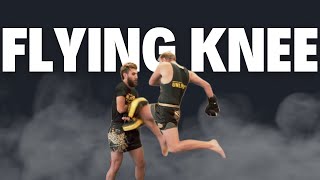
Flying Knee: Tips and Tricks
Martial Arts Unlimited Victoria