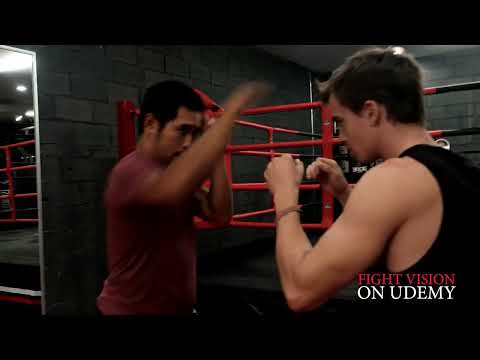
Straight Knee Kho Drong Muay Thai
0
Straight Knee·Fight Vision - Muay Thai - Thai Boxing
Straight Knee Kho Drong Muay Thai. Old school and Modern techniques. To get access to full course - become a sponsor: h…
Translation: straight knee
The straight knee is the most fundamental knee strike in Muay Thai, delivered in a direct upward or forward trajectory into the opponent's body or head. [1] Kraitus and Rennehan identify the straight knee as the first knee technique taught to Muay Thai students, forming the foundation of all other knee variations. [1] In Muay Boran, the straight knee was one of the 'mae mai' (master techniques) — core movements from which more advanced techniques were derived. [2] The straight knee was also preserved in Japanese karate as hiza-geri (knee kick), documented by Nakayama in Dynamic Karate as a close-range self-defence technique. [3]
From Muay Thai's khao trong. [1]
The most commonly thrown knee in Muay Thai and MMA. [1]
No images yet for this technique.
Sign in to suggest an image.
Straight Knee Kho Drong Muay Thai. Old school and Modern techniques. To get access to full course - become a sponsor: h…
No instructional courses yet for this technique.
Sign in to suggest a course.
Risk of injury to the person this technique is applied to
Muay Thai khao trong; direct upward thrust to body/head
Skill level needed to execute this technique reliably
Whether this technique is allowed under major competition rule sets
Muay Thai: The Art of Fighting (Yod Ruerngsa, Khun Kao Charuad & James Cartmell, 2002)
Alias sources — [1] Muay Thai: The Art of Fighting (Kraitus & Kraitus, 1988) [2] Dynamic Karate (Nakayama, 1966)
History sources — [1] Muay Thai: The Art of Fighting (Kraitus & Rennehan, 2002) [2] Muay Boran: The Ancient Art of Muay Thai (Rebac, 2008) [3] Dynamic Karate (Nakayama, 1966)
Official karate technique names (和語/漢語)
Established Japanese martial arts naming convention — native Japanese term (和語/漢語)
Alias sources — [1] Muay Thai: The Art of Fighting (Kraitus & Kraitus, 1988) [2] Dynamic Karate (Nakayama, 1966)
History sources — [1] Muay Thai: The Art of Fighting (Kraitus & Rennehan, 2002) [2] Muay Boran: The Ancient Art of Muay Thai (Rebac, 2008) [3] Dynamic Karate (Nakayama, 1966)
hip flexion power, clinch control ability, close-range comfort
long thigh for greater leverage, strong hip flexors
hip flexors, quadriceps, core, grip (for clinch)
Every move, in any martial art, shares a few universal traits. Mix and match below to pinpoint the right tool — or compare equivalents across styles.
A straight knee strike delivered from within the clinch, using collar ties and head control to pull the opponent into the rising knee.
A straight knee strike delivered from outside clinch range, stepping or lunging forward to close the distance and drive the knee into the target.
The straight knee (khao trong in Muay Thai) is delivered in a forward thrust from the clinch. It targets the body, face, or thigh of the opponent. Muay Thai clinch knees are one of the most damaging close-range weapons. (Delp, Muay Thai Unleashed; Kraitus, Muay Thai: The Art of Fighting)
Drive your hips forward as you execute the knee—the hip drive is essential to generating power in the straight knee. Fight Vision emphasizes that proper hip engagement is what makes the technique effective.
Step forward with one foot to close distance and set up your balance before driving the knee straight up. This stepping motion helps you generate momentum and stability for the strike.
Yes—you can parry an incoming strike with your hand and immediately step and drive a straight knee as a counter-attack in the same combination.
A knee strike driven directly upward or forward in a linear path, typically targeting the midsection, solar plexus, or face.
The straight knee is the most fundamental knee strike in Muay Thai, delivered in a direct upward or forward trajectory into the opponent's body or head. Kraitus and Rennehan identify the straight knee as the first knee technique taught to Muay Thai students, forming the foundation of all other knee variations.
Unified MMA: restricted — Knees to standing opponent legal, knees to head of grounded opponent banned; WBC/Boxing: banned — All knee strikes prohibited; WKF: banned — Prohibited in sport karate; Kyokushin: legal — Legal to body; WT: banned — Prohibited; ITF: banned — Prohibited; WAKO: banned — Prohibited in most formats; K: restricted — 1/GLORY — One clinch knee allowed before referee break; IFMA: legal — Legal — knees are a core Muay Thai weapon, clinch knees highly scored
Danger rating 7/10. Very High — Muay Thai khao trong; direct upward thrust to body/head
The standard setup chain: Fighting Stance → Weight Transfer → Extend → Snap Back.
Standard counters include: Hip Check — push the opponent's hips away to create distance and kill the knee angle / Clinch Control — control the opponent's head and posture to prevent knee generation / Step Back — create distance to escape the knee's effective range.
Common variants: Straight knee (driving the knee straight upward into the body or head); Curved knee (round knee) (swinging the knee from the side in a circular path); Flying knee (leaping forward and driving the knee at the apex of the jump); Clinch knee (pulling the opponent into the knee from Muay Thai plum po…).
The most commonly thrown knee in Muay Thai and MMA.
Top errors to watch for: Not driving the hip through the knee — the hip must extend fully, pushing the knee through the target / Bumping the knee into the opponent instead of driving upward through them / Not pulling the opponent into the knee from the clinch — the collision of forces is critical / Flat-footed support leg, which limits the height and power of the upward drive.
The Straight Knee is also known as Choku Hiza-geri, Khao Trong, Hiza Geri.