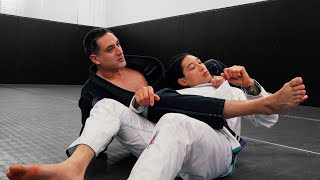
Body Positioning and Weight Distribution
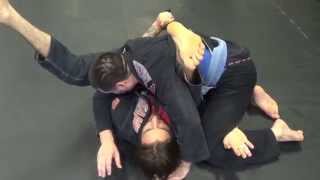
Proper body control in side control requires maintaining a perpendicular orientation to the opponent's torso, with the practitioner's chest forming a T-shape across the opponent's chest. The practitioner should keep their right hip pinned against the opponent's knee to prevent escape, while imagining the sensation of maintaining pressure during a free fall. This positioning maximizes weight distribution and control while minimizing the opponent's mobility.
Upper Body Control and Hand Placement
The left hand should remain underneath the opponent's head, gripping the shoulder to control the upper body like a steering wheel. This hand placement prevents the opponent's escape attempts while keeping the right hand free for the attacking sequence. Maintaining this control point is essential before initiating the choke setup.
Lapel Extraction Technique
The practitioner reaches down with their right hand to extract their own lapel from underneath their belt, pulling it out with an arrow-like point orientation. The extraction requires some maneuvering, but consistent upper-body control prevents the opponent from creating defensive space. Once extracted, the lapel should be pulled across the opponent's chest.
Lapel Placement and Initial Control
The extracted lapel is brought across the opponent's chest and positioned over the top of their shoulder, securing it firmly. This positioning alone serves as a dominant control point, preventing the opponent from escaping regardless of their head movement. The lapel placement is critical for preventing defensive turning and establishing the foundation for the choke.
Transition and Leverage Creation
The same hand that fed the lapel now transitions to the opposite side of the opponent's body, creating a dramatic leverage advantage. The practitioner begins rotating their wrist and upper body over the opponent's head while maintaining the lapel tension. This transitional movement positions the practitioner to apply full finishing pressure.
Arm Extension and Weight Application
The critical finishing detail involves straightening the left arm while stepping over the opponent's body to apply weight directly onto their head. Rather than pulling upward, the practitioner extends their arm and drops their body weight to create maximum choke pressure. This weight-based finishing method is significantly more effective than muscular pulling and leads to rapid submissions.
Full Sequence Execution
The complete technique flows from establishing head control with the left hand, extracting and placing the lapel across the opponent's shoulder, transitioning to the opposite side, and finally extending the arm while dropping body weight. Proper execution prevents the opponent from escaping at any stage of the technique. Chin defense by the opponent creates additional pain without preventing the submission.
Gi choke from side control
Key Takeaways
- •Body Positioning and Weight Distribution
- •Upper Body Control and Hand Placement
- •Lapel Extraction Technique
- •Lapel Placement and Initial Control
By holding your oppoent in traditional side control you can quickly feed your lapel to your near hand and place it over your opponents shoulder. you then line the lapel up with his neck and place the feeding arm to the other side hip. begin straightening your arm,circling to the head arm while bringing down pressure to finish the choke
Related Techniques
Frequently Asked Questions
What does this video teach about lapel tail feed choke?
This video covers body positioning and weight distribution, upper body control and hand placement, lapel extraction technique. It provides detailed instruction from Maryland BJJ.
How long does it take to learn lapel tail feed choke?
The basic mechanics can be understood in a single session, but developing reliable execution requires consistent drilling over weeks of practice. This 7-part breakdown helps structure your training by isolating each phase of the technique.
What are the key details for finishing lapel tail feed choke?
The critical finishing detail involves straightening the left arm while stepping over the opponent's body to apply weight directly onto their head. Rather than pulling upward, the practitioner extends their arm and drops their body weight to create maximum choke pressure. This weight-based finishing method is significantly more effective than muscular pulling and leads to rapid submissions.