How To Do The Bow And Arrow Choke From The Back
0
Bow And Arrow Choke·Bam Bam Martial Arts Houston·Added by Admin
For a free class visit - http://www.BamBamMartialArtsHouston.com 713-307-5375 Bam Bam Martial Arts 4007 Bellaire Blvd. i…
Translation: Bow and Arrow Strangle
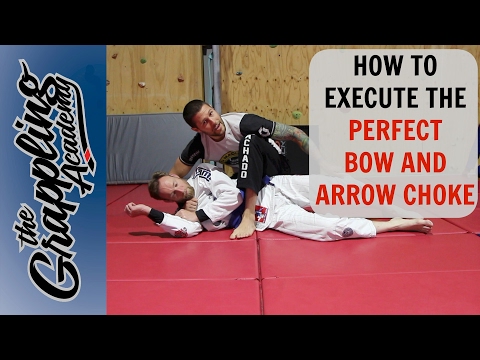
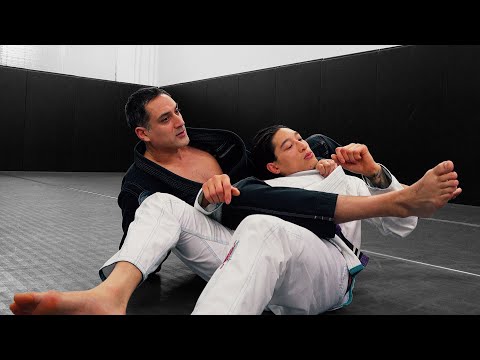
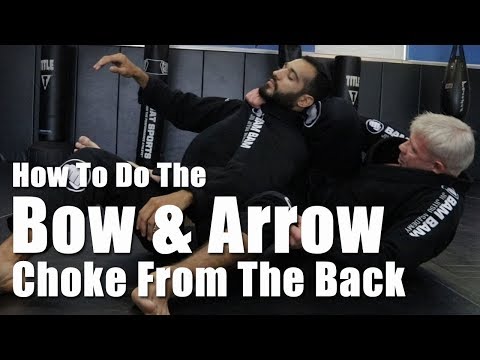
The bow-and-arrow choke is a powerful back control strangle where the attacker grips the opponent's collar with one hand and their pants or far leg with the other, then extends the body to create opposing forces that tighten the collar across the neck. [1],[2] The name comes from the finishing position, which resembles drawing a bow — one arm pulls the collar while the other pulls the leg in the opposite direction. [1] It is commonly entered from back mount by feeding the collar grip deep, securing a hand grip on the far leg or pants, and then falling to the side while extending. [1],[3]
The bow-and-arrow choke evolved from judo's collar strangulation techniques applied from rear control. [2],[3] It became one of the most iconic submissions in Brazilian Jiu-Jitsu competition, with practitioners like Roger Gracie and Bráulio Estima using it as a signature finish from back mount. [1] The technique is considered one of the highest-percentage gi submissions due to the extreme mechanical advantage created by the opposing-force configuration. [1],[4]
The bow and arrow choke is considered one of the tightest and most powerful collar chokes in gi grappling. [1] By gripping the collar behind the neck and controlling the far leg, the attacker stretches the opponent's body like a bow, amplifying the choking pressure through the entire torso extension. [1],[2]
No images yet for this technique.
Sign in to suggest an image.
For a free class visit - http://www.BamBamMartialArtsHouston.com 713-307-5375 Bam Bam Martial Arts 4007 Bellaire Blvd. i…
SALE SALE SALE OVER 50% OFF – BOX SET – ALL 4 COURSES 50% OFF CLICK HERE – https://bit.ly/2lAOHmp • The Blue Belt Sup…
Learn the Art of Jiu Jitsu: http://roydeanacademy.com One Channel. Every Instructional: https://roydean.vhx.tv/browse S…
The bow and arrow choke is a back-control submission that derives its name from the archer's stance—the opponent forms the bow while the attacker becomes the arrow. All three instructors agree on the fundamental setup: secure the opponent's collar deep with one hand while gripping the pants or leg with the other, then extend the legs to the side while keeping the torso upright, creating a mechanical advantage that strangulates the carotid arteries. Bam Bam Martial Arts Houston emphasizes the basic version first—collar grip, pants grab, feet disengage and stretch—before introducing an advanced variation where the attacker places the knee on the back of the opponent's hand or head to generate additional crushing force. ROYDEAN stresses critical technical details: maintaining a concave hand position (wristwatch grip) when feeding the collar, clearing the leg wide to prevent the opponent from collapsing onto it, and offers a tactical alternative by transitioning to an arm lock if the choke fails to develop. The Grappling Academy provides the most detailed progression, emphasizing the importance of stepping over the opponent while locking the hips and walking toward them to eliminate escape routes, keeping the arm bent when gripping the pants or leg, and crucially, placing the heel on the opponent's shoulder or armpit rather than merely applying hand pressure—this positional lock enables the final crushing motion. All three instructors note this technique's exceptional power and reliability from back control, with ROYDEAN and The Grappling Academy offering specific troubleshooting for common failure points.
Synthesized from 3 instructors
No instructional courses yet for this technique.
Sign in to suggest a course.
Risk of injury to the person this technique is applied to
The bow and arrow choke generates extreme torque through leg extension against the lapel grip
Skill level needed to execute this technique reliably
Whether this technique is allowed under major competition rule sets
golgo55.com BJJ technique resource; Yahoo知恵袋 BJJ community (ボウアンドアローチョーク)
Japanese Q&A community — BJJ technique name verification
Standard Japanese martial arts terminology (kanji/hiragana)
Established Japanese martial arts naming convention — native Japanese term (和語/漢語)
Japanese terminology sourced from golgo55.com BJJ technique resource; Yahoo知恵袋 BJJ community (ボウアンドアローチョーク)
grip strength for collar control, hip extension for stretching
strong grip and flexible hips
grip/forearm muscles, hip extensors, back extensors
The bow and arrow choke references appear in 88 passages across 28 books — one of the most documented chokes. Applied from back control using the opponent's lapel, with the free hand controlling the leg. Creates a stretching action like drawing a bow. One of the highest-percentage gi chokes from back control. (28 books in corpus; Jiu-Jitsu University, Ribeiro)
Your hand should be concave and bent like you're looking at a watch, with your pinky up and thumb down. According to ROYDEAN, this wristwatch position is essential for proper grip mechanics.
After popping the collar and feeding it to your hand, grab the opponent's knee, step off with alternating feet, and then lean back. ROYDEAN emphasizes that the hook on your hand becomes self-tightening as you lean back.
If the choke isn't coming, switch to an arm lock instead rather than fixating on the choke. ROYDEAN stresses that it's useful to have this option available when the choke doesn't develop.
The Grappling Academy emphasizes that you must walk your hips towards the opponent's hips and clear the way with your hand first before stepping over—otherwise you risk getting caught and losing position entirely.
If you straighten your arm when gripping under the leg, the opponent can kick their leg out and escape. The Grappling Academy advises always maintaining a bent arm grip so the escape doesn't work.
The bow-and-arrow choke is a powerful back control strangle where the attacker grips the opponent's collar with one hand and their pants or far leg with the other, then extends the body to create opposing forces that tighten the collar across the neck. The name comes from the finishing position, which resembles drawing a bow — one arm pulls the collar while the other pulls the leg in the opposite direction.
The bow-and-arrow choke evolved from judo's collar strangulation techniques applied from rear control. It became one of the most iconic submissions in Brazilian Jiu-Jitsu competition, with practitioners like Roger Gracie and Bráulio Estima using it as a signature finish from back mount.
IBJJF: legal — Legal at all belt levels, gi and no-gi — chokes are the safest submission cat…; IJF: legal — Legal (shime-waza) — strangulation techniques are one of three permitted subm…; ADCC: restricted — N/A (no-gi competition only — technique requires gi); Unified MMA: restricted — N/A (technique requires gi — not applicable in MMA); FIAS Sport Sambo: banned — All chokes prohibited in Sport Sambo; FIAS Combat Sambo: legal — Legal
Danger rating 9/10. The bow and arrow choke generates extreme torque through leg extension against the lapel grip
The standard setup chain: Achieve Controlling Position → Isolate the Neck → Set the Grip → Apply Pressure.
Standard counters include: Tuck Chin — protect the neck by lowering the chin to prevent the choke from sinking / Two-on-One Grip Fight — use both hands to strip the choking grip before it locks / Turn Into — rotate toward the choking arm to relieve carotid pressure / Posture Up — straighten the spine and create distance to break the choking angle.
Common variants: Standard bow and arrow (collar grip with far leg control, extending to stretch an…); No-leg grip bow and arrow (collar grip only with hip control instead of leg grab); Spinning bow and arrow (entering from turtle with a roll to the choking side).
Roger Gracie won multiple IBJJF World Championships using collar chokes from the back, with the bow and arrow being among his primary finishes. The bow and arrow is among the most common submission finishes at IBJJF black belt competitions.
Top errors to watch for: Not getting the collar grip deep enough — the hand must be deep past the centre line for the forearm to compress the … / Pulling the collar and leg in the same direction — the forces must oppose each other; pull the collar toward you whil… / Not capturing the far leg — the leg control is essential; without it, the opponent can turn and face you / Losing back control during the transition to the choke — maintain hooks until the collar grip is secure.
The Bow And Arrow Choke is also known as Yumiya-jime, Berimbau, Lapel Drag Choke, Arco e Flecha.